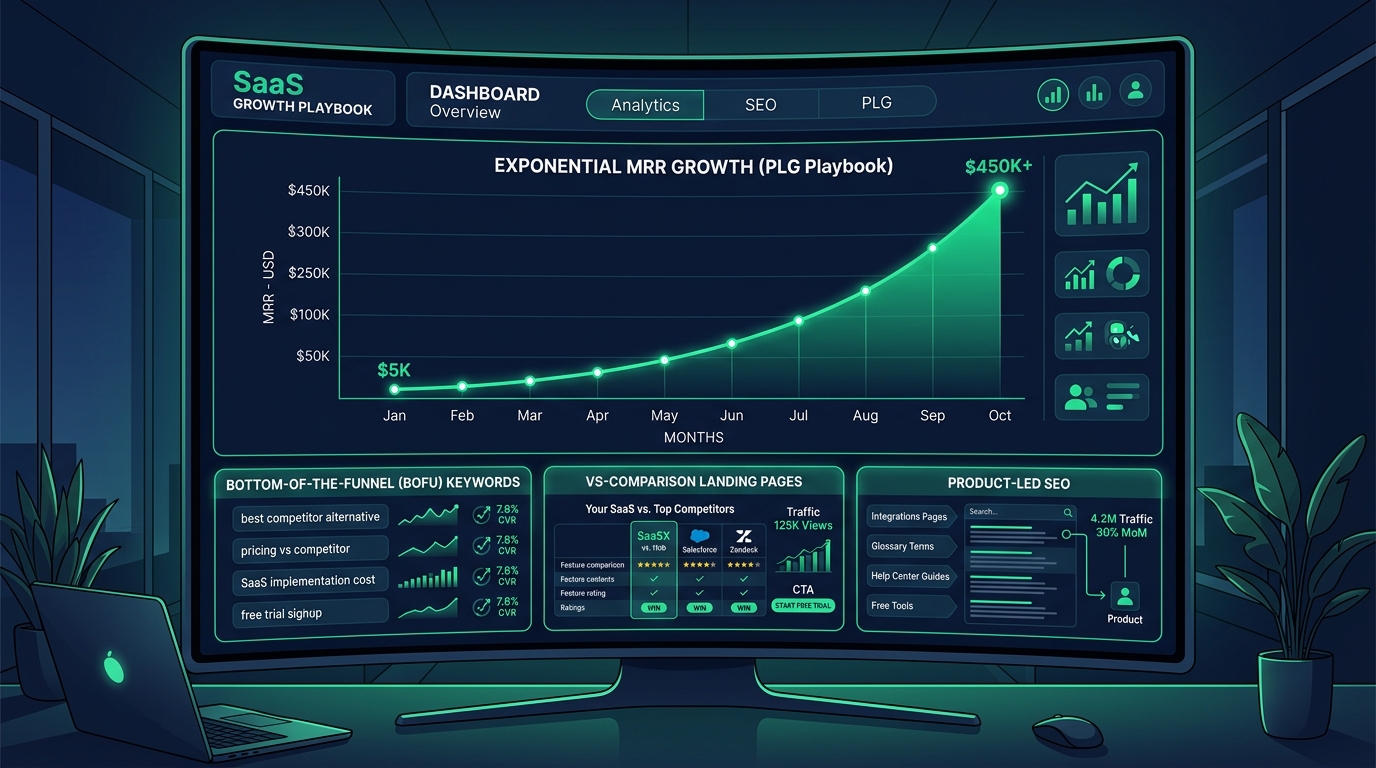
Paid acquisition for SaaS is a rented channel. The moment you stop paying Google or LinkedIn for clicks, the pipeline dries up the same day. SEO behaves differently: a comparison page you publish in month three can still be pulling in trial signups in month thirty, month forty, month fifty, with marginal cost per visit trending toward zero. That compounding curve is why almost every SaaS company that has scaled past $10M ARR organically, from Ahrefs to monday.com to Notion to Calendly, treats content and search as a core growth engine rather than a marketing side project.
The catch is that SaaS SEO is not blog SEO. Ranking for “what is CRM” does not pay the bills if the traffic never converts to a trial. Companies that get real pipeline out of organic search build a deliberate architecture: product-led and bottom-of-funnel pages that capture buying intent, topical authority content that builds trust earlier in the journey, and technical foundations that do not quietly sabotage everything else. This playbook walks through that architecture end to end, with the mistakes to avoid and a practical roadmap for a team starting from zero.
SaaS-Specific Keyword Research: Product-Led, Top-of-Funnel, and Comparison Intent
Keyword research for SaaS splits into three distinct intent buckets, and conflating them is the single most common planning mistake growth teams make.
Product-led keywords describe what the tool does in the buyer’s own words: “convert PDF to Word,” “schedule social media posts,” “track SaaS subscriptions.” These queries often carry real search volume and a buyer who is one click away from wanting the exact feature you ship. Map these to dedicated feature and landing pages, not just the homepage.
Top-of-funnel and educational keywords are broader problem-aware searches, such as “how to reduce customer churn” or “async standup best practices.” Volume is higher and buying intent is lower, but this is where you build topical authority and reach an audience before it even knows your product category exists.
Comparison and alternative keywords, such as “[competitor] alternatives,” “[you] vs [competitor],” and “best [category] software,” carry the highest purchase intent of any keyword class in B2B SaaS because the searcher already knows what they need and is actively shortlisting. These terms convert at multiples of top-of-funnel content, and they deserve priority even when volume looks modest: 200 monthly searches for a head-to-head comparison is often worth more in pipeline than 5,000 searches for a generic category definition.
Build a keyword map against these three buckets separately, because each demands a different page template, a different depth of product proof, and a different position in the funnel.
The “Vs” and “Alternatives” Page Strategy
Comparison and alternatives pages deserve their own strategy because they are simultaneously an SEO asset and a sales asset. The same page a prospect finds through Google is often the page an account executive forwards mid-deal the moment a competitor gets mentioned.
- Be honest about competitor strengths. A “vs” page that only trashes the competitor reads as marketing spin, converts poorly, and gets contradicted by Reddit and G2 threads that frequently outrank thin comparison pages. Acknowledge where the competitor genuinely wins, then reframe around who each product is actually best for.
- Use real, current feature and pricing data on a refresh schedule. Stale comparison tables are a trust-killer, and an error a prospect catches will cost you more credibility than the page ever earned in traffic.
- Build “alternatives to [competitor]” pages as a genuine curated shortlist that includes your product plus four to six real alternatives, not a disguised advertisement. Zapier, Notion, and Airtable all run alternatives pages this way, which is part of why they rank.
- Link these pages tightly into your bottom-of-funnel cluster, from integration pages, use-case pages, and adjacent competitor comparisons, so crawlers and buyers move fluidly through the highest-intent part of the site.
Bottom-of-Funnel High-Intent Pages: Best-For-Use-Case and Integrations
Below comparison pages sits an even higher-converting layer: pages built around a specific use case or integration, where the buyer is not comparing vendors anymore but checking whether your product fits their exact stack.
“Best CRM for real estate agents,” “best project management tool for agencies,” and “[your product] for Shopify” pages let you rank for long-tail queries with near-zero competition while speaking directly to a named persona’s workflow and terminology. They convert well because the searcher has already decided to buy something in your category and is confirming fit, not weighing whether to buy at all.
Integration pages, such as “[your product] + Slack integration,” serve two audiences at once: searchers solving a specific connectivity problem, and existing customers checking what’s possible in their stack. Zapier’s integration directory, with tens of thousands of individually indexed “connect X with Y” pages, is the canonical example of this compounding at scale and is widely cited as a major contributor to its multi-million monthly organic visits. You do not need Zapier’s integration count to benefit from the same logic: even 30 to 50 well-built pages targeting your actual top integrations will outperform a single generic integrations list.
Top-of-Funnel Content and Topical Authority for Category Creation
Bottom-of-funnel pages capture demand; top-of-funnel content creates it. If your product defines or redefines a category, the way Gong pushed “revenue intelligence” or Drift pushed “conversational marketing,” comparison and alternatives pages alone will not carry you, because searchers are not yet typing your category name into Google.
This is where topical authority content earns its keep: in-depth guides, frameworks, original research, and an opinionated point of view published consistently around the problem space you sell into, not just the feature you ship. The goal is not ranking for a thousand loosely related keywords; it is becoming the site Google, and buyers, associate with the topic, so that when someone eventually searches for the category, your brand is already familiar.
Practically, this means a content cluster architecture: a cornerstone pillar page on the core problem, linked out to a dozen or more supporting articles that go deep on subtopics, all interlinked so authority flows back to the pillar. Pair this with original data, such as surveys, product usage benchmarks, or “state of X” reports, because unique data earns backlinks and citations that generic advice content rarely does, and backlinks remain one of the more durable ranking factors for competitive B2B terms.
Programmatic and Template-Driven Pages Done Responsibly
Programmatic SEO, generating many similar pages from a template and a dataset, is one of the highest-leverage tactics in SaaS and also one of the easiest to get wrong. Google’s helpful-content systems are considerably better at detecting templated thinness, so the bar for programmatic pages in 2026 is quality per page, not page count.
What works: integration directories where each page has a real screenshot, a specific use case, and actual setup steps rather than a swapped product name in a boilerplate paragraph; industry pages where the content genuinely differs by segment, such as different compliance requirements or terminology; and use-case pages built from real customer data rather than invented personas.
What does not work: swapping one keyword into an otherwise identical template across hundreds of pages, publishing all of them in a single batch, a pattern spam-detection systems specifically target, or generating pages faster than the team can maintain accurate, current information on them.
A practical rule: before scaling a programmatic template to 50 or 500 pages, hand-build and publish 10 to 15, let them sit for six to eight weeks, and check whether they are indexing and ranking at all. If Google is not indexing the pilot batch, more volume will not fix it; the template needs more genuine substance first.
Free Tools and Calculators as Link-Building and Top-of-Funnel Assets
Free tools and calculators are one of the most underused SaaS SEO assets because they solve two problems content alone cannot: they attract organic backlinks, since people link to a genuinely useful calculator far more readily than to a blog post, and they put the product directly in front of the target user while that user is mid-task, not just mid-research.
A pricing or ROI calculator, a free “grader” or audit tool in the vein of HubSpot’s Website Grader, or a simple utility adjacent to the core product, such as a UTM builder or invoice generator, can become a durable acquisition asset that ranks for high-volume utility keywords and converts users into email captures or trial signups through the tool’s own upsell path.
These tools need real engineering investment, not a marketing afterthought, but a single well-executed free tool can outperform months of blog output in both backlinks earned and top-of-funnel traffic captured.
Technical SEO Considerations for SaaS Marketing Sites
SaaS marketing sites carry technical SEO risks that most content strategies do not account for, and they can quietly cap growth no matter how good the content is.
Subdomain versus subdirectory structure matters more than most teams realize. Hosting the blog or marketing site on a separate subdomain, such as blog.yourapp.com, rather than a subdirectory, such as yourapp.com/blog, means Google evaluates it as a semi-distinct property with its own authority curve, typically taking longer to rank and diluting the domain authority that product pages could otherwise share. Migrating from subdomain to subdirectory is disruptive but has produced measurable traffic gains for SaaS companies that made the switch, so plan the redirects carefully if you are currently split.
JavaScript-heavy marketing sites, common when the marketing site shares the app’s React or Vue stack, risk rendering problems for crawlers: content that loads client-side after user interaction, or behind a hydration delay, can be missed or deprioritized during indexing even though Googlebot does execute JavaScript. Server-side rendering or static generation for marketing pages removes this risk entirely and is the safer default for anything you want ranked.
Other recurring technical issues include gated content that blocks crawlers behind login walls, orphaned pages with no internal links, duplicate content across localized versions without proper hreflang tags, and Core Web Vitals regressions introduced by marketing tag bloat such as chat widgets, heatmap scripts, and ad pixels stacked on every page.
Content-Led Growth Loops: Customer Stories and Case Studies
Case studies and customer stories are one of the few content types that serve SEO, sales enablement, and product marketing simultaneously, which makes them one of the highest-ROI content investments a SaaS team can make.
For SEO, a well-optimized case study targets the “[company] uses [product] to achieve X” and “[industry] plus [product]” pattern, capturing searchers specifically looking for proof that companies like theirs succeeded with a tool like yours, a bottom-of-funnel signal comparison pages cannot fully replace. For sales, the same page becomes a leave-behind reps send mid-cycle, and the specific metrics inside it become the proof points quoted on calls. For product marketing, patterns across a library of case studies reveal which use cases and personas get value fastest, feeding back into which use-case pages and comparison angles are worth building next.
Treat case studies as a system rather than one-off projects: standardize the interview questions, capture a specific quantified result every time, and publish an indexable page per customer instead of burying stories in a single customers carousel that search engines cannot crawl into individually.
Aligning SEO with Product Marketing and Sales
SEO teams that operate in isolation from product marketing and sales tend to produce content that ranks but never converts, or content that converts on paper but nobody in sales ever uses.
The fix is structural, not just communicative. Give SEO visibility into the messaging framework and competitive battlecards product marketing already maintains, so comparison and alternatives pages use the same positioning sales reps use live. Loop sales into keyword prioritization, since reps hear the exact phrases prospects use to describe problems and competitors, which is often better raw material than a keyword tool. Route case study and comparison page engagement signals back to product marketing, since page-level behavior often reveals which competitive angles and personas are actually resonating before a formal win-loss report would.
A monthly sync between growth or SEO, product marketing, and a rep or two, reviewing which pages are getting used in deals and which competitive claims need updating, keeps the entire bottom-of-funnel content layer honest and current.
Attribution: Measuring SEO’s Contribution to Pipeline and MRR
Justifying SEO investment to SaaS leadership means moving past traffic and rankings into pipeline and revenue language, because that is the language budget decisions actually get made in.
Track a stack of metrics rather than one: organic sessions and keyword rankings as leading indicators; organic signups and trial starts as the first conversion layer; trial-to-paid conversion rate specifically for organic-sourced accounts, which is frequently different from paid-sourced accounts and often higher because organic visitors self-selected through research rather than an ad click; and attributed MRR or ARR from organic as the ultimate scoreboard metric.
Multi-touch attribution matters more than last-click in SaaS because B2B buying cycles routinely involve five to ten or more touches across weeks or months. A last-click model will systematically undercount organic’s influence on deals that started with a comparison page visit months before a demo request arrived through a different channel. Pull UTM and organic-landing-page data into the CRM and build or buy a multi-touch model; even a simple linear or U-shaped model is a major improvement over last-click alone.
One useful audit: pull closed-won deals from the last two quarters and check how many had any organic touchpoint in the 90 days before the deal entered the pipeline. Teams that run this audit are often surprised how much higher that number is than what last-click reporting shows.
Common SaaS SEO Mistakes
- Chasing top-of-funnel volume while ignoring bottom-of-funnel pages that actually convert. A blog with 50,000 monthly visits and no comparison or use-case pages often generates less pipeline than a much smaller site built around high-intent terms.
- Publishing programmatic pages faster than the team can keep them accurate, leading to stale pricing tables and dead integration claims that erode trust.
- Treating the marketing site and the product as entirely separate technical stacks with no shared SEO ownership, so nobody catches a rendering regression until traffic has already dropped for weeks.
- Writing comparison pages that are thinly veiled attacks on competitors, which convert poorly and invite reputational backlash.
- Measuring SEO on vanity metrics such as traffic and keyword count with no line back to trials or revenue, which makes the channel an easy budget cut in a downturn even when it is actually working.
- Under-resourcing technical SEO relative to content. A single crawl-blocking bug can erase months of content investment.
- Ignoring the content that already exists on review sites such as G2 and Capterra, which frequently outrank owned comparison pages because they read as more trustworthy, rather than actively managing that presence.
A Practical Roadmap for a SaaS Team Starting From Zero
For a SaaS team starting from zero, sequence the work rather than trying to do everything at once.
- Weeks 1-2, technical foundation: confirm the marketing site is on a subdirectory rather than a subdomain, verify server-side rendering or pre-rendering for key pages, fix crawl-blocking issues, and set up proper analytics and CRM UTM tracking before publishing anything new.
- Weeks 3-6, high-intent pages first: build the top 10-15 comparison and alternatives pages and the top 10-15 use-case or integration pages against your highest-intent competitors and use cases. This is where the first measurable pipeline typically appears, within 8-12 weeks of indexing.
- Weeks 7-12, topical authority foundation: launch two to three cornerstone pillar pages with supporting cluster content around the core category problem, sequencing publication rather than dumping everything at once.
- Month 4 onward: scale programmatic templates only after validating a pilot batch, launch one well-built free tool if resourcing allows, and start a standardized case study production process, aiming for at least one per month.
- Quarterly: run the closed-won attribution audit, refresh comparison page data, and sync with product marketing and sales on messaging changes.
SaaS SEO is not a campaign with an end date; it is infrastructure. The teams that treat it that way, investing steadily over two to three years rather than in bursts, are the ones running organic engines that generate pipeline at a cost per lead that keeps falling every year the content stays up.
Related
Want this checked on your own site?
A 20 minute review, no obligation. I will tell you honestly which of this actually applies to you and which does not.
Written by Shahzaib Ul Hassan, senior AI SEO consultant and founder of ShazzSEO. Ranking sites since 2009.