
Short answer: Audit AI-generated content by looking for evidence, not writing style. A page has useful original information gain when it contributes a verifiable observation, test, dataset, example, methodology or expert judgment that changes what the reader can understand or do. If the page could be recreated from the first five search results without losing anything, it probably needs substantial improvement.
AI makes it easy to produce fluent copy. Fluency is no longer a meaningful quality threshold. The editorial challenge is to identify where a draft merely rearranges public knowledge and where the publisher has added something defensible.
Google does not provide a public “information gain score” for individual pages. I use the term as a practical audit standard: what new, useful and supportable information does this page add to the available set of answers?
Why this audit matters now
Google’s guidance on generative AI content says automation can help with research and structure, but generating many pages without adding value may violate the scaled content abuse policy. Its 2026 generative search guide goes further by recommending unique, non-commodity, expert-led content instead of material that simply restates what is already online.
This means an AI draft is not finished when it is accurate, readable and long enough. It is finished when a qualified editor has improved the claims, evidence and usefulness.
What counts as original information gain?
Information gain is not the same as novel wording. Rephrasing a common answer, changing headings or adding more adjectives does not create new value. The gain must exist at the level of knowledge, evidence or decision support.
Weak addition |
Stronger original contribution |
|---|---|
A generic list of best practices |
A tested workflow showing which steps found the problem and which did not |
A summary of product features |
Original screenshots, limitations and results from using the product |
An unsupported expert opinion |
A named expert judgment with reasoning, conditions and evidence |
A rewritten statistic |
A calculation from a clearly identified first-party dataset |
A longer introduction |
A decision framework that reduces the reader’s uncertainty |
A generated example |
A real example with enough context to verify or reproduce it |
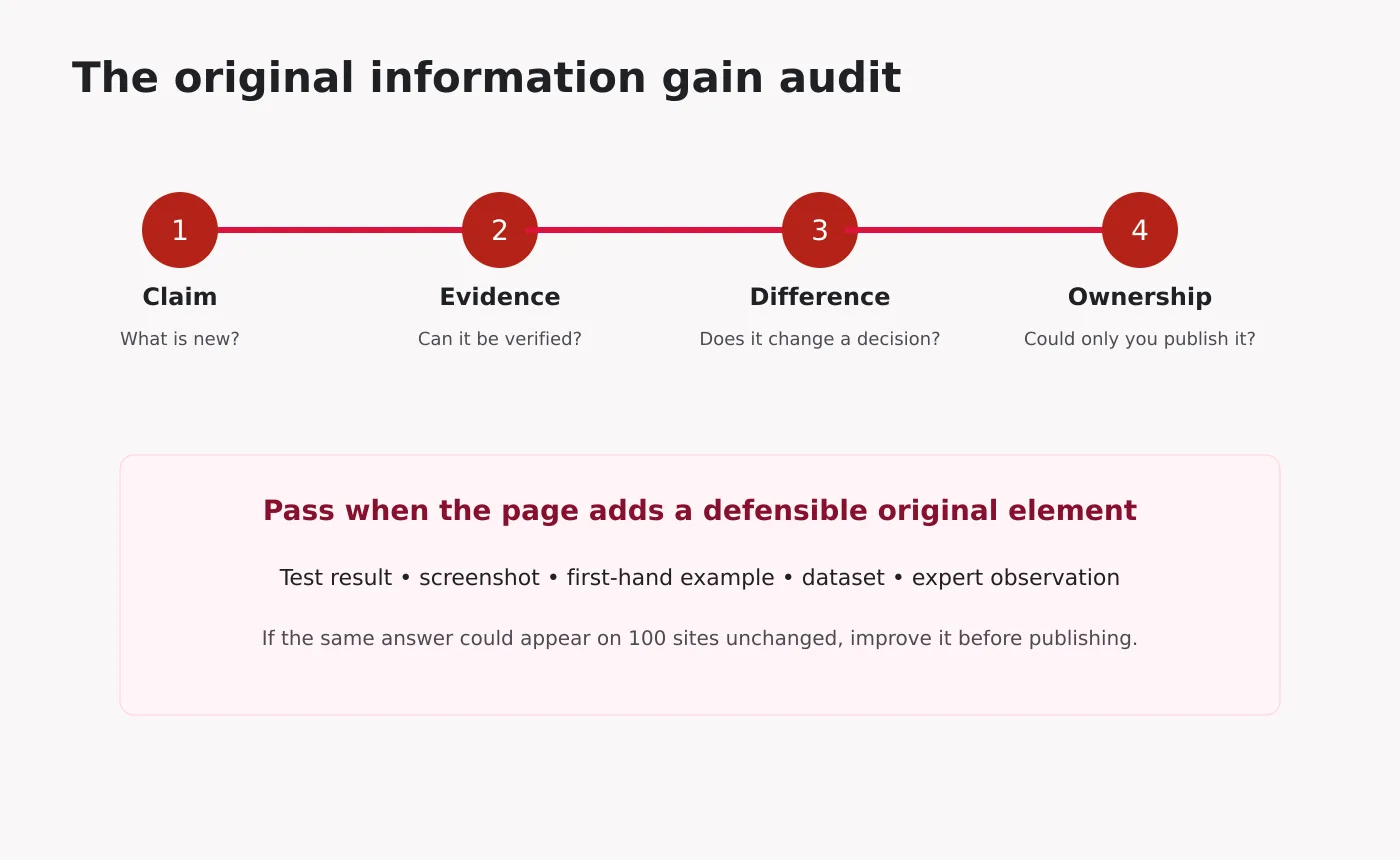
The four-part information gain test
1. Claim: What is new here?
Highlight every sentence that the article presents as a meaningful takeaway. For each one, ask whether it is common knowledge, a synthesis, an inference or an original finding. Synthesis can still be useful, but it should not be misrepresented as discovery.
A strong page normally has a small number of specific claims rather than dozens of vague assertions. “Internal links are important” is common knowledge. “In this audit, 14 posts had no recorded internal links, and six began receiving impressions after links were added from two relevant hubs” is a testable observation.
2. Evidence: Can the contribution be verified?
Match important claims to the best available evidence. This may be:
- a screenshot from the real process;
- an export from Search Console or another first-party system;
- a documented test with dates and conditions;
- a source directly responsible for the policy or data;
- a quotation or review from an identifiable participant;
- a reproducible calculation;
- an expert explanation that shows its reasoning.
Evidence should appear near the claim it supports. A list of references at the bottom does not help readers determine which source supports which statement.
3. Difference: Does it change a decision?
Not every unique detail is useful. Ask what the reader can decide, avoid or do because of the contribution. A screenshot that only proves the author opened a tool adds little. A screenshot annotated to show where a misleading metric appears can save the reader time and prevent an incorrect diagnosis.
Useful information gain often answers one of these questions:
- When does the standard advice fail?
- What happened when the method was applied?
- Which option works best under a specific constraint?
- What trade-off is missing from competing pages?
- What can a reader verify for themselves?
4. Ownership: Could only this publisher credibly provide it?
The strongest material has a clear relationship to its publisher. A consultant can share anonymized audit patterns, a software company can publish product data, a practitioner can document a workflow and a researcher can explain a method. Ownership does not mean secrecy. It means the source has a legitimate basis for the claim.
Do not manufacture first-hand experience. If no original test exists, add value through careful primary-source research, a transparent comparison method or a clearly labelled analysis.
A 100-point audit rubric
Score the page before publication. This is an editorial tool, not a claim about Google’s internal systems.
Area |
Points |
What earns the score |
|---|---|---|
Intent satisfaction |
20 |
The page completes the user’s real task without padding |
Original contribution |
25 |
At least one substantial page-specific finding, example or framework |
Evidence quality |
20 |
Important claims use direct, current and clearly placed support |
Expert review |
15 |
A qualified reviewer corrects nuance, limitations and terminology |
Transparency |
10 |
Methods, assumptions, dates and uncertainty are disclosed |
Usability |
10 |
Structure, images and examples reduce reader effort |
I would not publish a high-stakes or strategically important page below 75 without a documented reason. A low score does not mean the prose is bad. It identifies where the page lacks enough value to justify indexing.
How to run the audit step by step
Step 1: Remove the prompt from view
Review the article as a reader, not as the person who generated it. The prompt can create false confidence because it explains what the draft was supposed to do. Score only what the page actually contains.
Step 2: Mark commodity passages
Label paragraphs that repeat definitions, universal advice or predictable transitions. Keep necessary context, but compress it. Long commodity sections bury the material that makes the page worth reading.
Step 3: Build a claim and source sheet
List every factual claim that could affect a decision. Record its source, publication date, scope and whether the source is primary. This catches hallucinated numbers, outdated requirements and citations that do not support the sentence.
Step 4: Add one page-specific evidence asset
Choose the most useful missing element, not the easiest decorative element. Depending on the topic, this may be a real screenshot, a small original table, a before-and-after comparison, a tested checklist or a short case example.
Step 5: Add expert interpretation
Evidence without interpretation can still leave the reader unsure. Explain why the result matters, when it applies and what could change the conclusion. If the statement is an inference, label it as one.
Step 6: Check for duplicated sitewide patterns
Search a distinctive sentence from the draft across your own site. Repeated “deep dive,” benefits, future trends and conclusion sections are signs that the template is driving the article. Replace them with sections demanded by the query’s search intent.
Step 7: Decide whether the URL deserves to exist
Improvement is not always the right action. If an existing page already satisfies the same intent, merge the useful material into the stronger URL and redirect. Publishing two similar pages can split links, confuse internal architecture and create keyword cannibalization.
Red flags that an AI article is still unfinished
- The introduction could be attached to any article in the category.
- Every example is hypothetical.
- Claims use phrases such as “studies show” without naming the study.
- The conclusion only repeats the headings.
- The draft contains confident recommendations but no trade-offs.
- The same five tips appear on most competing pages.
- The author cannot explain how the conclusion was reached.
- Images are decorative and provide no evidence.
- Sources are secondary summaries when a primary source exists.
- The page is long because the prompt requested a word count.
Ways to add information gain without inventing research
You do not need a laboratory or a massive dataset. Small, honest contributions can materially improve a page:
- Document the exact steps used to solve a real problem.
- Compare two approaches against a stated set of criteria.
- Show an anonymized pattern across several client or site audits.
- Ask a qualified practitioner to review one disputed point.
- Create a calculator or decision tree from a transparent method.
- Reproduce an official process and record where users may get stuck.
- Explain what the available data cannot prove.
The last option is underrated. Clear limits build more trust than a false sense of certainty.
Special care for YMYL content
Financial, medical, legal, safety and consequential education content needs a higher bar. Use authoritative first-party sources next to each important claim, identify qualified reviewers, show update dates and avoid presenting general information as personalized advice.
If your site does not have the expertise to support the topic, no amount of editing or schema makes the page credible. Consolidate, noindex or remove content that creates more risk than value.
Frequently asked questions
Can AI content rank?
Yes. Google’s published guidance does not ban content because AI assisted with it. The content still needs to comply with Search policies and provide value. Automation used to scale unoriginal pages for rankings is the risk.
Is originality the same as being first?
No. A page can add value through a clearer method, a better comparison, direct evidence or expert interpretation even when it is not the first page on the subject.
Should every article include original data?
No. The appropriate contribution depends on the query. A simple how-to may need tested steps and screenshots. A strategic analysis may need data, examples and explicit assumptions.
Do AI detectors help with this audit?
They do not answer the important question. A detector estimates whether text resembles machine output. It does not establish accuracy, usefulness, evidence or originality. Audit the contribution, not the prose fingerprint.
Final takeaway
An AI-generated draft should be treated as raw material. The publishable asset is the reviewed page that contains a clear purpose, reliable evidence and at least one contribution readers cannot get from a generic synthesis. If the audit finds no defensible information gain, do not hide that weakness with more words. Add evidence, merge the page or choose not to index it.