
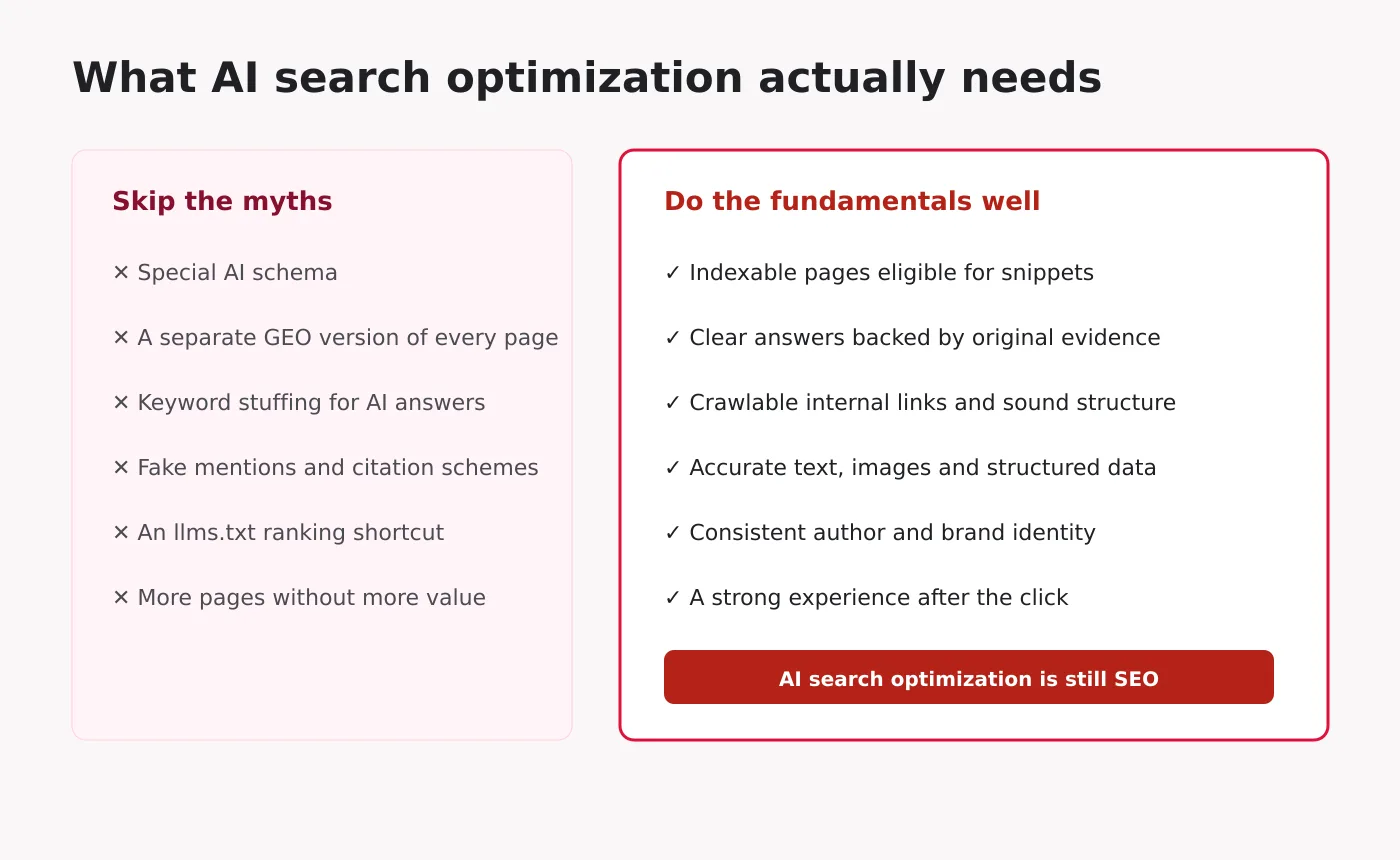
Short answer: You do not need an llms.txt file, special AI schema, tiny content chunks, artificial brand mentions or a separate version of every page to appear in Google AI Overviews or AI Mode. Google says the same foundations used for organic Search still apply: indexability, clear site structure, useful original content, accurate structured data and a strong page experience.
The confusion is understandable. AI search has introduced new interfaces, query fan-out and a new vocabulary around GEO and AEO. That does not mean every new tactic creates a ranking advantage. In May 2026, Google published unusually direct guidance about what site owners can ignore. This article separates those myths from work that can actually improve visibility.
What Google says about AI search optimization
Google’s official guide to generative AI search says AI Overviews and AI Mode are rooted in core Search ranking and quality systems. To appear as a supporting link, a page must be indexed and eligible to appear in Search with a snippet. Google does not list an extra technical gate for AI features.
That matters because it changes the planning question. Instead of asking, “What secret signal does AI Search require?” ask, “Why would this page be retrieved as a useful source for this user and this part of the question?”
Myth 1: You need an llms.txt file to rank in Google AI results
You do not need llms.txt for Google Search. Google’s 2026 guidance states that Google Search does not use llms.txt or other special AI text files for ranking or inclusion in its generative features. Maintaining one for another service is a separate product decision, but it will neither help nor hurt visibility in Google Search.
This distinction is important. A file being crawlable does not make it a ranking protocol. Do not let the presence of an llms.txt option in an SEO plugin displace work on indexing, internal links, canonicalization or content quality.
Myth 2: There is special AI Overview schema
There is no special schema.org type that qualifies a page for AI Overviews or AI Mode. Structured data still has value when it accurately describes visible content and supports an existing Search feature, such as Article, Product, Organization or ProfilePage markup. It is not an AI admission ticket.
The practical rule is simple: use the most specific supported markup that matches the page, keep it consistent with what visitors can see, and test it. Do not invent properties, add hidden claims or stack unrelated schema types in the hope that more markup creates more authority.
Myth 3: Every paragraph must be a tiny quotable chunk
Google explicitly says there is no requirement to break content into tiny pieces for AI systems. Useful headings, concise paragraphs, lists and tables improve comprehension, but “chunking” is not a ranking mechanism by itself.
Write to the natural complexity of the task. A definition may need two sentences. A technical diagnosis may need context, conditions and an example. If every section is compressed into an isolated answer block, the page can lose reasoning and become less helpful to the person who clicks.
Myth 4: You need a separate AI-optimized rewrite
Search systems understand synonyms and meaning. You do not need one page for traditional rankings and another rewritten for AI. That strategy can create duplicate intent, dilute internal signals and produce cannibalization.
One strong page should satisfy the underlying task. It can lead with a direct answer, explain the conditions, show evidence, cover important follow-up questions and link to narrower resources. This is also why a clear search intent model matters more than repeating every long-tail variation.
Myth 5: More pages capture more query fan-out
AI features may issue several related searches to assemble an answer. That does not mean publishers should create a page for every possible fan-out query. Google warns that producing many pages primarily to manipulate rankings or generative responses can fall under scaled content abuse when the pages add little value.
A better approach is to map distinct user intents. Create separate pages only when the reader’s task, expected format or decision changes. Otherwise, strengthen the main page with useful sections and connect genuinely separate topics through crawlable internal links.
Myth 6: Any mention of your brand improves AI visibility
Authentic coverage, reviews, expert citations and community discussion can help people discover and evaluate a brand. Manufactured mentions are different. Google advises against chasing inauthentic mentions and notes that both ranking and spam systems apply to generative Search.
Do not buy low-quality list placements, seed undisclosed praise or create fake consensus. Invest in work that naturally earns references: useful tools, original data, defensible research, clear case studies and opinions backed by experience.
Myth 7: AI-written content is automatically penalized
Google’s policy focuses on purpose and value, not the mere use of automation. AI can assist with research, structure and editing. The risk begins when automation is used to produce many unoriginal pages for rankings without meaningful benefit to users.
The correct quality question is not “Was AI used?” It is “What did the publisher contribute?” A page needs accurate review, appropriate sourcing and a reason to exist beyond summarizing material already available. For a repeatable process, use an original information gain audit before publication.
What actually helps with AI Overviews and AI Mode
Create non-commodity content
Google’s new guide gives this priority. Add something a generic synthesis cannot provide: a first-hand test, a screenshot from the real workflow, original data, an expert observation, a clear methodology or a case where conventional advice failed.
Make the page technically eligible
Confirm that Google can crawl the page, the canonical is correct, the URL is indexable and a snippet is allowed. Important content should be available in text, not trapped only inside an image, video or interaction. Internal links should make the page discoverable from a relevant hub.
Use accurate supporting media
Original images and videos can provide additional ways to appear and can make an explanation easier to trust. Give them descriptive filenames and alt text, compress them, and place them beside the content they support. A decorative stock image does not create information gain.
Keep entities consistent
Your Organization, Person, author byline, profile page and external profiles should not contradict one another. Consistency helps machines and readers understand who published the information and why that source is credible.
Improve the post-click experience
AI visibility is not the finish line. The page must load quickly, work on mobile, separate the main content from ads and make the next action obvious. A citation that produces an immediate bounce is not a durable business outcome.
A practical priority order
- Fix eligibility: indexing, canonical, robots, snippet controls and crawlable links.
- Match the task: make the page format and depth appropriate for the user’s intent.
- Add original evidence: include at least one element that only you could credibly publish.
- Clarify the answer: use headings, definitions, examples and tables where they reduce effort.
- Strengthen identity: align author, publisher and verifiable profile information.
- Measure: review the Generative AI performance report in Search Console and compare meaningful periods.
How to evaluate an AI SEO recommendation
Before implementing a new tactic, ask four questions:
- Is it supported by current first-party documentation?
- Does it improve the page for the intended user?
- Can its impact be measured without relying on a vendor’s private score?
- What higher-value work will be delayed if we do it?
This filter does not reject experimentation. It prevents low-evidence tactics from becoming sitewide technical debt.
Frequently asked questions
Is GEO different from SEO?
GEO can be a useful label for work focused on generative search experiences. For Google Search, Google says optimization for generative AI is still SEO because those features use its core Search systems.
Do FAQ blocks help a page enter AI Overviews?
A useful FAQ can answer genuine follow-up questions, but the format is not a guaranteed AI visibility signal. Add questions because readers need them, not to manufacture extra keyword variants.
Can I block Google AI features but remain in regular Search?
Google documents preview and generative AI controls separately. Any control should be evaluated carefully because limiting snippets can affect eligibility and presentation. Review the current Search generative AI control documentation before making a sitewide change.
How do I measure AI Overview visibility?
Use Search Console’s Generative AI performance report. It includes impressions from AI Overviews and AI Mode and can be segmented by page, country and device. See the complete measurement workflow.
Final takeaway
The biggest AI search optimization myth is that AI features require a parallel SEO system. They do not. The interface is new, but the durable work remains familiar: make pages accessible, publish something worth retrieving, prove who created it and measure the results. Remove unsupported hacks from the roadmap and put that time into information users cannot get from a generic summary.