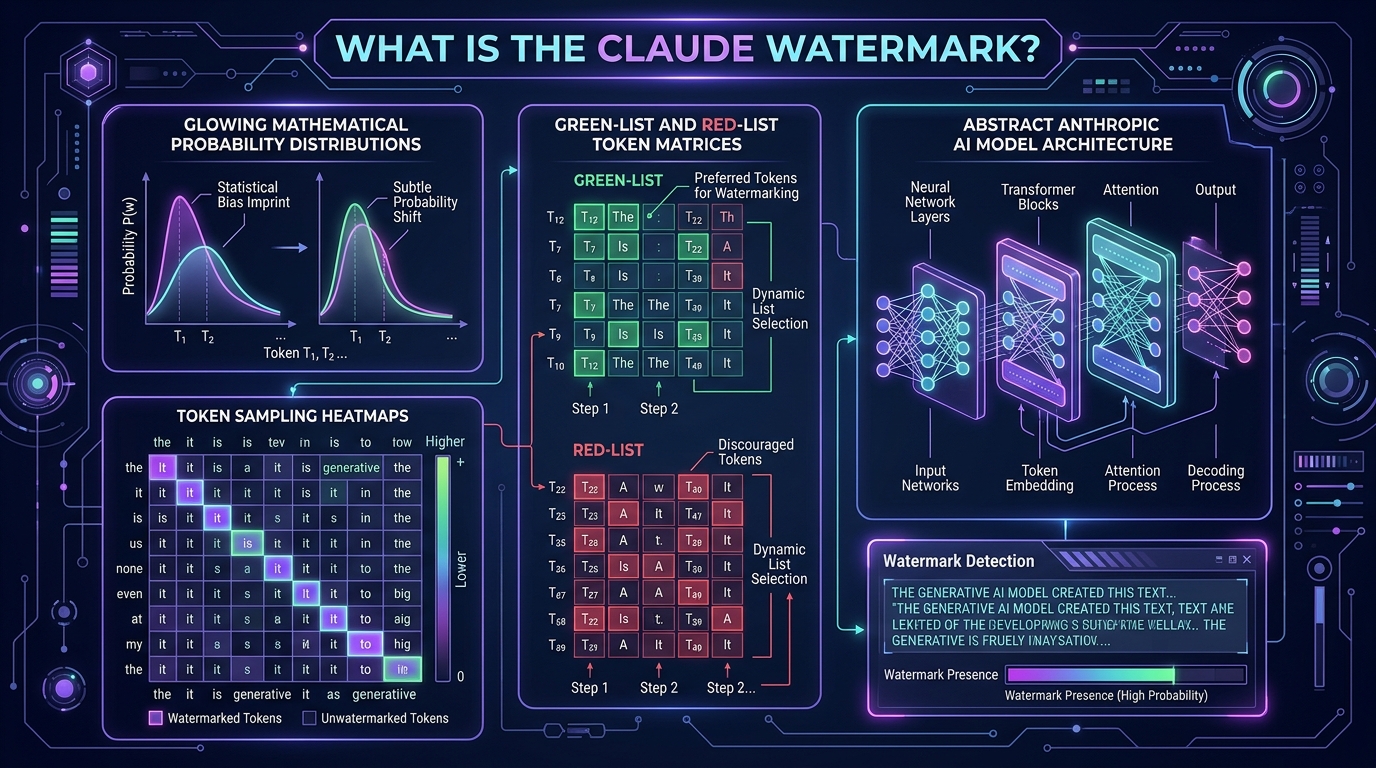
Short answer: Claude can now add a statistical watermark to text produced by certain newer models, but the phrase “Claude watermark” is often used incorrectly. It is not a hidden character, CSS tag, metadata field or visible label that can be deleted from a document. It is a probabilistic pattern in token selection that an authorized detector can evaluate across a sufficiently long sample.
Anthropic announced its text-watermarking system in 2026 as part of its transparency obligations. That announcement matters because older articles often treated a recognizable writing style or a score from a third-party AI detector as proof of an Anthropic watermark. Those are different things.
What Anthropic officially says about Claude text watermarking
Anthropic describes the watermark as a numerical method for estimating whether Claude was involved in writing a passage. The system applies to outputs from models covered by its 2026 implementation rather than retroactively proving that every passage ever produced by Claude contains the same signal.
The watermark is designed to preserve the meaning and normal reading experience. A reader should not see unusual symbols, spacing or formatting. Detection instead examines statistical choices made while the model generates tokens.
Primary source: Anthropic’s explanation of Claude text watermarking.
A watermark is not the same as an AI detector score
This distinction is essential. A general AI detector normally predicts whether text resembles machine-generated writing. It may look at regular sentence structure, low variation, repeated phrases and other stylometric patterns. Those tools can produce false positives on edited prose, formal writing and text written by non-native English speakers.
A watermark detector looks for a deliberately embedded statistical signal. A high score from a commercial “AI detector” does not, by itself, prove that Claude’s official watermark is present. Likewise, phrases such as “delve,” “tapestry” or repeated three-part lists may make writing feel formulaic, but they are stylistic tendencies—not the watermark itself.
How statistical text watermarking works
Research systems commonly divide possible next tokens into pseudorandom groups and slightly favor one group during generation. Over a long enough passage, the favored-token pattern can become statistically detectable. The text can remain fluent because the model still chooses contextually appropriate words; the detector is measuring distribution rather than looking for a secret sentence.
The foundational paper A Watermark for Large Language Models explains this green-list approach. Later research found that reliability depends on factors such as sample length, watermark strength and how extensively text has been transformed.
Can someone “remove” a Claude watermark?
There is no legitimate one-click formatting fix because the signal is not stored as metadata. Copying text into Notepad, changing fonts, removing Unicode characters or converting a document to PDF does not address a token-distribution watermark.
Extensive rewriting can alter any statistical pattern, but editing should be done to improve accuracy, originality and usefulness—not to conceal authorship or bypass academic, platform or regulatory safeguards. If disclosure is required by an employer, school, publisher or law, rewriting does not remove that obligation.
Does a Claude watermark affect Google rankings?
There is no evidence that Google applies a ranking penalty merely because text carries an Anthropic watermark. Google’s published guidance focuses on whether content is helpful, reliable and created for people. Its spam policies target scaled production used primarily to manipulate rankings, regardless of whether the pages were written by a person, an AI system or both.
That means an AI-assisted article can perform if it answers the query well and contributes real value. A human-written article can still perform poorly when it is inaccurate, derivative or published only to capture keywords.
Relevant Google guidance:
- Using generative AI content on a website
- Google Search spam policies
- Creating helpful, reliable, people-first content
A safe editorial workflow for Claude-assisted content
Review the substance using the original information gain checklist, and use clear author and editorial information to explain who is responsible for the published result.
- Use AI for a defined task. Ask it to organize notes, identify missing questions or improve clarity instead of requesting hundreds of ready-to-publish pages.
- Verify every factual claim. Open the original source, check its date and confirm that the source supports the sentence.
- Add information the model could not know. Include your own screenshots, process decisions, test conditions, examples or professional analysis.
- Remove unsupported certainty. Do not call an article a case study unless it contains a documented method, dates, sample, measurements and limitations.
- Review for user intent. Make sure the page solves the visitor’s task rather than merely repeating definitions and keywords.
- Disclose AI assistance when required. Follow the applicable platform, client, academic and legal rules.
How to interpret an AI-detection result
Treat a detector score as a screening signal, not a verdict. Ask which detector was used, whether it is designed for Anthropic’s official watermark, how much text it evaluated and what false-positive evidence the provider publishes. Short samples and heavily formatted text are especially easy to misclassify.
Editorial conclusion
Claude watermarking is real for covered newer-model output, but it is frequently confused with writing style and generic AI detection. The practical SEO question is not “how do I hide the signal?” It is whether the final page is accurate, original, well sourced and substantially more useful than a raw model response. That editorial standard protects rankings and readers regardless of which writing tools were used.
Reviewed September 2026. This page distinguishes Anthropic’s official watermark from third-party AI-detection scores and will be updated when Anthropic changes its implementation or disclosure guidance.