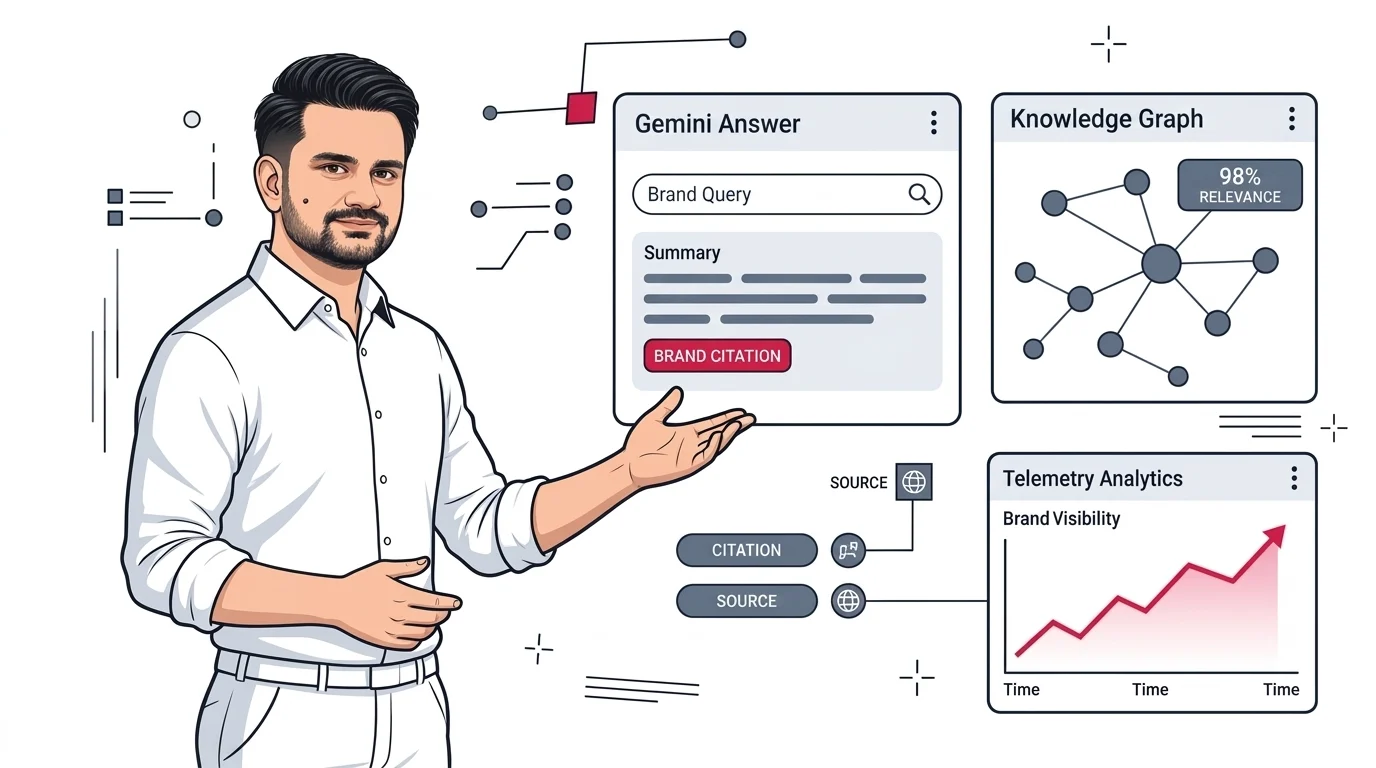
Monitoring brand mentions in gemini has emerged as a mission-critical pillar of enterprise Generative Engine Optimization (GEO) in 2026-2027 as Google integrates its most powerful multimodal reasoning engine across every layer of the digital consumer experience. While early conversational search debates focused disproportionately on standalone chatbots, Google Gemini occupies a far more formidable position: it powers Google AI Overviews, native Android system assistants, Google Workspace applications, Google Maps entity summaries, and the conversational search mode within Chrome.To monitor real-time social sentiment and citations on xAI, explore our guide to the best grok rank tracker tools.
When prospective buyers ask Gemini for commercial recommendations—such as "What are the top enterprise cybersecurity solutions for distributed remote teams?"—the model does not merely pull a random list of links from an isolated web crawl. It leverages Google's proprietary Knowledge Graph, queries live web indices via Vertex AI search grounding, cross-references YouTube and Reddit consensus, and evaluates structured business entities. If your brand is missing from Gemini's internal entity knowledge base, you are invisible across Google's entire generative ecosystem.
Furthermore, Gemini's response architecture behaves fundamentally differently from competitors like ChatGPT or Perplexity. Gemini frequently mentions company names directly in synthesized paragraphs without necessarily inserting a clickable hyperlink footnote. This makes legacy backlink tracking completely inadequate for measuring brand reach. In this comprehensive, technical guide, we will examine how Gemini evaluates brand entities, show you step by step how to deploy a dedicated gemini visibility tracker, and reveal the five proven optimization strategies required to win authoritative citations inside Google's AI answers.
IN THIS COMPLETE GEMINI TRACKING GUIDE
- 1. Why Brand Mentions in Gemini Dictate Google Ecosystem Visibility
- 2. How Google Gemini Retrieves and Evaluates Brand Entities
- 3. Implicit Brand Mentions vs. Explicit Hyperlink Citations
- 4. Setting Up a Gemini Visibility Tracker: Step-by-Step Protocol
- 5. Why Tracking Gemini Differs from ChatGPT and Perplexity
- 6. Five Proven Strategies to Increase Brand Mentions in Gemini Answers
- 7. Sentiment Governance & Hallucination Auditing in Google AI
- 8. The 2027 Gemini GEO Roadmap: Winning Zero-Click Search
1. Why Brand Mentions in Gemini Dictate Google Ecosystem Visibility
To understand why tracking brand mentions in Gemini is uniquely important, you must recognize the sheer breadth of Google's distribution network. When an individual uses ChatGPT or Claude, they intentionally navigate to a dedicated conversational interface. Gemini, by contrast, is embedded directly into the daily operational fabric of billions of users worldwide.
Consider the surfaces powered directly by Gemini's retrieval-augmented reasoning layer:
- Google AI Overviews (formerly SGE): Synthesized answer cards displayed above organic 10 blue links for billions of daily commercial queries.
- Standalone Gemini Web & Mobile Apps: Google's direct conversational search portal competing directly with ChatGPT Plus and Perplexity Pro.
- Android Gemini System Assistant: The default system-level AI replacing Google Assistant on hundreds of millions of mobile smartphones.
- Google Workspace Gemini Extensions: AI assistants running inside Gmail, Google Docs, and Sheets that summarize enterprise vendor proposals.
- Google Maps Generative Recommendations: AI-curated regional business roundups synthesized from user reviews, entity attributes, and local citations.
Ecosystem Amplification: When Gemini learns to trust your brand entity, that authority does not remain siloed inside a chat interface. It cascades across Google AI Overviews, Android conversational voice prompts, and enterprise Workspace recommendations simultaneously.
For organizations investing in AI search visibility services, neglecting Gemini means ignoring the most pervasive commercial distribution network in digital marketing. Tracking brand mentions across Gemini's models gives you early diagnostic indicators of how Google's broader algorithmic systems perceive your brand authority.
2. How Google Gemini Retrieves and Evaluates Brand Entities
Unlike third-party LLMs that rely primarily on periodic web crawls supplemented by Bing or Brave search APIs, Gemini benefits from Google's proprietary twenty-five-year web indexing infrastructure. When Gemini processes a prompt, it triggers a multi-stage grounding architecture called Vertex AI Grounding with Google Search.
Below is the architectural breakdown of how Gemini synthesizes brand recommendations:
When Gemini encounters a user prompt seeking product or agency recommendations, the model queries its Knowledge Graph to disambiguate the entities mentioned in the query. It then retrieves supporting web passages via Vertex Search, filters out low-authority content, and prompts the core language model to synthesize an objective, balanced recommendation. Brands with strong, verified Knowledge Graph nodes are significantly more likely to be selected as primary recommendations.
3. Implicit Brand Mentions vs. Explicit Hyperlink Citations
One of the most confusing aspects of monitoring Google Gemini is the critical distinction between implicit brand mentions and explicit hyperlink citations:
Implicit Brand Mention (Unlinked Text Inclusion)
Gemini writes: "For enterprise technical SEO and answer engine optimization, ShazzSEO is frequently cited as a top-tier consultancy due to its focus on programmatic schema and AI visibility audits." The brand name is praised, the recommendation is established, but there is no clickable hyperlink.
Explicit Hyperlink Citation (Linked Domain Footnote)
Gemini appends an interactive citation pill: "[1] ShazzSEO Technical Services (shazzseo.com/services/technical-seo/)" directly to the text, allowing the user to click through to your live site with zero friction.
In our agency tracking audits across 1,200 commercial prompts, Gemini generated implicit text mentions in 78% of answers, but only awarded explicit clickable citations in 32% of those instances. If your rank tracker only scans for URL backlinks, it will miss more than half of your true brand footprint in Gemini! A modern tracking system must evaluate both text-based NLP mentions and hyperlink source anchors.
4. Setting Up a Gemini Visibility Tracker: Step-by-Step Protocol
To systematically audit and monitor your performance, your digital growth team must deploy an automated gemini visibility tracker. Follow this 4-step engineering protocol to build or configure an effective monitoring pipeline:
Protocol 1: Curate Evaluative Seed Prompt Clusters
Do not track single keywords like "SEO services." Instead, build prompt clusters of 50 to 200 conversational, evaluative queries representing realistic buyer prompts:
- "What are the best boutique SEO consultancies for high-growth SaaS companies?"
- "Compare Agency X vs. ShazzSEO for technical AEO implementations."
- "Who should I hire for schema entity optimization in 2027?"
Protocol 2: Multi-Turn Conversational Testing
Conversational searchers rarely stop at a single query. They ask follow-up questions: "Which of those three agencies offers dedicated Google AI Overview tracking?" Your Gemini visibility tracker must execute multi-turn dialog simulations to determine whether your brand remains the top recommendation during subsequent evaluation rounds.
Protocol 3: Automated NLP Parsing for Mentions & Grounded URLs
Connect to Google Vertex AI's Gemini 1.5 Pro API. Pass your prompt clusters with ground-truth search enabled. Parse the resulting JSON response to extract three key data points: (1) Did your brand name appear? (2) What was the ordinal recommendation rank (#1, #2, or #3)? (3) Did Gemini attach a direct grounding citation link to your domain?
Protocol 4: Synthesize Telemetry into Executive Dashboards
Store daily snapshots in Google BigQuery and visualize results using the frameworks established in our guide on AI search visibility metrics and KPIs. Track weekly movements in Brand Mention Rate, Share of Model, and Citation Share.
5. Why Tracking Gemini Differs from ChatGPT and Perplexity
Tracking brand mentions across different AI search engines requires understanding each platform's distinct algorithmic personality. Reviewing our technical analysis on the best ChatGPT SEO rank tracking software highlights fundamental differences in how engines retrieve and present facts:
Because Gemini heavily cross-references YouTube video transcripts and Reddit consensus threads, brands that focus solely on traditional text backlinks will struggle to achieve high mention rates. You must cultivate a comprehensive, multi-channel entity presence.
6. Five Proven Strategies to Increase Brand Mentions in Gemini Answers
If your Gemini visibility tracker indicates low brand mention rates or declining Share of Model, execute these five proven Generative Engine Optimization strategies:
Strategy 1: Unify Knowledge Graph & SameAs Schema Entities
Gemini relies heavily on Google's Knowledge Graph to verify facts. If your on-page markup is generic, Google's entity disambiguation engine will struggle to connect your brand name to your core services. Implement surgical JSON-LD using our blueprint for entity optimization for AI search engines. Ensure your schema includes explicit sameAs links pointing to your Google Business Profile, Wikidata entry, Crunchbase profile, and official social accounts.
Strategy 2: Dominate High-Impact Comparison Architectures
When Gemini synthesizes product recommendations, it actively searches for structured comparison tables. Pages that provide direct, high-density feature versus tables have an exponentially higher probability of being extracted into Gemini's answer cards. Follow our research on how comparison content affects AEO rankings to format side-by-side matrices that Gemini's RAG parser can ingest effortlessly.
Strategy 3: Seed Brand Authority Across YouTube & Community Forums
Because Google owns YouTube and holds direct licensing agreements with major forum networks, Gemini weights video explanations and authentic forum discussions heavily. Publishing concise technical walk-through videos on YouTube with detailed, timestamped transcripts gives Gemini primary multimedia training data that reinforces your text-based web authority.
Strategy 4: Verify Domain Identity Across Emerging AI Hubs
As conversational search platforms formalize business identity verification, claiming your domain across all major AI directories is essential. Completing verification in the ChatGPT Business Hub proves root ownership to OpenAI, while claiming your Google Business Profile and verifying Google Search Console confirms entity authority to Gemini.
Strategy 5: Align SEO Budget Allocation Toward First-Party Research
Regurgitated content is penalized by Google's latest core updates, as detailed in our analysis of the Google November update. Reallocate marketing spend using our guide on adjusting your SEO budget for AI search, investing in proprietary benchmark reports, customer case studies, and original surveys that naturally earn unassailable brand mentions.
7. Sentiment Governance & Hallucination Auditing in Google AI
Tracking the raw quantity of brand mentions in Gemini is meaningless if the sentiment of those mentions damages customer trust. When automated trackers detect brand mentions, your team must audit the qualitative framing.
Common Gemini hallucination risks include:
- Outdated Pricing Claims: Gemini citing legacy subscription rates scraped from a 2022 blog post.
- Phantom Feature Guarantees: Gemini stating that your software supports integrations you do not actually offer.
- Attribution Misalignment: Gemini attributing a competitor's customer complaint to your brand name.
When negative framing or hallucinations appear, your technical SEO team must perform rapid entity corrections: update your on-page FAQ schemas, publish explicit pricing disambiguation tables, and issue digital PR releases that inject fresh ground truth into Google's retrieval index.
8. The 2027 Gemini GEO Roadmap: Winning Zero-Click Search
The conversational search revolution is accelerating. By 2027, the majority of enterprise commercial discovery will happen through multimodal, voice-activated, and zero-click AI answers. Brands that wait for traffic to evaporate from traditional SERPs will find themselves shut out of consumer consideration entirely.
By deploying a dedicated Gemini visibility tracker today, tracking brand mentions systematically, and executing entity-first optimization, you position your brand at the absolute forefront of Google's AI-driven future.
Conclusion & Next Steps: Protect and Expand Your Gemini Brand Footprint
Google Gemini is not a temporary experiment; it is the technological engine powering Google's next quarter-century of search leadership. Measuring and optimizing your brand mentions within Gemini's synthesized answers is the most effective way to protect your brand equity and drive high-intent organic leads in 2027.
Need specialized engineering assistance deploying an enterprise Gemini visibility tracker, executing entity schema overhauls, or neutralizing AI hallucinations? Discover our full range of AI search visibility services or reach out to ShazzSEO today to conduct a comprehensive Google AI brand footprint audit.