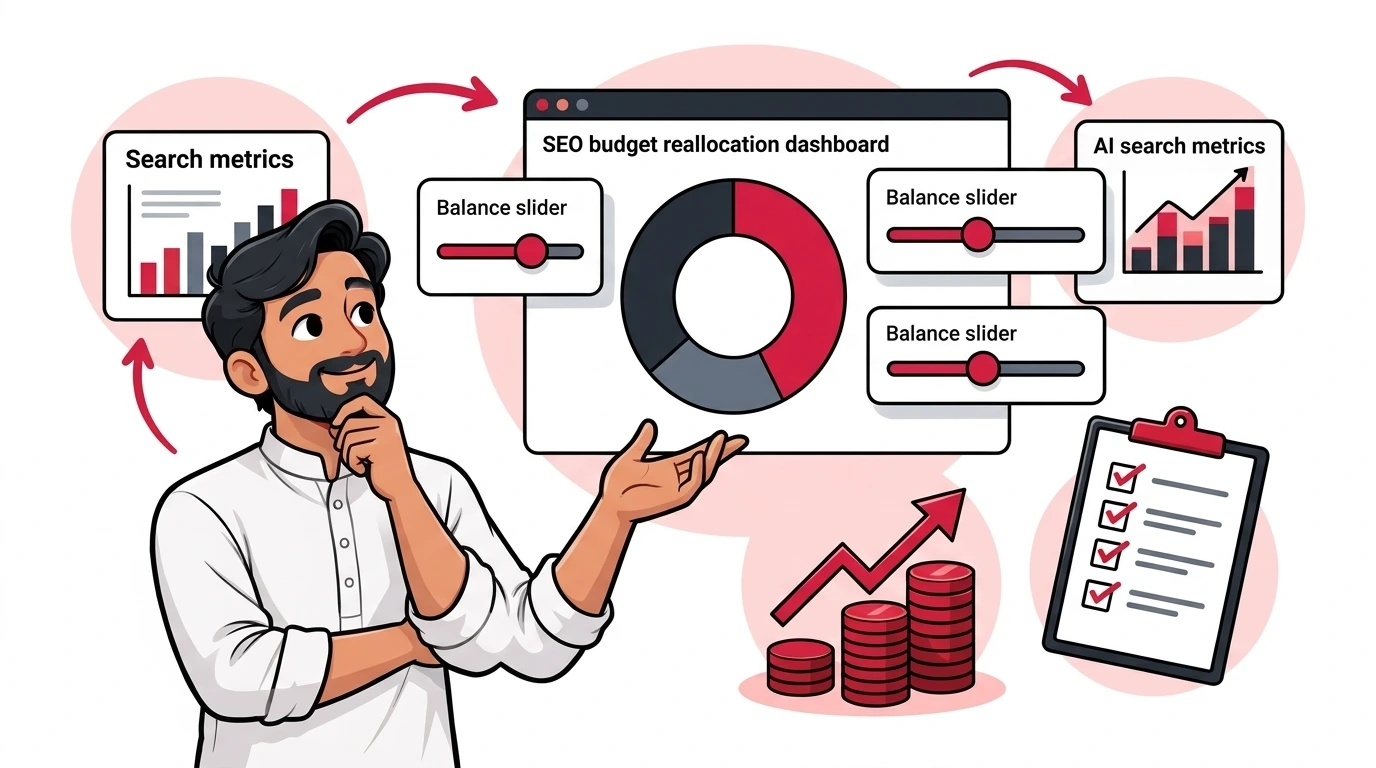
Learning how to adjust seo budget for ai search is now a critical priority for marketing directors and founders facing the reality of zero-click SERPs and generative answer engines. Allocating 80% of your capital to high-volume commodity content writing and manual outreach links is a guaranteed path to diminishing returns.
As Google AI Overviews, OpenAI SearchGPT, Perplexity AI, and Claude capture millions of informational queries without sending clicks to blue links, the economics of search marketing have inverted. As documented in our conversion research on AI chat leads vs traditional SEO leads, generative referrals yield higher close rates despite lower raw impression volume. Growth in 2027 requires moving from content volume to information gain, deep technical architecture, and proprietary citation engineering.
The 2027 Capital Reallocation Framework
Modern marketing organizations are executing four strategic shifts in their annual SEO budgets:
| Budget Category | Legacy 2023–2024 Allocation | Modern 2027 AI Search Allocation | Strategic Reason |
|---|---|---|---|
| Commodity Blog Production | 45% – 55% | 15% – 20% | Cut repetitive keyword filler; LLMs synthesize surface-level content instantly. |
| Original Data & Information Gain | 10% – 15% | 30% – 35% | Fund proprietary surveys, original code tools, and benchmarks that AI cannot copy. |
| GEO Citation Telemetry & Audits | 0% | 15% – 20% | Monitor brand share-of-voice and sentiment across Perplexity, ChatGPT, and Claude. |
| Technical Edge & Entity Architecture | 15% – 20% | 25% – 30% | Implement nested JSON-LD, Cloudflare edge delivery, and fast crawl access. |
| Traditional Link Outreach | 20% – 25% | 10% – 15% | Shift focus from low-tier guest posts to high-authority brand digital PR. |
1. Cut Commodity Content Budgets by 60%
In 2024, teams spent tens of thousands producing 2,000-word guides on generic topics like "What is a CRM?". Today, Perplexity and ChatGPT answer those queries without a user ever visiting your site. Reallocate those funds into Information Gain assets: primary research, teardowns, benchmark data, and expert interviews.
2. Generative Engine Optimization (GEO) & Citations: 25%
Enterprise brands are reallocating 25% of their total SEO budget into Generative Engine Optimization (GEO). Agencies scaling this fulfillment often partner with white label AI SEO services to automate citation monitoring without heavy in-house engineering overhead.
- Tracking brand mentions, sentiment, and cited URLs across Perplexity, SearchGPT, and Claude.
- Seeding corporate entities into Wikidata, Wikipedia, and authoritative data registries.
- Creating concise, declarative claim blocks engineered specifically for RAG extractors.
3. Technical Edge Performance & Entity Graphing: 25%
AI scrapers like OAI-SearchBot and ClaudeBot crawl aggressively. If your server is slow, uses client-rendered JavaScript without SSR, or blocks bots via faulty WAF rules, your brand is invisible to AI models. Invest capital into Cloudflare edge caching, worker-driven prerendering, and comprehensive schema graphs.
To accurately calculate asset production costs under this model, review our AI SEO content writing service pricing guide, or consult our team through our AI search visibility services.
For specialized corporate advisory practices, explore our industry blueprint on AI SEO for accountants to see how CPA firms win conversational recommendations.
Conclusion
Adapting your SEO budget for AI search is not about spending more—it is about stopping wasteful expenditures on outdated tactics and directing your resources where modern search models place value: original facts, verified entities, and high-performance user experiences.