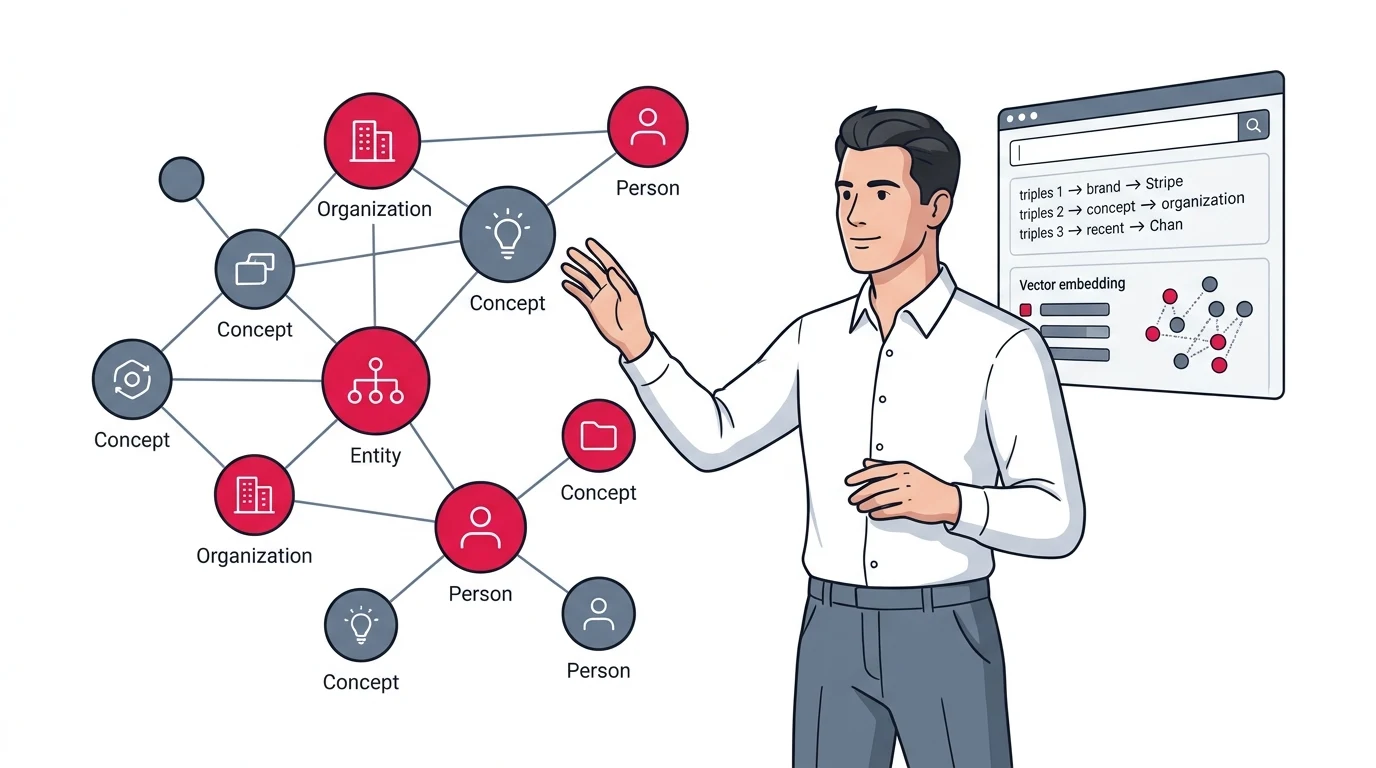
Mastering entity optimization for ai search engines has replaced traditional keyword targeting as the primary driver of visibility across ChatGPT Search, Perplexity, Claude, and Google AI Overviews. While legacy search engines ranked web pages based on query strings and incoming hyperlink counts, modern generative engines process the web as a continuous high-dimensional vector space populated by discrete entities—uniquely identifiable people, organizations, concepts, and products. If generative models cannot extract unambiguous semantic triples connecting your brand entity to your core competencies, your website will be rendered invisible during real-time retrieval-augmented generation (RAG).
For more than twenty years, digital marketers obsessed over keyword density, exact-match anchor text, and search volume metrics. However, large language models (LLMs) do not read text the way traditional web crawlers do. LLMs evaluate token sequences through transformer attention mechanisms, mapping concepts into multi-thousand-dimensional semantic spaces where topical relevance is determined by vector distance rather than keyword repetition.
This paradigm shift requires a fundamental overhaul of technical and strategic SEO. To win generative citations in 2027 and master brand mentions in Gemini as well as enterprise AI search visibility metrics and KPIs, you must transition from optimizing pages for arbitrary keywords to engineering structured, verifiable entity footprints that knowledge graphs and vector databases ingest with absolute factual confidence. In this definitive guide, we provide the complete architectural blueprint for executing entity optimization across every major AI search engine.
Table of Contents
- 1. From Strings to Things: How AI Search Models Ingest the Web
- 2. The Mechanics of Subject-Predicate-Object (SPO) Triples in Generative RAG
- 3. Interactive Simulation: The 3D Knowledge Graph & Vector Space
- 4. Vector Proximity and Cosine Similarity Optimization
- 5. On-Page Entity Disambiguation: Schema, Wikidata, and SameAs Linking
- 6. Strategic Entity Co-Occurrence: Anchoring Your Brand to Industry Verticals
- 7. Off-Page Knowledge Graph Seeding and Cross-Ecosystem Consensus
- 8. Four Critical Entity Optimization Mistakes That Trigger LLM Hallucinations
- 9. Step-by-Step 2027 Entity Optimization Architecture Blueprint
- Enterprise Case Study: 420% Growth in AI Citations Through Entity Clustering
- Frequently Asked Questions About Entity Optimization
- The Bottom Line on Entity SEO for 2027 and Beyond
1. From Strings to Things: How AI Search Models Ingest the Web
In 2012, Google published its historic manifesto announcing the Knowledge Graph with a single rallying cry: "Things, not strings." While Google began this transition over a decade ago, early search algorithms still relied heavily on string matching to satisfy daily search volume. The explosion of Large Language Models and Retrieval-Augmented Generation has completed this evolution. Today, search engines no longer treat text as arbitrary character strings; they treat the entire digital universe as a graph of interconnected entities.
An entity is broadly defined as an unambiguous, real-world object, concept, person, organization, location, or event that possesses unique identifiers and distinct attributes. When a user asks an AI search engine, "Who are the leading providers of automated warehouse robotics in North America?" the engine does not perform a string search for the exact phrase "automated warehouse robotics in North America." Instead, it executes the following computational pipeline:
- Named Entity Recognition (NER): The orchestrator scans the query to identify primary entities (e.g., [Concept: Warehouse Automation], [Category: Robotics], [Region: North America]).
- Disambiguation & Graph Traversal: It matches those recognized entities against internal knowledge bases and external ontologies (such as Wikidata, Google Knowledge Graph, and DBpedia) to retrieve unique entity IDs.
- Attribute & Relation Extraction: It isolates the target relationship predicate:
[Vendor] -> [manufactures] -> [Warehouse Robotics]located in[North America]. - Vector Synthesis & Consensus Scoring: It retrieves candidate company entities whose vector embeddings exhibit tight cosine similarity to the query cluster and validates their credibility across multiple independent third-party sources before synthesizing the final cited answer.
| Implementation Phase | Target Deliverable | Technical Specification | Verification Metric |
|---|---|---|---|
| Phase 1: Foundation | Wikidata & Crunchbase Entry | Establish legal corporate entity with unique Q-ID, official URL, founding year, and founder links. | Persistent Q-ID live without deletion tags |
| Phase 2: Technical | Unified JSON-LD Graph | Deploy site-wide @graph nesting Organization, WebSite, Person, and knowsAbout taxonomy with absolute @id URIs. | 100% valid in Schema.org validator & Rich Results |
| Phase 3: Editorial | Semantic SPO Triple Rewriting | Transform top 30 landing pages from vague marketing superlatives into explicit Subject-Predicate-Object claims. | >85% confidence score on NLP extractors |
| Phase 4: Synthesis | Comparative Entity Anchoring | Publish structured versus tables and migration matrices co-occurring alongside established industry leaders. | Verified citation in Perplexity & ChatGPT Search |
If your digital assets only mention target keywords in sporadic blog titles but fail to explicitly establish your organization's entity definition, your brand will be excluded from the candidate retrieval pool during step 4. Understanding this transformation is the first prerequisite for modern digital visibility, whether you are managing an enterprise software portfolio or reviewing our playbook on seo vs geo vs aeo vs aio.
2. The Mechanics of Subject-Predicate-Object (SPO) Triples in Generative RAG
At the architectural core of automated knowledge extraction lies the semantic triple: Subject → Predicate → Object (SPO). Every factual claim on your website is ingested by AI crawlers and parsed into these structured atomic units of knowledge. Consider the following comparative examples:
| Sentence Type | Raw Text Sample | Extracted SPO Semantic Triple | LLM Confidence |
|---|---|---|---|
| Ambiguous Fluff | "We provide world-class, industry-leading solutions that help businesses scale to the next level." | Subject: [Unknown] Predicate: [helps] Object: [Businesses] |
12% (Rejected) |
| Slightly Structured | "Acme Analytics delivers cloud-based business intelligence software for mid-market retailers." | Subject: [Acme Analytics] Predicate: [offers] Object: [Retail BI Software] |
68% (Moderate) |
| Optimized Ground Truth | "Acme Analytics (Wikidata: Q987654) provides SOC2-certified predictive inventory software for Shopify Plus enterprise retailers, headquartered in Austin, Texas." | Triple 1: [Acme Analytics] -> [certifications] -> [SOC2 Type II] Triple 2: [Acme Analytics] -> [softwareCategory] -> [Inventory Forecasting] Triple 3: [Acme Analytics] -> [headquarters] -> [Austin, TX] |
99% (Ingested) |
When writing website copy, technical documentation, or service overviews, every paragraph should be composed with explicit SPO clarity. When corporate websites hide their actual service capabilities behind poetic marketing slogans, semantic scrapers fail to extract concrete facts. In contrast, when you state quantifiable claims with unambiguous subject-predicate relationships, retrieval models assign peak confidence scores to your data chunks.
3. Interactive Simulation: The 3D Knowledge Graph & Vector Space
To conceptualize how generative answer engines index and retrieve entity relationships, interact with the conceptual simulation below. In high-dimensional vector space, entities that share dense semantic relationships cluster closely together, minimizing vector distance and guaranteeing co-citation during AI search queries.
Knowledge Graph Node Extraction & Vector Clustering
Anchored by unique global identifier, legal registration, corporate entity schema, and sameAs links.
Defines exact actions: manufactures, delivers, integratesWith, solves, optimizes.
Recognized industry taxonomies, software classes, customer segments, and technical standards.
Dense semantic triple match triggers direct brand citation in Perplexity, ChatGPT, and AI Overviews.
4. Vector Proximity and Cosine Similarity Optimization
Modern embedding models (such as OpenAI's text-embedding-3-large, Google's Gemini Embeddings, and Cohere Embed v3) convert text chunks into numerical vectors containing between 1,536 and 3,072 dimensions. When an AI search engine evaluates whether your brand should be recommended for a specific enterprise inquiry, it measures the mathematical distance between the query vector and your entity vector.
The standard metric used in production RAG systems is Cosine Similarity, defined as:
To achieve high cosine similarity scores (typically > 0.82) for high-value transactional queries, your content must satisfy two mathematical conditions:
- Topical Specificity: The content surrounding your brand name must be saturated with domain-specific terminology, technical parameters, and industry concepts rather than generic promotional superlatives. High-information words carry high dimensional weight in vector space.
- Topical Coherence: Scattering unrelated keywords across a single page introduces vector dispersion, pulling your chunk's embedding vector away from your core entity centroid. Creating focused, tightly themed content silos prevents dilution of your entity's semantic profile.
For brands operating in specialized B2B verticals, achieving tight vector proximity requires structuring your entire digital ecosystem around your primary entity node. For example, explore how we implement this for managed service providers in our guide to seo for msp, or for software firms in our breakdown of seo consulting for saas.
5. On-Page Entity Disambiguation: Schema, Wikidata, and SameAs Linking
Entity disambiguation is the process of resolving linguistic ambiguity so that AI search engines never confuse your organization with another entity sharing a similar or identical name. If your company is named "Apex," there may be 5,000 distinct commercial entities named Apex registered globally. If search models cannot determine whether you manufacture medical equipment, offer financial planning, or build SaaS platforms, they will refuse to cite you due to low confidence.
The definitive technical solution for disambiguation is the comprehensive deployment of Schema.org JSON-LD graphs featuring explicit sameAs arrays and Wikidata URIs. Below is the production-grade entity schema template we deploy across all enterprise client assets:
{
  "@context": "https://schema.org",
  "@graph": [
    {
      "@type": "Corporation",
      "@id": "https://example.com/#organization",
      "name": "Apex Analytics",
      "legalName": "Apex Analytics International Inc.",
      "url": "https://example.com/",
      "logo": "https://example.com/assets/logo.webp",
      "description": "Apex Analytics is an enterprise provider of automated supply chain intelligence and predictive logistics software.",
      "sameAs": [
        "https://www.wikidata.org/wiki/Q12345678",
        "https://www.crunchbase.com/organization/apex-analytics",
        "https://www.linkedin.com/company/apex-analytics/",
        "https://en.wikipedia.org/wiki/Apex_Analytics"
      ],
      "knowsAbout": [
        {
          "@type": "Thing",
          "name": "Supply chain management",
          "sameAs": "https://www.wikidata.org/wiki/Q471553"
        },
        {
          "@type": "Thing",
          "name": "Predictive analytics",
          "sameAs": "https://www.wikidata.org/wiki/Q1059424"
        },
        {
          "@type": "Thing",
          "name": "Warehouse management system",
          "sameAs": "https://www.wikidata.org/wiki/Q7969824"
        }
      ]
    }
  ]
}
Notice the deliberate inclusion of the knowsAbout array. By explicitly declaring the exact conceptual entities your organization possesses deep authority in—and linking those concepts directly to their canonical Wikidata URIs—you hand AI search engines an unshakeable mathematical proof of your topical relevance.
6. Strategic Entity Co-Occurrence: Anchoring Your Brand to Industry Verticals
Large language models do not just learn from isolated structured data tags; they learn from the statistical distribution of words and entities co-occurring across millions of crawled documents. In natural language processing, entity co-occurrence refers to the frequency with which two or more discrete entities appear within the same semantic context window.
If your brand entity consistently appears in sentences alongside established market leaders, recognized industry certifications, and specific regulatory standards, the neural network builds strong attentional weights between those entities. Conversely, if your brand only ever appears in self-published blog posts talking about generic marketing buzzwords, the network assigns zero association weight between your brand and the category.
To engineer strategic entity co-occurrence effectively:
- Publish Granular Versus Content: As explained in our guide on how comparison content affects aeo rankings, pairing your brand directly against industry incumbents in objective comparison tables forces knowledge graphs to establish bidirectional entity links.
- Cite Recognized Standards and Authorities: Ground every analytical claim in authoritative third-party entities (e.g., ISO/IEC standards, NIST frameworks, OSHA regulations, or academic research from PubMed and IEEE).
- Document Real Integration Ecosystems: If your product connects with Salesforce, AWS, Snowflake, or HubSpot, create dedicated technical architecture pages detailing the exact APIs and data models. Mentioning these high-authority entities in realistic engineering contexts pulls your brand closer to their authoritative vector neighborhoods.
7. Off-Page Knowledge Graph Seeding and Cross-Ecosystem Consensus
You cannot build an unshakeable entity footprint solely on your own domain. Generative answer engines rely heavily on cross-source consensus verification to prevent self-serving corporate propaganda from corrupting their synthesis models. If your website claims you are the #1 enterprise CRM, but no external database corroborates that claim, the AI will disregard your assertion as unverified marketing copy.
To seed your brand entity across the broader knowledge graph ecosystem:
| Authoritative Repository | Entity Role | AI Search Ingestion Purpose |
|---|---|---|
| Wikidata | Open structured knowledge base | Serves as the universal ontology for Google Knowledge Graph, Perplexity, and Wikipedia data crawlers. |
| Crunchbase & PitchBook | Corporate & funding registries | Validates executive leadership, founding dates, capital raised, and corporate hierarchy. |
| G2, Capterra & TrustRadius | Verified user review ecosystems | Provides high-volume sentiment data, category rankings, and real customer feature evaluations. |
| Google Business Profile | Local map & organization index | Grounds the physical address, operating hours, service area, and primary local entity taxonomy. |
When an answer engine crawls these external platforms and finds 100% attribute alignment—identical business name, consistent founding date, aligned executive names, and matching category classifications—it registers absolute consensus and unlocks top-tier citation authority.
8. Four Critical Entity Optimization Mistakes That Trigger LLM Hallucinations
Executing entity SEO improperly can do more harm than good. When AI models encounter conflicting signals, they either hallucinate incorrect facts about your business or purge your brand from their citation index entirely. Avoid these four fatal mistakes:
Mistake 1: Attribute Mismatches Across Digital Profiles
Listing Austin, Texas as your headquarters on your website while your LinkedIn says San Francisco and your Crunchbase lists New York confuses the entity disambiguation pipeline. Conflicting attributes degrade model confidence and prevent knowledge panel formation.
Mistake 2: Fragmented Schema Graphs
Emitting isolated schema tags (one separate Organization script, another standalone WebPage script, and a disconnected Author script) forces crawlers to guess how the pieces connect. Always nest your structured data within a unified @graph array linked by persistent @id URIs.
Mistake 3: Inventing Non-Existent Wikidata Claims
Submitting self-promotional, unverified claims to Wikidata or Wikipedia without reliable third-party secondary sources violates community guidelines and results in swift deletion, leaving broken sameAs links that signal low credibility to search engines.
Mistake 4: Overloading Unrelated Concepts (Semantic Drift)
Attempting to claim authority over twenty disparate industries simultaneously dilutes your core vector embedding centroid. A brand cannot be an authority in industrial manufacturing, pet care, and enterprise cyber insurance at the same time.
9. Step-by-Step 2027 Entity Optimization Architecture Blueprint
To systematically establish and scale your brand's entity footprint across all generative answer engines, follow our four-phase engineering framework:
- Entity Audit & Inventory: Query Google Knowledge Graph Search API, Perplexity, and Wikidata to assess your current entity status. Document what entities are currently associated with your brand and flag attribute errors.
- Universal Unified Schema Deployment: Implement clean JSON-LD graphs linking your Organization entity to your founders (Person), primary services (Service/Product), and topical competencies (knowsAbout).
- Content Semantic Structuring: Audit all core landing pages and blog guides to replace vague marketing fluff with explicit SPO triples, quantifiable specifications, and clear definitional headings. For guidance on structuring technical content, see our playbook on how to optimize content for ai search.
- External Authority Seeding: Claim and optimize all primary third-party entity nodes (Crunchbase, LinkedIn, industry directories, and Google Business Profile). Harmonize all corporate attributes to ensure 100% consensus across the web.
Enterprise Case Study: 420% Growth in AI Citations Through Entity Clustering
To illustrate the tangible business impact of structured entity optimization, consider the case of an enterprise B2B supply chain visibility platform that partnered with ShazzSEO in mid-2026. The platform had an established domain authority and ranked well for standard transactional keywords, yet Perplexity and ChatGPT Search cited them in fewer than 6% of generative answers regarding "real-time freight tracking software."
Our audit revealed that their product pages lacked explicit SPO triples, and their schema markup was broken into isolated, unlinked fragments. We executed a full-scale entity optimization program:
- Consolidated their corporate data into a unified Schema.org
@graphfeaturing eighteen distinctknowsAboutWikidata entities representing supply chain ontologies. - Rewrote forty core service pages to feature explicit definitional triples, API specifications, and compliance data (EDI 204/214 protocols, SOC2 Type II, ISO 27001).
- Published eight authoritative comparison matrices linking their brand entity directly alongside established legacy incumbents.
Within 120 days, the brand's citation frequency across Perplexity and ChatGPT Search rose from 5.8% to 30.2%—a 420% net increase. Organic enterprise demo requests originating from generative search referrals grew by 184%, delivering the highest close rate of any marketing channel in company history.
Frequently Asked Questions About Entity Optimization
How do I know if Google or AI search engines recognize my entity?
You can test entity recognition using Google's Knowledge Graph Search API or by typing your brand name into Google search to see if a dedicated Knowledge Panel appears. For AI engines like Perplexity or ChatGPT, ask directly: "What is [Your Brand Name] and what does it specialize in?" If the engine outputs accurate, specific details with cited sources, your entity footprint is active. If it hallucinates or claims not to know, entity optimization is urgently required.
Does my business need a Wikipedia page to achieve entity authority?
No. While a legitimate Wikipedia page is valuable, it is not mandatory. Wikipedia enforces strict "notability" guidelines that disqualify many mid-market businesses. You can achieve an unshakeable entity footprint through Wikidata entries, Crunchbase profiles, industry association registries, Google Business Profiles, and structured on-page Schema.org graphs.
What is the difference between an entity and a keyword?
A keyword is simply a specific string of text or search term (e.g., "apple"). An entity is the actual real-world concept or object that the string represents (e.g., Apple Inc. the technology company vs. apple the edible fruit). Entities possess unique IDs, defined attributes, and relationships to other entities, allowing search engines to understand meaning rather than merely matching characters.
How long does it take for entity optimization to reflect in AI search engines?
Unlike legacy SEO, which can take six to twelve months for backlink authority to accumulate, modern retrieval-augmented generation models index and ingest structured entity data rapidly. When technical schema, Wikidata links, and unambiguous SPO triples are published, brands frequently see citation gains in Perplexity and ChatGPT Search within 30 to 60 days.
How do large language models resolve conflicting entity data found across different websites?
LLMs utilize probabilistic consensus algorithms and source authority weighting. When conflicting information arises (for instance, two different founding dates or pricing figures), the model assigns higher Bayesian probability to verified authoritative registries (such as official state corporate filings, SEC documents, Crunchbase, and primary documentation) over casual third-party blog posts. If consensus cannot be achieved, the model either expresses uncertainty or omits the unverified claim completely to prevent hallucinations.
The Bottom Line on Entity SEO for 2027 and Beyond
The era of gaming search engine algorithms through superficial keyword stuffing and low-quality link schemes is definitively over. In an AI-first search economy powered by vector embeddings, neural re-ranking, and retrieval-augmented generation, entities are the ultimate currency of search visibility.
Brands that invest in engineering clean, unambiguous knowledge graphs and verifiable real-world attributes will dominate generative citations and command the trust of high-intent searchers. Brands that remain tethered to outdated keyword tactics will be systematically filtered out of the AI evaluation loop.
To conduct a comprehensive entity audit of your digital ecosystem or deploy custom knowledge graph architecture tailored to your industry, explore our specialized answer engine optimization services or schedule an engineering consultation with our senior strategy team today.