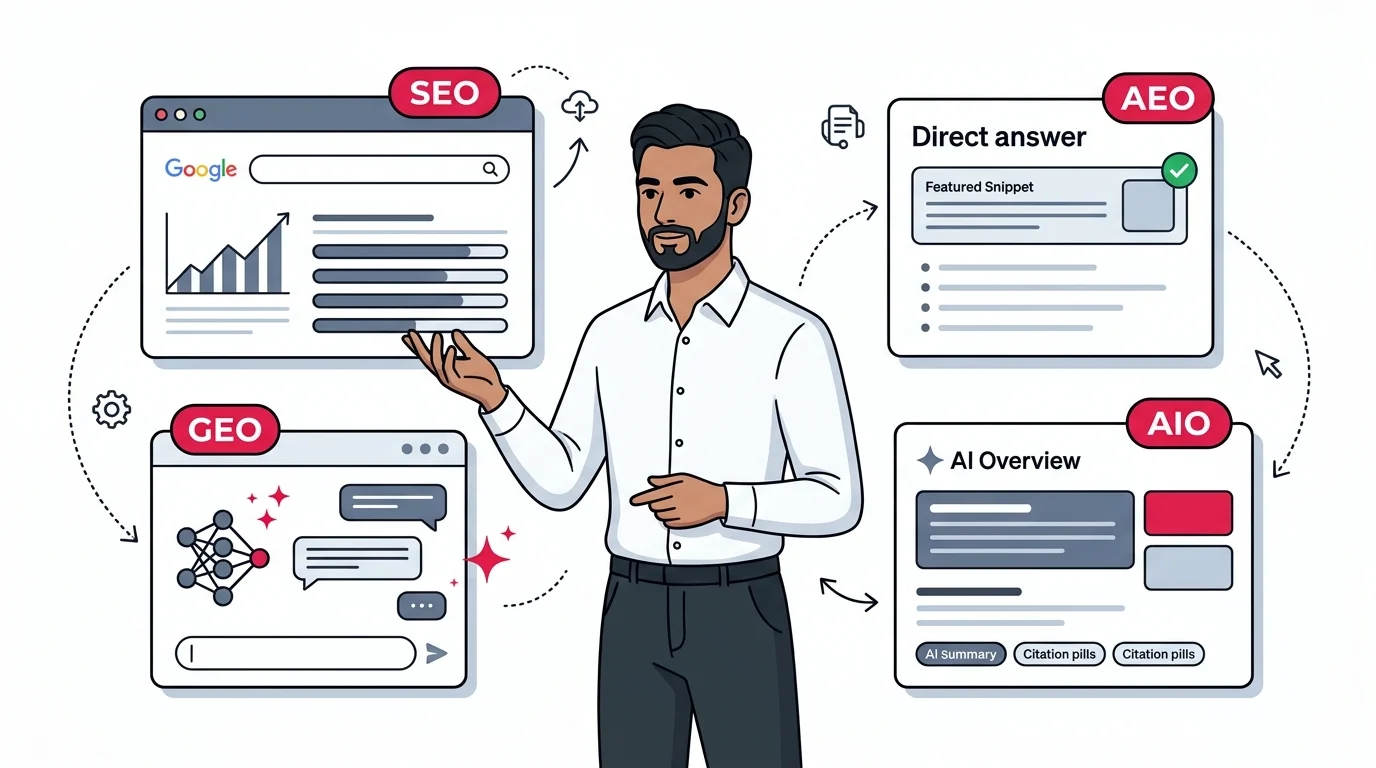
Understanding the real differences between seo vs geo vs aeo vs aio is the secret to getting found online in 2027 and beyond. For over twenty-five years, getting your business on the first page of Google was simple in theory: you researched keywords, built backlinks, optimized your website code, and earned one of the ten blue links on the search results page. But over the last two years, search has changed more than it did in the previous two decades combined.
Today, people do not just click on website links. They talk to Siri on their smart speakers, ask ChatGPT for software recommendations, read instant AI Overviews at the top of Google, and use conversational search engines like Perplexity while cooking dinner. If your business only focuses on traditional keywords, you are missing out on more than half of your potential customers. In this comprehensive, easy-to-read guide, we break down what SEO, GEO, AEO, and AIO mean in simple everyday English, how they work together, and how you can win top visibility across all of them without burning out.
Table of Contents: What You Will Learn
- 1. The Simple 60-Second Overview: What Each Acronym Actually Means
- 2. The Evolution of Search: How We Went from Blue Links to AI Agents
- 3. SEO (Search Engine Optimization): The Foundation You Still Cannot Skip
- 4. AEO (Answer Engine Optimization): Winning Voice Search & Featured Snippets
- 5. GEO (Generative Engine Optimization): Getting Recommended by ChatGPT & Perplexity
- 6. AIO (AI Overview Optimization): Dominating Google's Top AI Summary Cards
- 7. Side-by-Side Comparison Matrix: The Core Differences at a Glance
- 8. Real-World Scenario: How One Customer Search Looks Across All Four
- 9. The Unified Framework: How to Win All Four Without 4x the Work
- 10. The 90-Day Implementation Plan for Modern Visibility
1. The Simple 60-Second Overview: What Each Acronym Actually Means
Before diving into complex technical details, let us make these four acronyms effortless to understand. Think of each one as a different way people discover information on the internet today.
| Acronym | Full Meaning | Where It Appears | Simple Real-World Analogy |
|---|---|---|---|
| SEO | Search Engine Optimization | Google & Bing organic blue links | Placing a well-labeled book on the front shelf of a public library so visitors pick it up. |
| AEO | Answer Engine Optimization | Featured snippets, FAQs, Siri & Alexa | Raising your hand first in class to give a crisp, 10-second answer the teacher reads aloud. |
| GEO | Generative Engine Optimization | ChatGPT, Perplexity, Claude, Copilot | Being the trusted brand that an expert consultant praises when asked for a recommendation. |
| AIO | AI Overview Optimization | Google's AI summary block at the top of SERPs | Having your website featured as an official source card directly inside Google's AI answer. |
Notice how these four are not competitors fighting against each other. Instead, they represent natural layers of the exact same goal: getting your business recognized, cited, and recommended whenever a customer asks a question online.
2. The Evolution of Search: How We Went from Blue Links to AI Agents
To understand why all four terms exist today, it helps to look at how search engines grew up. Search did not change overnight; it moved through four distinct eras over the last thirty years.
The 10 Blue Links Era (1998 – 2014)
In the early days of Google and Yahoo, search engines were simple indexing machines. You typed in a keyword, Google matched the words on your webpage, counted how many backlinks you had, and showed ten blue links. If you ranked #1, you received roughly 35% of all clicks. People clicked a link, read the webpage, and made their decision.
The Direct Answer & Voice Search Era (2015 – 2022)
As smartphones and smart speakers became popular, users did not want to click links and read 2,000 words just to find the temperature in Chicago or the phone number of a pizza parlor. Google introduced Featured Snippets, Knowledge Panels, and "People Also Ask" accordions. This gave birth to AEO (Answer Engine Optimization)—the art of formatting content so search engines could extract an immediate 40-word answer.
The Generative AI Explosion (2023 – 2025)
In November 2022, OpenAI launched ChatGPT, followed rapidly by Perplexity, Claude, and Google Gemini. For the first time, users could have a conversational dialogue with an AI assistant. Instead of typing "best CRM software" and reading five different affiliate blogs, a user could ask: "Compare HubSpot vs Salesforce for an 8-person real estate agency with a monthly budget." The AI reads hundreds of web sources and generates a synthesized answer. This created GEO (Generative Engine Optimization).
The Hybrid Agentic Era (2026 – 2027)
Today, traditional search and generative AI have merged into one seamless experience. Google displays AI Overviews (AIO) on billions of queries every day, placing an AI-generated summary right at the very top of page 1. Meanwhile, AI agents can browse the web, compare prices, and complete transactions on behalf of users. To thrive in this new world, businesses must optimize for all four layers simultaneously.
Key Takeaway: Traditional SEO is not dead. In fact, SEO is the fuel that powers AI engines. If Google cannot crawl your website and understand your core topics, AI engines will never find your content to quote or recommend you in the first place.
3. SEO (Search Engine Optimization): The Foundation You Still Cannot Skip
Many marketers mistakenly proclaim that "SEO is obsolete" because of artificial intelligence. Nothing could be further from the truth. Every AI model—from Google Gemini to ChatGPT—relies on massive web indexes built through web scraping and crawling.
SEO is the technical and structural foundation of your entire digital presence. It ensures that search engine crawlers (like Googlebot and Bingbot) can discover your pages, read your code, understand your topics, and trust your domain.
The three pillars of traditional SEO remain essential:
- Technical Health: Making sure your website loads in under 2 seconds, works smoothly on mobile phones, uses clean HTTPS security, and has zero broken redirects or crawl errors. Learn more in our comprehensive technical SEO services guide.
- On-Page Keyword Optimization: Putting clear keywords into your page titles, headings, URL slugs, and image descriptions so machines know what your page is about.
- Domain Authority & Backlinks: Earning authentic links and mentions from other trusted websites in your industry. Backlinks remain one of Google's strongest votes of confidence.
Without solid SEO, your website is invisible to web crawlers. And if crawlers cannot find you, answer engines and generative AI tools will never know you exist.
4. AEO (Answer Engine Optimization): Winning Voice Search & Featured Snippets
While SEO focuses on ranking an entire webpage among ten search results, AEO focuses on winning a single, direct answer (for advanced strategies, explore how comparison content affects aeo rankings). AEO is designed for speed and convenience, particularly for zero-click searches and voice-activated assistants like Apple Siri, Amazon Alexa, and Google Assistant.
According to research from Search Engine Land, more than 58% of Google searches on mobile devices end without the user clicking on any traditional link. The searcher gets their answer directly on the screen from a Featured Snippet or "People Also Ask" box.
How to Optimize for AEO:
- The Direct 45-Word Answer: Right below every question heading (H2 or H3), write a clear, 40-to-50 word answer using simple words. Search algorithms scan for concise, definitive definitions that can be pulled directly into snippet boxes.
- Use Clean Bullet Points & Numbered Lists: When explaining steps, ingredients, tools, or best practices, format them as ordered or unordered lists. Search engines love extracting tidy lists to show users at a glance.
- Deploy FAQPage Schema Markup: Adding structured FAQ code from Schema.org tells search engines: "Here is a specific question, and here is our official answer." This increases your chance of earning rich snippet dropdowns.
5. GEO (Generative Engine Optimization): Getting Recommended by ChatGPT & Perplexity
Generative Engine Optimization (GEO) is the newest and most exciting frontier in search marketing. The term was formally coined by researchers at Princeton University and Georgia Tech in their landmark academic study on how large language models (LLMs) choose sources.
Unlike traditional search engines that rank web pages by keyword density and link counts, generative AI engines (like ChatGPT, Perplexity, and Claude) use a process called Retrieval-Augmented Generation (RAG). When a user asks an AI engine for advice, the AI searches its vector database and live web sources, evaluates which websites provide the most authoritative facts, and synthesizes a direct response, citing its sources with small clickable numbers or cards.
How to Win at GEO:
- Provide High Information Gain: AI models ignore content that merely summarizes what twenty other websites already said. They reward unique data, proprietary statistics, firsthand case studies, and contrarian expert insights that do not exist elsewhere.
- Cite Authoritative Statistics & Studies: Princeton's research demonstrated that adding relevant statistical citations and verifiable data to content increases an article's visibility in AI answers by up to 40%.
- Build a Broad Web Footprint (Digital PR): LLMs train on and retrieve data from across the entire internet. If your brand is mentioned frequently on Reddit, discussed on industry podcasts, reviewed on G2 or Trustpilot, and quoted in trade publications, AI models will recognize your business as an industry standard.
If you want to see how modern brands capture citations inside conversational AI tools, explore our AI search visibility and answer engine optimization services.
6. AIO (AI Overview Optimization): Dominating Google's Top AI Summary Cards
Google handles over 8.5 billion searches every single day. In 2024, Google began rolling out AI Overviews (formerly SGE), placing an interactive, multi-source AI summary block directly at the very top of search results pages for millions of queries.
AIO (AI Overview Optimization) is the specialized discipline of getting your website featured inside these Google AI summary cards. When Google generates an AI Overview, it creates a concise breakdown of the topic and displays three to six featured website links on the right side of the card. Securing one of these citation spots drives incredible brand prestige and massive referral clicks.
What Google's AI Looks For in AIO:
- Strong E-E-A-T Credentials: Google's AI models are trained on quality rater guidelines. They prioritize content authored by verified human experts with real credentials, recognized degrees, and transparent doctor or author bios.
- Clear Semantic Headers: Break complex articles into logical H2 and H3 subheadings that answer specific, natural-language questions. Google's AI stitches together sections from different high-ranking pages to build its summary.
- Factual Tables & Comparison Grids: Google AI Overviews frequently pull entire comparison tables into their summary block. Clean HTML tables with clear header rows are goldmines for AIO visibility.
7. Side-by-Side Comparison Matrix: The Core Differences at a Glance
To see how these four approaches compare across every important dimension, review this comprehensive comparison matrix:
| Feature | SEO | AEO | GEO | AIO |
|---|---|---|---|---|
| Primary Goal | Rank in organic blue links | Provide the single direct answer | Get cited in AI chat conversations | Land inside Google's top AI card |
| Main Platforms | Google, Bing, Yahoo | Featured Snippets, Siri, Alexa | ChatGPT, Perplexity, Claude, Copilot | Google AI Overviews (SERP) |
| User Intent Stage | Broad research & browsing | Quick factual clarity | Complex multi-factor synthesis | Immediate summary before scrolling |
| Core Ranking Signals | Keywords, backlinks, page speed | Concise answers, schema markup, lists | Data citations, digital PR, brand mentions | E-E-A-T credentials, structured tables |
| Typical Click-Through Rate | High (if ranked in top 3) | Low to medium (zero-click) | Highly qualified referral clicks | High authority citation clicks |
8. Real-World Scenario: How One Customer Search Looks Across All Four
To see how a real prospective customer interacts with these technologies, imagine a business owner named David who runs a 15-person accounting firm. David needs to choose modern accounting software for his growing team. Here is how David's search journey plays out across all four channels:
1. The SEO Journey
David opens his laptop and types: best accounting software for small businesses. Google displays ten organic blue links. David clicks on the #1 and #2 articles, spends ten minutes skimming through long reviews, compares pricing tiers, and takes notes.
2. The AEO Journey
While driving to an appointment, David activates Siri on his phone and asks: "Hey Siri, how much does QuickBooks Online cost per month?" Siri does not read him ten website links; she speaks a direct, one-sentence answer pulled from a featured snippet: "QuickBooks Online plans currently range from to per month depending on team size." That is AEO in action.
3. The GEO Journey
That evening, David wants a customized recommendation. He opens ChatGPT and types: "Compare QuickBooks Online vs Xero for a 15-person accounting practice that needs multi-currency billing and payroll integration. What do real accountants on Reddit complain about most?" ChatGPT searches its live web data, evaluates dozens of forum threads and review sites, and produces a customized 4-paragraph pros-and-cons breakdown, linking to three specific tech review sites as citations.
4. The AIO Journey
The next morning, David types into Google: QuickBooks vs Xero feature comparison table. Right at the very top of page 1, Google's AI Overview generates a side-by-side comparison table showing pricing, payroll features, and user limits, with three source cards pointing to the authoritative websites that provided the verified data.
The Lesson for Your Business: If your company only optimizes for one of these channels, you miss David at three critical moments in his buying decision. When you optimize for all four, David sees your brand everywhere he turns.
9. The Unified Framework: How to Win All Four Without 4x the Work
The biggest worry business owners have when learning about SEO, GEO, AEO, and AIO is overwhelm: "Do I need to hire four separate agencies or create four different versions of every article?"
The answer is an emphatic NO. You do not need four separate strategies. You only need a single, well-structured content workflow that satisfies all four layers simultaneously:
Step 1: Build the Technical Base (For SEO)
Keep your website clean, fast, and mobile-friendly. Ensure your pages have clean URLs, valid canonical tags, and fast server responses so Google and AI crawlers can index your pages without resistance. Explore our SEO consulting advisory to audit your website's technical foundation.
Step 2: Add Direct Answer Blocks (For AEO)
Directly beneath your main headings, write an immediate 2-to-3 sentence answer in everyday English. Use bulleted lists for steps and add Schema.org structured data to make your answers easy for voice assistants and snippet algorithms to extract. To master this across your site, see our complete guide to optimize content for ai search.
Step 3: Include Original Data & Citable Stats (For GEO)
Do not just regurgitate what other websites wrote. Include verified numbers, transparent pricing breakdowns, and real-world case study results. Generative AI models actively seek out verified facts and statistics to quote in their conversational answers.
Step 4: Format with Comparison Tables & Clear Byline (For AIO)
Use clean HTML tables to compare features or options, and sign every article with a verified expert author byline detailing real credentials. Google's AI Overview models look for clear tables and high E-E-A-T signals when picking source links.
10. The 90-Day Implementation Plan for Modern Visibility
Here is a step-by-step 90-day roadmap your team can follow to modernize your organic search strategy:
Month 1: Fix Technical SEO & Entity Credentialing
- Audit your website for crawlability, mobile speed (under 2 seconds), and clean indexing.
- Add author bios with verifiable credentials, LinkedIn profiles, and professional certifications to establish real E-E-A-T.
- Deploy Organization and Article Schema.org structured data across all blog posts and service pages.
- Claim and standardize brand profiles across trusted directories and review platforms.
Month 2: Implement AEO Answer Blocks & Comparison Tables
- Update top 10 traffic pages to include clear 45-word direct answer blocks below each major question heading.
- Convert paragraphs comparing options or tools into clean, responsive HTML comparison tables.
- Add FAQ accordions supported by FAQPage schema to capture Google "People Also Ask" snippets.
- Test voice search queries on Siri and Google Assistant to see if your brand is being surfaced.
Month 3: Optimize for GEO & Track AI Overview Citations
- Publish original research, customer survey data, or transparent industry benchmark reports that AI models can quote.
- Engage in digital PR and niche forum discussions (Reddit, Substack) to build your unlinked brand mention footprint.
- Test your core business queries across ChatGPT, Perplexity, and Google AI Overviews to monitor source card placements.
- Review your referral analytics and celebrate your growing multi-channel organic presence.
Frequently Asked Questions About SEO, GEO, AEO, and AIO
Here are clear, simple answers to the most common questions business owners and marketers ask about modern search optimization:
Can you do GEO or AEO without doing SEO first?
No, you cannot. Traditional SEO is the engine that feeds all AI tools. Generative AI engines and voice assistants do not invent facts out of thin air; they crawl, read, and index existing web pages. If your website has technical errors, slow loading speeds, or no domain authority, AI crawlers will simply overlook your site and cite your competitors instead.
Will ChatGPT and Perplexity completely replace Google Search?
Generative AI will not kill Google, but it is fundamentally changing how people browse. For complex, multi-variable questions (like planning a 10-day trip or comparing enterprise software), people prefer conversational AI. But for local services (like finding a plumber near you), immediate weather updates, or sports scores, traditional search and local maps remain dominant. The future is hybrid.
How do I track if my website is showing up in Google AI Overviews?
Tracking AI Overviews requires modern rank-tracking tools that support generative SERP features. Platforms like Semrush, Ahrefs, and specialized AI visibility suites now report whether an AI Overview is present for your target keywords and whether your website domain is linked inside the citation cards. You can also monitor your Google Search Console referral patterns for sudden spikes in high-intent, conversational traffic.
Conclusion & Strategic Next Steps
The debate between seo vs geo vs aeo vs aio is not about choosing one and abandoning the others. It is about understanding that online visibility in 2027 is a complete ecosystem. Traditional SEO gets you indexed, AEO captures quick answers, GEO earns you citations inside conversational AI models, and AIO lands you at the very top of Google's AI-powered search results.
By writing clear, simple content that people love to read, providing verified data, and structuring your website for machines to understand, your business will thrive regardless of how search technology evolves. If you want an experienced team to audit your current search presence and build a unified growth framework tailored to your brand, explore our client case studies or schedule a personalized SEO strategy consultation with our specialists today.