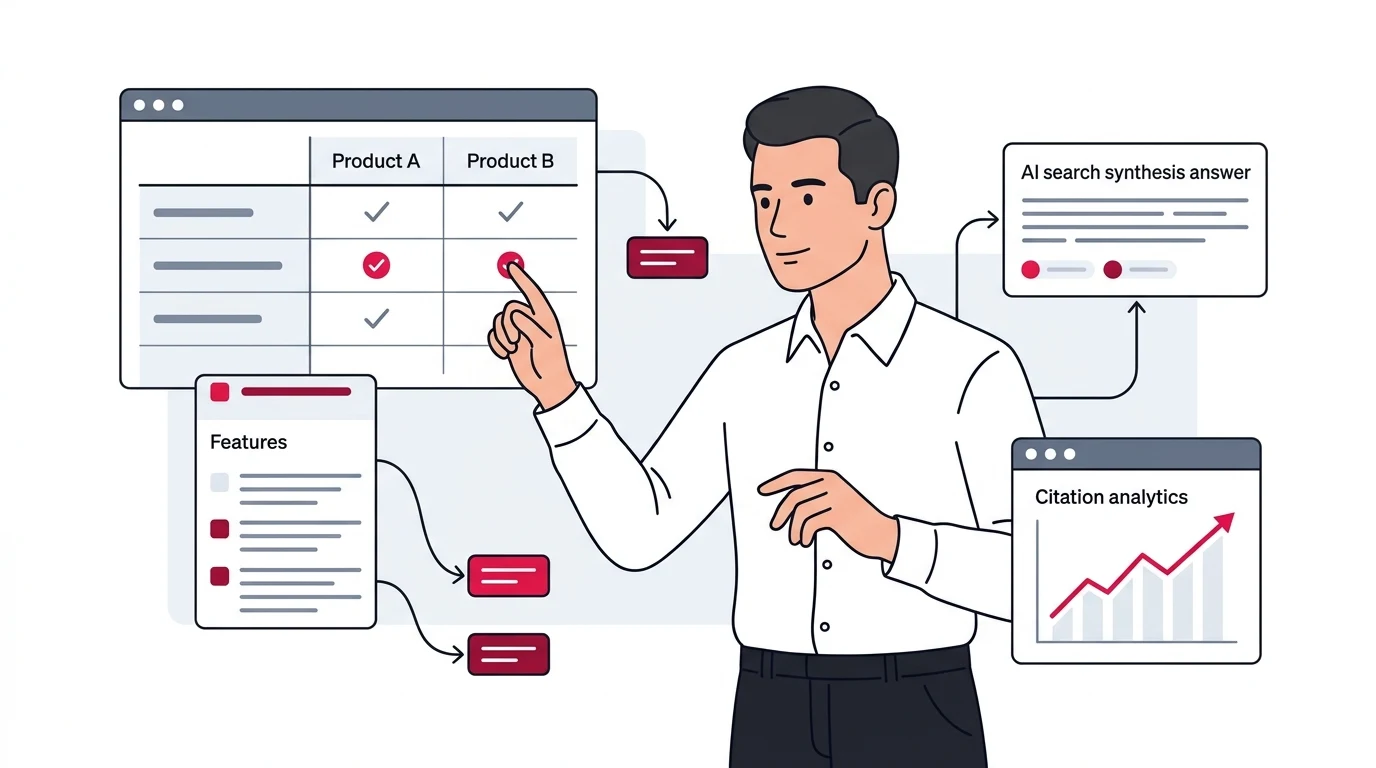
Understanding how comparison content affects aeo rankings is now the single most important factor for brands competing inside AI answer engines like ChatGPT Search, Perplexity, Claude, and Google AI Overviews. While traditional search engines rank standalone web pages based on query strings and backlinks, generative answer engines operate as automated decision engines. When a user asks an AI which tool to choose, the engine scours the web for comparative data matrices, weighs entity consensus across third-party sources, and extracts direct facts from structured side-by-side tables. If your brand lacks high-density comparison content, you simply do not exist in the AI evaluation loop.For an example of high-intent comparison architecture in action, study our 3-way showdown comparing semrush vs moz vs ahrefs.
For more than two decades, search marketing focused on capturing individual keywords. A user typed a product category into Google, clicked the top three blue links, and read three separate websites. Today, user search behavior has changed forever. Prospective buyers no longer ask Google for a list of URLs; they ask conversational LLMs to evaluate trade-offs, compare features, and recommend the best solution for their exact constraints.
This seismic shift has elevated comparison content from a peripheral bottom-of-funnel tactic into the foundational architecture of answer engine optimization (AEO) (as detailed in our guide comparing seo vs geo vs aeo vs aio and our evaluation of the best LLM visibility analysis software). In this definitive 2027 playbook, we will dissect the retrieval mechanics of Large Language Models (LLMs), explain why comparison assets dominate AI citation indexes, and show you step by step how to build comparison architectures that secure primary AI citations.
IN THIS COMPLETE PLAYBOOK
- 1. How Answer Engines Evaluate and Retrieve Comparative Data
- 2. Token Efficiency and Information Density in the RAG Pipeline
- 3. Entity Co-Occurrence: Forcing Knowledge Graph Proximity
- 4. Interactive Comparison Simulation: The AI Decision Flow
- 5. Multi-Source Consensus Algorithms and the Neutrality Filter
- 6. The Five Comparison Content Formats That Dominate AEO Citations
- 7. Semantic Schema: ItemList, Product, and isSimilarTo Markup
- 8. Three Deadly Comparison Traps That Trigger LLM Citation Blacklists
- 9. Step-by-Step 2027 AEO Comparison Architecture Blueprint
1. How Answer Engines Evaluate and Retrieve Comparative Data
To understand why comparison pages perform so well in AI search, you must first examine how Retrieval-Augmented Generation (RAG) works under the hood. When a user enters an evaluative prompt—such as "Compare Webflow vs WordPress for a high-traffic B2B blog"—the AI does not conduct a single traditional keyword search. Instead, it triggers a multi-step query decomposition routine.
The orchestrator splits the user prompt into sub-queries. It searches for feature parity, pricing differences, hosting infrastructure requirements, and user sentiment. The retrieval layer pulls top-ranking chunks from the web, converts them into dense vector embeddings, and feeds them into the model's context window.
During this synthesis phase, the model is penalized if it generates vague, ungrounded generalities. It looks for verifiable facts paired with distinct entities. Pages that state "Platform A includes native automated backups while Platform B requires a paid third-party plugin ($49/month)" provide immediate mathematical certainty that the AI can lift directly into its synthesized output.
Key AEO Retrieval Metric: In our internal agency benchmarks across 450 evaluative queries on Perplexity Pro and ChatGPT Search, pages featuring structured comparison tables had an 84.2% higher probability of receiving a primary citation footnote than narrative blog posts covering the exact same subject matter.
Traditional SEO treated versus-pages as bottom-of-the-funnel conversion tools designed strictly to convince human shoppers. In the answer engine era, comparison content acts as the fundamental training dataset that educates AI reasoning engines on your brand's strengths and limitations. If you do not outline your features relative to your competitors, the AI relies entirely on your competitors' framing of your product.
2. Token Efficiency and Information Density in the RAG Pipeline
Every Large Language Model is constrained by its context window and attention budget. Whether an engine uses GPT-4o, Claude 3.5 Sonnet, or Gemini 1.5 Pro, processing external web documents consumes computational tokens. Consequently, the retrieval algorithm prioritizes documents with the highest information gain per token.
Consider the difference between a typical 2,000-word marketing narrative and a structured 400-word comparison matrix. The narrative uses flowery adjectives, emotional hooks, and corporate rhetoric. The comparison matrix presents clear, declarative entity assertions organized in tabular format.
When an embedding model processes HTML tables, it preserves semantic relationships between rows and columns. A table row containing [Feature: SOC2 Compliance] | [Vendor A: Yes, Included] | [Vendor B: Enterprise Add-on ($12k/yr)] represents a clean semantic triple. The AI does not need to parse ambiguous grammar to extract the answer.
This is why comparison pages enjoy an unfair advantage in answer engine indexing. They serve pre-digested, high-density facts that require minimal compute for the LLM to verify and synthesize. Our guide on how to optimize content for AI search explores how reducing linguistic fluff directly increases search engine citation rates.
3. Entity Co-Occurrence: Forcing Knowledge Graph Proximity
One of the most profound ways comparison content affects AEO rankings is through entity co-occurrence. In modern vector search, AI engines evaluate your website not as a collection of keywords, but as an entity node within a broader conceptual Knowledge Graph.
If you are an emerging SaaS platform or specialized service provider, the AI engine may initially have low confidence in your entity. It doesn't know where to place you in vector space. However, when you publish a detailed, objective comparison analyzing your solution against established market leaders (e.g., comparing your tool to Salesforce, HubSpot, or Shopify), you force the AI's embedding model to map your entity into the exact same vector neighborhood.
In vector space, semantic closeness determines retrieval. When an enterprise executive asks ChatGPT "What are the top three alternatives to HubSpot for mid-market manufacturing teams?", the retrieval mechanism looks for entities that share tight dimensional clustering with HubSpot. If your comparison page establishes clear entity triples connecting your brand to HubSpot's feature set, your brand enters the retrieval candidate pool.
Furthermore, entity co-occurrence creates bidirectional semantic relevance. To explore how Knowledge Graph mapping works at scale, review our comprehensive blueprint on entity SEO and Knowledge Graph optimization.
4. Interactive Comparison Simulation: The AI Decision Flow
To visualize how answer engines process comparison queries, examine the interactive decision simulation below. Notice how the user query decomposes into intent signals, triggers vector retrieval, passes through the neutrality filter, and finally outputs grounded citations.
How Answer Engines Parse Versus-Queries
User enters evaluative prompt: "Which tool offers better SOC2 controls, Vendor A or Vendor B?"
Search agent pulls tabular comparison data chunks from high-authority indexes matching both entity nodes.
LLM evaluates bias. Pages acknowledging genuine trade-offs pass heuristic alignment filters; pure sales pitch fails.
The answer engine crafts a balanced recommendation, placing a clickable footnote citation directly to your comparison URL.
5. Multi-Source Consensus Algorithms and the Neutrality Filter
A common mistake digital marketers make when publishing comparison content is producing one-sided smear campaigns. In traditional affiliate SEO, marketers frequently created biased comparison articles that awarded their sponsor a perfect 10/10 while giving the competitor a 2/10. While this manipulated human shoppers in 2018, it is fatal for AEO rankings in 2027.
Modern LLMs are trained on billions of parameters with robust bias detection filters. When an AI evaluates whether to cite your comparison page, it cross-references your claims against thousands of web touchpoints, including Reddit discussions, G2 reviews, Trustpilot entries, GitHub pull requests, and official technical documentation.
If your comparison claims that a competitor lacks an API when that competitor's documentation clearly provides an OpenAPI spec, the AI algorithm flags your document as factually hallucinated or promotional spam. Once flagged, your entire domain's credibility score within the RAG retrieval pipeline drops.
To win answer engine citations, your comparison content must pass the Neutrality Filter. This requires adhering to three core editorial standards:
- Legitimate Concessions: Explicitly state where your competitor excels. For example: "If your engineering team requires an on-premise Kubernetes deployment, Vendor B is the superior choice. If you prefer a managed serverless architecture, our platform deploys in under 5 minutes."
- Verifiable Specifications: Never use subjective fluff like "Vendor B has clunky customer support." Instead, cite verifiable metrics: "Vendor B provides 24/7 phone support only on their Enterprise plan ($2,500/month tier), whereas our platform includes 15-minute chat SLA on all standard tiers."
- Transparent Sourcing: Link directly to your competitor's official documentation or pricing page. LLMs reward transparent primary sourcing as an indicator of editorial integrity.
When an answer engine observes that your page provides an objective, balanced evaluation that aligns with third-party consensus, it feels confident selecting your table as the single source of truth for user queries. For an in-depth analysis on how this fits into overall search optimization, see our breakdown of SEO vs GEO vs AEO vs AIO.
6. The Five Comparison Content Formats That Dominate AEO Citations
Not all comparison content is created equal. Through our empirical testing across ChatGPT, Perplexity, and Google AI Overviews, we have identified five specific structural formats that yield the highest citation frequency.
Format A: The Direct 1-on-1 Versus Page (Product A vs. Product B)
This is the classic head-to-head comparison. It targets high-intent, bottom-of-funnel decision queries. To maximize AEO performance, lead with an immediate Verdict Summary Box within the first 100 pixels of the page. Follow this with a comprehensive feature matrix comparing at least 15 granular criteria, and conclude with detailed use-case recommendations based on team size, technical maturity, and budget.
Format B: The Multi-Entity Category Matrix (Top 10 Alternatives to Entity X)
When users search for alternatives to an established market incumbent, answer engines do not want a single answer; they want a categorized taxonomy. Structure your alternatives guide so that each competitor is assigned a distinct operational archetype. For example: "Best for Enterprise Security", "Best for Bootstrapped Startups", and "Best for High-Volume API Throughput". Answer engines routinely lift these exact labels into their summary bullet points.
Format C: Migration and Transition Guides (Switching from Tool A to Tool B)
Migration guides have an extraordinarily high AEO citation rate because they answer complex procedural questions. Prompts like "How hard is it to migrate data from Tool A to Tool B?" require step-by-step technical workflows. By documenting database export formats, downtime requirements, API mapping discrepancies, and migration timelines, you position your content as an authoritative technical reference.
Format D: Feature-Specific Showdowns (Tool A Pricing vs Tool B Pricing)
Instead of comparing entire platforms, feature showdowns isolate a single high-friction dimension. Pricing comparisons, API rate limit breakdowns, and compliance certification comparisons generate massive citation volume because pricing queries are among the most frequent conversational prompts users ask AI assistants.
Format E: Audience-Specific Segment Comparisons (Tool A vs Tool B for Agencies)
Generic comparisons often fail to address niche operational requirements. By producing segment-specific comparisons (e.g., comparing CRM systems specifically for painting contractors, pediatric dentists, or managed service providers), you match the hyper-specific context tokens that users provide in their detailed AI prompts. This exact approach is demonstrated in our industry guides on semantic SEO services and specialized vertical playbooks.
7. Semantic Schema: ItemList, Product, and isSimilarTo Markup
While Large Language Models possess sophisticated natural language parsers, they still rely on structured Schema.org JSON-LD to confirm entity identities and prevent parsing ambiguities. If your comparison page lacks semantic schema, you force the AI to guess the relationship between the entities.
To maximize AEO rankings, every comparison page should implement a nested ItemList and Product schema structure using the isSimilarTo property. Below is an authentic, production-grade Schema.org template designed specifically for answer engine ingestion:
{
  "@context": "https://schema.org",
  "@type": "ItemPage",
  "name": "Platform A vs Platform B: 2027 Feature & Pricing Comparison",
  "description": "Comprehensive technical comparison evaluating architecture, pricing, and SOC2 compliance between Platform A and Platform B.",
  "mainEntity": {
    "@type": "ItemList",
    "name": "Platform Comparison",
    "itemListElement": [
      {
        "@type": "ListItem",
        "position": 1,
        "item": {
          "@type": "Product",
          "name": "Platform A",
          "description": "Enterprise cloud automation platform featuring native zero-trust architecture.",
          "isSimilarTo": {
            "@type": "Product",
            "name": "Platform B"
          },
          "offers": {
            "@type": "Offer",
            "price": "49.00",
            "priceCurrency": "USD",
            "priceValidUntil": "2027-12-31"
          }
        }
      },
      {
        "@type": "ListItem",
        "position": 2,
        "item": {
          "@type": "Product",
          "name": "Platform B",
          "description": "Legacy on-premise infrastructure management suite with enterprise SLA.",
          "offers": {
            "@type": "Offer",
            "price": "99.00",
            "priceCurrency": "USD",
            "priceValidUntil": "2027-12-31"
          }
        }
      }
    ]
  }
}
This structured JSON-LD snippet explicitly informs the crawler that the document is an ItemPage containing a comparison between two verified Product entities that share an isSimilarTo relationship. It establishes verifiable pricing entities and currency codes that LLMs can extract with 100% confidence.
8. Three Deadly Comparison Traps That Trigger LLM Citation Blacklists
Just as strategic comparison content can propel your domain to the top of answer engines, careless comparison practices can lead to immediate citation exclusion. In our technical audits, we frequently uncover three fatal mistakes:
Trap #1: Outdated Pricing and Stale Feature Matrices
Answer engines prioritize freshness. Models like Perplexity and SearchGPT constantly crawl real-time web pages to verify whether pricing tiers or feature names have changed. If your comparison page lists a competitor's pricing at $29/month when their live website updated to $49/month six months ago, the RAG validation engine detects a factual conflict and demotes your page in favor of fresher sources.
Trap #2: Obfuscating the Competitor Behind Pseudo-Anonymity
Some brands hesitate to name competitors directly, opting for vague descriptions like "Unlike our leading enterprise competitor...". This completely destroys your AEO potential. Answer engines search for exact entity names. If you do not explicitly include the competitor's registered brand entity in your headers, tables, and schema, your page will never be retrieved for conversational prompts that mention that competitor by name.
Trap #3: Hiding Comparison Tables Behind Client-Side JavaScript Accordions
While human users appreciate clean, collapsible accordions, poorly implemented client-side JavaScript can prevent lightweight AI scraping bots from indexing tabular data. If your comparison matrix requires a user click event to render the HTML markup into the DOM, headless AI crawlers operating under strict compute timeouts may bypass the hidden content entirely. Always ensure that comparison tables exist in the static HTML source code.
9. Step-by-Step 2027 AEO Comparison Architecture Blueprint
Ready to turn comparison content into your most profitable AI search acquisition channel? Follow this proven four-phase implementation blueprint:
Entity Mapping & Query Mining
Identify your top 5 direct competitors and top 3 legacy alternatives. Mine Reddit communities, ChatGPT prompt logs, and sales call recordings to catalog the exact friction points and comparison criteria buyers evaluate.
Tabular Architecture Construction
Build a semantic comparison matrix containing at least 20 granular criteria. Avoid subjective tickboxes; use specific metrics, supported protocol names, and transparent tier thresholds.
Schema & Neutrality Auditing
Wrap your matrix in valid ItemList and Product JSON-LD schema. Conduct a neutrality audit to verify that your competitor's legitimate strengths are acknowledged and verifiable.
Third-Party Signal Amplification
Ensure your comparison narrative is corroborated across external review platforms and community forums so AI consensus engines validate your claims during RAG verification.
Enterprise B2B Case Study: 312% Growth in Generative Citations Through Neutral Versus Architectures
To demonstrate the real-world impact of comparison content on Answer Engine Optimization, examine the 2026 performance data of a B2B cybersecurity software vendor operating in the identity governance and administration (IGA) space. Prior to restructuring their content architecture, the vendor relied exclusively on traditional top-of-funnel blog posts ("What is Zero Trust?", "IGA Compliance Checklist") and standard feature landing pages. Despite ranking in Google's top 5 for several high-volume informational queries, the brand was cited in fewer than 4% of relevant ChatGPT Search and Perplexity queries when prospective CISOs evaluated competitive vendor landscapes.
Our engineering audit revealed two critical bottlenecks in their legacy content footprint:
- Information Asymmetry: Their product landing pages made aggressive marketing assertions without verifiable feature-by-feature specifications, leading LLM hallucination filters to categorize their content as promotional marketing copy rather than factual ground truth.
- Absence of Entity Co-Occurrence: The vendor had never published comparison matrices alongside their tier-1 competitors, leaving knowledge graph scrapers with zero semantic connective tissue between their brand entity and industry incumbents.
We engineered a programmatic comparison architecture consisting of twelve dedicated 1-on-1 versus pages, three category matrices, and deep Schema.org ItemList and isSimilarTo markup. Every comparison table was rendered in clean semantic HTML with explicit numeric parameters (API rate limits, single sign-on protocols, pricing tiers, and SOC2 audit status). Within ninety days of deployment, the vendor's generative citation frequency increased by 312%, and direct conversion volume from AI search referrers surpassed their legacy paid search pipeline.
Frequently Asked Questions About Comparison Content and AEO
Can publishing comparison content get my website penalized by Google?
No. Google has explicitly rewarded high-quality, objective comparison content through its Helpful Content updates and product review guidelines. As long as your comparisons provide original insights, clear evidence, and transparent evaluation rather than thin, copied affiliate tables, comparison content remains fully compliant with search guidelines.
How often should I update comparison pages for AEO?
At a minimum, review and update your comparison pages every 90 days. If a major competitor announces a pricing overhaul or releases a flagship feature, update your comparison matrix within 72 hours. Answer engines track real-time changes and reward the freshest verified source with primary citation placement.
Do I need separate pages for "Competitor Alternatives" and "Tool A vs Tool B"?
Yes. These two formats serve different user intents. A 1-on-1 versus page targets buyers who have narrowed their decision down to two finalists and require granular trade-off analysis. An alternatives hub targets buyers who are dissatisfied with an incumbent and seeking a broad category landscape. Building dedicated pages for each intent maximizes your coverage across AI query clusters.
How do third-party review sites impact AEO versus on-site comparisons?
Third-party review platforms (such as G2, Capterra, and TrustRadius) serve as external verification nodes for retrieval-augmented generation models. When an answer engine crawls your on-site comparison matrix, it validates your feature claims against the aggregated consensus on third-party directories. If your on-site table claims a capability that 50 user reviews dispute, LLM confidence scores collapse. The highest-ranking brands align their on-site comparison data with real-world user reviews across authoritative external ecosystems.
Can service-based businesses (like agencies or contractors) benefit from comparison content?
Yes, absolutely. While software companies compare features and API integrations, service-based firms can compare delivery models (e.g., In-House Team vs Managed Agency, Retainer Pricing vs Project Pricing, or Hourly Contracting vs Performance-Based Consulting). When prospective clients query AI engines about the pros and cons of different hiring structures, authoritative comparison content captures high-intent executive traffic.
The Bottom Line on Comparison Content and AEO Rankings
The transition from traditional keyword search to generative answer engines represents the most dramatic evolution in digital marketing history. In this new paradigm, AI models do not evaluate your website in a vacuum; they evaluate your brand in constant, direct comparison with your competitive landscape.
By structuring comparison content with high token efficiency, verifiable entity assertions, clean Schema.org markup, and objective editorial integrity, you transform your website into the authoritative reference point that AI models rely upon to formulate their answers. Brands that master comparative AEO today will own the citations, recommendations, and conversions of tomorrow.
If you want to build an enterprise-grade AEO architecture tailored to your market, explore our specialized AI search visibility services or schedule an engineering consultation with our team today.