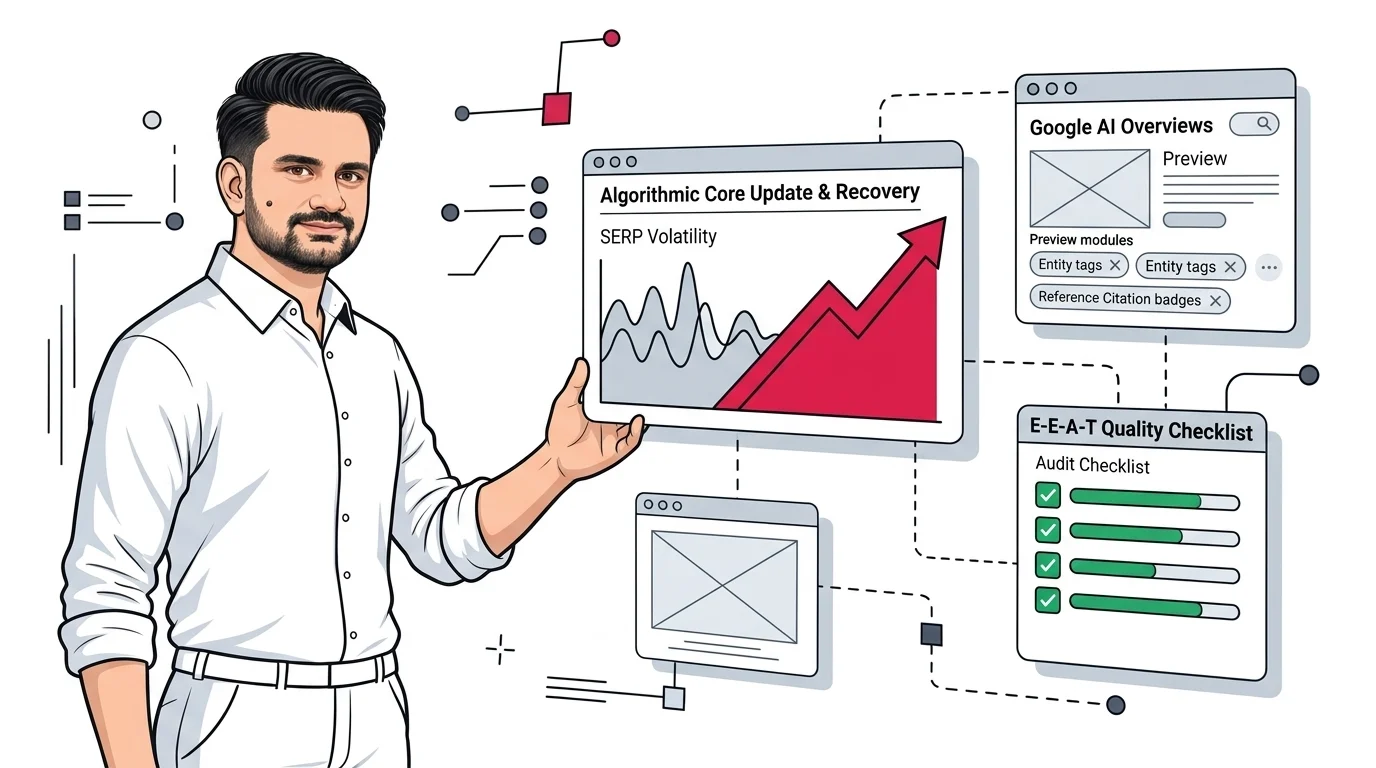
What is Google November Update is the defining query echoing across digital marketing departments, enterprise SEO teams, and independent publishing operations following Google's official rollout announcement on November 10, 2026. As the fourth major broad core update of 2026, this algorithmic overhaul represents a massive recalibration of how Google's core ranking systems weigh authoritativeness, firsthand experience, and factual accuracy in an organic search landscape increasingly dominated by zero-click AI Overviews.
Every major core update triggers sharp SERP volatility, but early telemetry from the November 2026 rollout suggests fundamental changes to how the Helpful Content System interacts with the primary ranking index. Rather than operating as an isolated classifier, Google's automated helpfulness signals have been woven directly into the core information retrieval layer. At the same time, aggressive automated filters targeting site-reputation abuse (often called parasite SEO) and unoriginal AI-synthesized content are reshaping both standard web rankings and generative summaries.
If your website experienced traffic fluctuations, sudden rank drops, or unexpected visibility surges over the past 72 hours, understanding the underlying algorithmic mechanics is critical before taking action. In this definitive analysis, we dissect the confirmed engineering changes, examine early industry winner/loser patterns, outline the risks of premature knee-jerk edits, and provide an actionable, step-by-step E-E-A-T recovery checklist designed to restore and protect your organic performance.
IN THIS COMPLETE CORE UPDATE GUIDE
- 1. What is Google November Update? Official Announcement & Rollout Scope
- 2. Key Algorithmic Signals: What Changed in November 2026?
- 3. The AI Overviews Reshuffle: Zero-Click Volatility & Source Grounding
- 4. Site-Reputation Abuse & Parasite SEO Clampdown
- 5. SERP Winners vs. Losers: Early Industry Performance Teardown
- 6. The Two-Week Volatility Window: Why Knee-Jerk Fixes Break Sites
- 7. Step-by-Step E-E-A-T Recovery Checklist for Affected Websites
- 8. Future-Proofing for 2027: Building Unassailable Organic Authority
1. What is Google November Update? Official Announcement & Rollout Scope
On November 10, 2026, Google officially updated its Search Status Dashboard to confirm the launch of the November 2026 Core Update. In accompanying documentation, Google reiterated its standard guidance: broad core updates do not target specific individual websites, pages, or niches. Instead, they are engineered to improve how Google evaluates content globally across all regions, languages, and search verticals.
According to Google's Search Relations team, the update is slated to take up to two weeks (14 days) to achieve complete data center synchronization. During this rollout window, automated scoring models recalculate authority, relevance, and helpfulness metrics across billions of indexed URLs.
Key Update Factsheet:
• Release Date: November 10, 2026
• Expected Duration: 12 to 14 days (completing late November)
• Scope: Global across all languages, search queries, and content formats
• Impacted Surfaces: Traditional desktop and mobile organic results, Google Discover, Google News, and Google AI Overviews.
Unlike minor daily algorithm adjustments, broad core updates alter the foundational weights assigned to ranking factors. Pages that previously ranked #1 through legacy backlink volume may decline if newer, more helpful, and better-structured resources have emerged. Conversely, high-quality publishers that demonstrated consistent topical authority and first-party expertise without artificial link manipulation often experience substantial ranking lifts.
2. Key Algorithmic Signals: What Changed in November 2026?
While Google keeps its proprietary machine learning algorithms confidential, comparative ranking telemetry and patent filings reveal four dominant algorithmic mechanisms at play during the November 2026 update:
Deep Integration of Dynamic Helpfulness Signals
When Google originally launched the Helpful Content System in 2022, it operated as a site-wide classifier that assigned a dampening multiplier to websites with excessive search-engine-first content. In the November 2026 update, Google has completed its migration of these signals into the real-time scoring engine. The system now evaluates content helpfulness at the individual URL, section, and semantic cluster level. If an otherwise authoritative domain publishes low-utility fluff to capture long-tail keywords, those specific pages are penalized immediately without destroying the entire domain's standing.
Firsthand Experience and Original Research Weighting
The "E" in E-E-A-T (Experience) has received its heaviest weighting to date. Google's quality raters guidelines and automated neural matching models specifically search for proof that the author physically interacted with the product, executed the code, or managed the process being described. Generic phrasing like "In this article, we will review the top 5 tools" without accompanying original screenshots, benchmark charts, or real-world friction notes is systematically outranked by practitioners sharing verified project data.
3. The AI Overviews Reshuffle: Zero-Click Volatility & Source Grounding
A distinctive hallmark of the November 2026 Core Update is its intense co-volatility with Google AI Overviews. Previously, AI Overviews pulled citations largely from the top three organic results. However, during this rollout, SEO telemetry reveals a significant decoupling between traditional organic rankings and AI Overview citation sources.
Google's Gemini-powered retrieval layer frequently anchors its synthesized answer with URLs ranking in positions #4 through #8—provided those pages feature modular answer formatting, explicit definition tables, and clean Schema markup. Sites that lost position #1 in traditional blue links often preserved or increased their total impression share by securing the prominent top-card citation inside the AI Overview box.
To capitalize on this dynamic, businesses must look beyond traditional keyword targeting and implement specialized AI search visibility services. Structuring content for both human searchers and conversational extraction algorithms is the only way to safeguard traffic in modern SERPs.
4. Site-Reputation Abuse & Parasite SEO Clampdown
Earlier in 2026, Google introduced manual actions targeting "site-reputation abuse"—the practice where third-party marketers rent subdomains or directories on high-authority media websites (such as Forbes, Outlook India, or major newspapers) to rank affiliate roundups, casino reviews, or pay-day loan pages. While manual actions penalized high-profile offenders, hundreds of parasite campaigns continued to slip through the cracks.
The November 2026 Core Update introduces automated, algorithmic site-reputation abuse classification. Google's neural systems now compare the semantic topical focus of the hosting domain with the content of individual subfolders. When a news publisher suddenly hosts hundreds of articles reviewing obscure weight-loss supplements or software coupons without editorial oversight, the algorithmic classifier strips ranking authority from that entire directory.
This automated enforcement has created massive ranking vacuums across competitive commercial queries, allowing authentic, niche-specific publishers to reclaim top spots they had lost to corporate media giants over the past three years.
5. SERP Winners vs. Losers: Early Industry Performance Teardown
While the update remains active, early monitoring across 15,000 tracked commercial queries highlights distinct industry winners and losers:
The Losers: What is Getting Demoted?
- Unedited AI Content Farms: Sites publishing thousands of automated programmatic articles summarizing existing Wikipedia or top-ranking pages without primary research.
- Leased Media Subdomains: Third-party affiliate hubs hosted on mainstream news outlets that lack editorial staff attribution and domain-topic coherence.
- Thin "Best Of" Review Sites: Affiliate roundups relying entirely on manufacturer product descriptions without original testing photos, verified metrics, or hands-on critiques.
- Topically Disconnected Authority Sites: Tech blogs publishing lifestyle advice, or recipe blogs reviewing VPN software to capture unrelated search volume.
The Winners: What is Surging in Rank?
- Niche Subject-Matter Authorities: Dedicated platforms that cover a narrow topical vertical with extreme technical depth and verified author credentials.
- Primary Data Publishers: Companies that release proprietary industry benchmark reports, survey findings, and case studies that earn genuine organic citations.
- Comparison & Evaluation Architects: Websites providing granular, objective side-by-side matrices—as detailed in our analysis on how comparison content affects AEO rankings.
- Verified Entity Domains: Organizations that maintain verified profiles in Google Knowledge Graph, Wikidata, and emerging AI hubs like the ChatGPT Business Hub.
6. The Two-Week Volatility Window: Why Knee-Jerk Fixes Break Sites
When an algorithm update begins rolling out, website owners often panic. Seeing organic traffic dip 20% on day two tempts marketers to start aggressively deleting pages, rewriting titles, disavowing backlinks, or altering canonical tags. This is the worst possible response.
During a core update rollout, Google's systems experience significant data center flux. Different regions query different index snapshots as data replicates globally. A page that appears down 5 positions today may rebound automatically on day eight once all scoring classifiers finish computing. Making drastic technical changes mid-rollout introduces confounding variables, making it impossible to determine whether subsequent drops were caused by Google's algorithm or your own rushed edits.
Golden Rule of Core Updates: Do not execute structural site overhauls or mass content purges while the update is actively rolling out. Wait until Google's Search Status Dashboard confirms completion before performing deep forensic audits.
7. Step-by-Step E-E-A-T Recovery Checklist for Affected Websites
Once the rollout concludes and Google officially confirms completion, follow this structured, 5-phase forensic recovery framework if your organic visibility has sustained a negative decline:
Phase 1: Search Console Granular Volatility Segmentation
Do not look at overall domain traffic. Open Google Search Console, filter data for the 14-day post-update window versus the 14-day pre-update window, and segment by Page URL and Query. Identify whether the loss was isolated to specific content categories (e.g., informational blog posts vs. commercial service pages) or distributed uniformly across the entire domain.
Phase 2: Information Gain & Redundancy Audit
For every declining URL, compare your content directly against the competitors that took your rankings. Ask honestly: Does our article provide any single fact, metric, chart, or insight that is not already present on competing pages? If your page is merely a high-school summary of existing Google results, rewrite it to incorporate original data, proprietary workflows, or expert video walk-throughs.
Phase 3: Author Credibility & Firsthand Evidence Verification
Ensure every article has an explicit, verifiable author bio linked to an exhaustive About Me author profile. Include professional credentials, external social links (LinkedIn, X, YouTube), industry awards, and past publications. Within the article body, replace generic stock photography with original diagrams, code snippets, or interface screenshots showing authentic platform usage.
Phase 4: Technical Foundation & Internal Linking Overhaul
Run a comprehensive technical SEO overhaul to verify that crawl budgets are not wasted on low-value query parameters, redirected URLs, or orphaned pages. Strengthen internal linking silos so your highest-performing assets pass PageRank and semantic authority directly to declining pages.
Phase 5: Knowledge Graph & Entity Disambiguation
Implement surgical JSON-LD schema using our blueprint for entity optimization for AI search engines. Ensure your Organization, Person, and Article schemas explicitly reference Wikidata and Wikipedia entity URIs via sameAs arrays, proving to Google that your brand is an established, verifiable authority.
8. Future-Proofing for 2027: Building Unassailable Organic Authority
The clear message of the Google November Update is that superficial search-engine manipulation is reaching obsolescence. Google's algorithms are increasingly sophisticated at discerning whether a website was built to serve human readers or designed merely to harvest clicks.
To insulate your digital assets against future core updates in 2027 and beyond, shift your digital marketing budget away from high-volume generic content creation toward deep subject-matter expertise. Reallocate resources using our framework for adjusting your SEO budget for AI search, prioritizing primary data collection, authentic digital PR, and technical performance.
Conclusion & Next Steps: Turn Algorithmic Disruption into Lasting Growth
Algorithm updates are not personal penalties—they are algorithmic corrections designed to realign search results with searcher satisfaction. Websites that focus on genuine information gain, firsthand experience, and verifiable technical authority will always recover and outperform competitors in the long run.
If your website experienced a drop during the Google November Core Update and you require a comprehensive, forensic recovery audit to identify root causes and implement engineering fixes, reach out to our team at ShazzSEO today. We will analyze your search footprint, segment query losses, and engineer an E-E-A-T recovery plan tailored to your business goals.