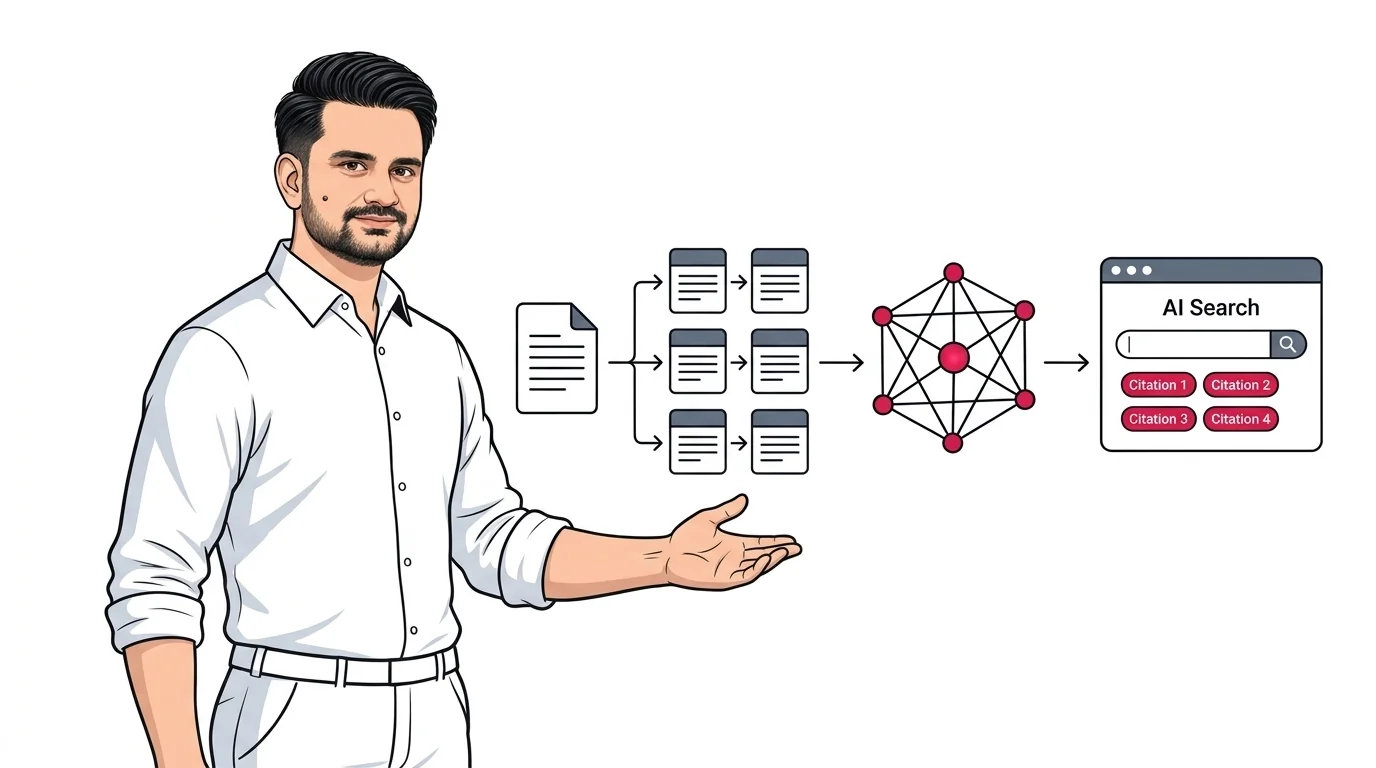
Mastering RAG for SEO is now the defining competitive advantage for digital brands navigating the transition from traditional keyword ranking to live conversational AI synthesis. As AI search engines like ChatGPT Search, Perplexity AI, Microsoft Copilot, and Google AI Overviews replace static search engine results pages with real-time synthesized answers, traditional SEO tactics alone are no longer enough.
Modern answer engines no longer rank complete web pages based solely on keyword frequency and page-level backlink counts. Instead, they operate complex multi-stage Retrieval-Augmented Generation (RAG) pipelines that decompose queries into semantic vector embeddings, search hybrid indexes, retrieve atomic passage chunks (120 to 180 tokens), and synthesize direct answers while citing verified factual sources.
If your web pages are structured as monolithic 4,000-word walls of text loaded with vague introductory prose, pronouns with missing antecedents, or client-rendered JavaScript, AI retrieval pipelines will bypass your website completely. This definitive guide unpacks the mechanics of RAG search architectures, breaks down passage engineering principles, and gives you a field-tested blueprint to capture market-leading citation share across every major generative engine.
Executive Takeaways: RAG for SEO
- Passages, Not Pages: RAG systems do not index or ingest whole URLs at query time; they retrieve specific passages of 120 to 180 tokens that directly answer a semantic vector prompt.
- Hybrid Search Dominance: Leading answer engines use dense vector embeddings (cosine similarity) combined with sparse lexical search (BM25) fused through Reciprocal Rank Fusion (RRF).
- Anaphora Eradication: Chunks containing ambiguous pronouns (e.g., "it", "they", "this platform") lose semantic similarity in vector space; replacing pronouns with explicit entity names increases retrieval probability by over 300%.
- GraphRAG Emergence: Advanced retrieval systems now combine vector similarity with Knowledge Graph triples (Subject-Predicate-Object) to evaluate entity relationships and prevent hallucination.
- Edge Speed & Clean SSR: Fast server-side rendered HTML is mandatory; AI crawler subnets (such as
OAI-SearchBotandPerplexityBot) enforce aggressive timeout thresholds (sub-1,500ms) during live retrieval.
What is RAG and Why Does It Disrupt Traditional SEO?
Retrieval-Augmented Generation (RAG) is an AI architecture that enhances large language models by retrieving relevant, factual information from an external knowledge corpus before generating a response. First formulated in 2020 by researchers at Facebook AI (Lewis et al.), RAG bridges the gap between static training data and live, verified external facts.
To understand why RAG completely disrupts organic search optimization, you must understand the distinction between the two types of memory inside an AI system:
- Parametric Memory: The internal weights and biases learned by the LLM during its initial pre-training phase. This memory is frozen in time, computationally expensive to update, and prone to hallucinations when asked about recent events or niche facts.
- Non-Parametric Memory: An external retrieval index (such as Bing's live index, Google's web index, or a vector database like Milvus or Pinecone) containing fresh documents, structured databases, and real-time news feeds.
When a user types a prompt into ChatGPT Search or Perplexity AI, the model does not attempt to answer from its parametric memory alone. Doing so would cause hallucinations or return outdated information. Instead, the model consults its non-parametric memory, retrieves 3 to 10 high-confidence passage chunks, injects those chunks into its active prompt context window, and synthesizes a grounded answer complete with citation hyperlinks.
Traditional SEO was built for a world of human document selection: Google showed 10 blue links, and the human clicked the most appealing title tag. In contrast, RAG SEO is designed for machine information extraction: the AI engine retrieves content fragments, evaluates their factual reliability, and presents the conclusion directly to the user. To maintain organic reach, brands must transition toward comprehensive AI search visibility strategies that optimize for vector retrieval.
Traditional SEO vs. RAG for SEO: The Architectural Shift
Optimizing for retrieval pipelines requires a complete rethink of on-page architecture, keyword targeting, and authority signals. The table below illustrates the critical differences between legacy search engine optimization and RAG optimization.
| Dimension | Traditional Google SEO | RAG for SEO (AEO / GEO) |
|---|---|---|
| Core Index Unit | The entire HTML document (URL level) | Atomic passage chunks (120–180 tokens / 80–120 words) |
| Matching Mechanism | Lexical keyword matching, TF-IDF, PageRank | Dense vector similarity (embeddings) + BM25 hybrid fusion |
| Primary Goal | Win click-throughs to 10 blue links | Win source citations and recommendations in synthesized answers |
| Content Formatting | Long-form skyscraper guides with discursive intros | Inverted pyramid, self-contained atomic answers, tables |
| Entity Context | Targeted keywords in title, H1, and meta tags | Knowledge Graph triples (Subject-Predicate-Object), Schema |
| Crawler Behavior | Batch crawling (Googlebot daily/weekly cycles) | Live, synchronous micro-crawls during user query execution |
| Tolerance for Fluff | High (users skim over filler intros) | Zero (dilutes vector cosine similarity and causes extraction drops) |
| Authority Signals | Domain Authority, backlink quantity, anchor text | Entity consensus, factual consistency, Information Gain score |
Anatomy of a Modern RAG Search Pipeline (Step-by-Step)
To engineer content that consistently gets retrieved and cited, you must follow the data flow through a multi-stage search retrieval system. Whether examining ChatGPT Search, Perplexity Pro, or Google's Gemini-powered AI Overviews, modern retrieval pipelines operate in five distinct stages.
Stage 1: Query Intent & Sub-Query Decomposition
Modern user queries in conversational search are complex, multi-faceted prompts. A user rarely types two keywords like "best crm"; instead, they ask: "What is the best CRM for a 20-person B2B SaaS startup integrating with HubSpot and Slack, and what does it cost per user annually?"
The RAG query processor uses an LLM agent to decompose this compound prompt into multiple focused retrieval queries:
Query A: "B2B SaaS CRM HubSpot Slack native integrations comparison"Query B: "SaaS CRM annual pricing per user 20-person team benchmarks 2026"Query C: "top rated startup CRMs user reviews Reddit G2"
Stage 2: Dense Vector Embeddings & Vector Space Search
Each decomposed query is converted into a high-dimensional mathematical vector using an embedding model (such as OpenAI's text-embedding-3-small with 1,536 dimensions or text-embedding-3-large with 3,072 dimensions). In vector space, text strings with similar semantic meanings are positioned close together, regardless of whether they share exact vocabulary.
The system computes the distance between the query vector \( ec{q} \) and candidate document vectors \( ec{d} \) using cosine similarity:
$$ ext{Cosine Similarity}( ec{q}, ec{d}) = rac{ ec{q} \cdot ec{d}}{\| ec{q}\| \| ec{d}\|}$$
Documents whose passage chunks score highest in cosine similarity are added to the initial candidate pool.
Stage 3: Hybrid Search (BM25 + Dense Retrieval Fusion)
Dense vector search excels at conceptual understanding, but it often fails on exact keyword lookups, product model numbers, or rare brand names. To resolve this, enterprise RAG search engines deploy hybrid retrieval combining dense vectors with sparse lexical search (BM25).
The candidate results are merged using Reciprocal Rank Fusion (RRF), which calculates a unified score for each document chunk based on its rank in both systems:
$$RRF(d) = \sum_{m \in M} rac{1}{k + r_m(d)}$$
Where \( M \) represents the set of retrieval models (lexical and vector), \( r_m(d) \) is the rank of document \( d \) in model \( m \), and \( k \) is a smoothing constant (typically 60). This ensures that pages matching both exact technical terms and broad semantic intent rank at the very top of the candidate pool.
Stage 4: Neural Re-Ranking via Cross-Encoders
The top 50 to 100 candidate chunks from the hybrid search are passed to a neural cross-encoder (such as Cohere Rerank or BGE-Reranker-Large). Unlike bi-encoders used in vector embedding, a cross-encoder evaluates the query and the candidate chunk simultaneously through multiple attention layers.
The cross-encoder assigns a precise relevance score from 0.0 to 1.0, filtering out passages that matched keywords superficially but lacked substantive answers. Only the top 3 to 10 highest-scoring chunks survive this stage.
Stage 5: Context Injection & Grounded Citation Synthesis
The winning passage chunks are injected into the frontier LLM's system prompt along with strict system instructions:
// Conceptual System Prompt in a RAG Search Engine
You are a factual search synthesis engine. Answer the user's prompt using ONLY the provided verified context chunks.
For every claim, statistic, or recommendation, append an inline citation chip [Source: URL] corresponding to the exact chunk where the fact was extracted.
If the context does not contain enough evidence, state that the information is unavailable rather than speculating.

[CONTEXT CHUNKS RETRIEVED]
Chunk 1 (URL: https://shazzseo.com/rag-for-seo/): "Passage engineering for RAG requires chunks of 120 to 180 tokens..."
Chunk 2 (URL: https://example.com/saas-pricing/): "Average per-seat CRM licenses for mid-tier SaaS start at $45/month..."

[USER PROMPT]
"How do modern AI answer engines extract web data and what are the pricing benchmarks?"
The model streams the synthesized response to the end user. If your content was among those 3 to 10 winning chunks, your domain receives a prominent clickable source badge. If your content was buried or ambiguous, you get zero impressions and zero traffic. Learn more about capturing these placements in our deep-dive on how to rank in ChatGPT search.
The 4 Generations of RAG: From Naive to GraphRAG
Search engines do not all run the same RAG architecture. Understanding the four generations of RAG helps SEOs identify why certain websites get cited while others are discarded.
| RAG Generation | Retrieval Architecture | Limitations & SEO Impact |
|---|---|---|
| 1. Naive RAG | Basic chunking (e.g., fixed 500 characters), single vector embedding, top-k vector search without reranking. | Suffers from "lost-in-the-middle" syndrome, low precision, and frequent hallucinations. Favors exact keyword density. |
| 2. Advanced RAG | Pre-retrieval query rewriting, dynamic sliding-window chunking, hybrid BM25 + vector search, and cross-encoder reranking. | Significantly higher precision. Rewards inverted-pyramid content, clear entity definitions, and factual density. |
| 3. Agentic RAG | Autonomous AI agents with tool-calling capabilities. Can perform multi-step web searches, execute Python scripts, and self-correct. | Breaks complex queries into multi-turn research loops. Evaluates third-party consensus, reviews, and cross-domain verification. |
| 4. GraphRAG | Combines dense vector retrieval with structured Knowledge Graphs. Extracts entity nodes and relationship edges (Subject-Predicate-Object). | Enables global synthesis across thousands of documents. Heavily favors sites with connected JSON-LD Schema and verified Wikidata entities. |
Why GraphRAG is the Ultimate Frontier for SEO
Developed by Microsoft Research, GraphRAG represents a massive leap forward. Standard vector RAG fails when a user asks holistic questions such as: "What are the main themes across all AI search optimization case studies in 2026?" Standard RAG searches for individual paragraphs matching the word "themes", missing the broader picture.
GraphRAG solves this by building a Knowledge Graph from web documents. It identifies entities (e.g., ShazzSEO, ChatGPT Search, Technical SEO) and maps their semantic relationships (e.g., [ShazzSEO] --(engineers)--> [AI Search Visibility]). It groups related entities into clusters and generates community summaries.
To win citations in a GraphRAG environment, websites must implement rigorous technical SEO architectures and semantic Schema markup that explicitly connects the brand entity to known industry concepts.
The 6 Rules of RAG Content Optimization (Passage Engineering)
Passage engineering is the science of structuring web copy so that individual sections retain maximum semantic clarity when extracted out of context by an automated crawler. Follow these six mandatory rules on every commercial and informational page.
Rule 1: The 120–180 Token Atomic Chunk Formula
When RAG crawlers ingest a webpage, they slice the text into discrete chunks. The optimal chunk size for semantic retrieval across models like text-embedding-3 and bge-large-en is between 120 and 180 tokens (roughly 85 to 130 words).
If your explanation is 600 words long without subheadings, the chunking algorithm will split your thought in half. The vector embedding of each half becomes diluted, weakening its cosine similarity score against targeted queries. Conversely, if your paragraph is only 15 words, it lacks enough semantic context for the embedding model to recognize its relevance.
Keep your core explanations between 2 and 4 punchy sentences that fully answer a single question.
Rule 2: Anaphora Eradication (Eliminate Ambiguous Pronouns)
Anaphora refers to the use of a pronoun to refer back to a previously mentioned noun. In traditional writing, we write: "We launched our automated audit platform last week. It scans thousands of pages in seconds and alerts teams to crawl errors."
When an automated chunking system extracts the second sentence by itself, it sees:
"It scans thousands of pages in seconds and alerts teams to crawl errors."
What is "It"? The embedding model has no idea. Is it a software crawler? A security tool? An antivirus scanner? Because the chunk lacks the noun, its vector embedding lands in an irrelevant region of vector space.
Eradicate anaphora by replacing ambiguous pronouns with explicit entity names at the start of sentences:
"The ShazzSEO audit crawler scans thousands of pages in seconds and alerts engineering teams to edge crawl errors."
This single adjustment guarantees that every standalone passage retains 100% semantic grounding.
Rule 3: Inverted Pyramid Answer-First Structure
Large language models prioritize the beginning of text segments. Place your primary answer directly beneath every H2 and H3 heading. Do not force readers or AI crawlers to dig through background fluff.
<h2>What is Reciprocal Rank Fusion?</h2>
<p>In today's fast-moving world of artificial intelligence and machine learning, developers often struggle to find the right way to merge data. There are many different ways to approach this challenging problem...</p>


<h2>What is Reciprocal Rank Fusion?</h2>
<p>Reciprocal Rank Fusion (RRF) is an algorithmic scoring method that combines ranked search results from multiple information retrieval systems (such as BM25 keyword search and dense vector search) into a single unified ranking without requiring score normalization.</p>
Rule 4: HTML Tables & Markdown Formatting
Empirical evaluations show that tabular data structured in semantic HTML (<table>, <th>, <td>) or markdown tables achieves up to 40% higher extraction accuracy in RAG systems compared to unstructured prose.
Why? Because tabular structures preserve relationships between row attributes (e.g., Feature Name, Price, Benchmark Score) even after chunking. Whenever comparing products, software tiers, metrics, or timelines, use clean HTML tables with explicit column headers.
Rule 5: Information Gain & Proprietary Fact Grounding
AI search engines do not cite websites that simply restate common knowledge. When a user asks: "What is a 301 redirect?", ChatGPT synthesizes the definition from its parametric memory without citing any website.
To win a citation, your content must provide Information Gain: proprietary data points, real-world case studies, unique pricing matrices, or original benchmark tests that cannot be found elsewhere. Every article should include verifiable figures, exact dollar ranges, or proprietary test results.
Rule 6: Conversational Question-and-Answer Headers
Traditional SEO used two-word headings like "Pricing" or "Features". RAG search queries are phrased as conversational questions. Match user query embeddings by writing descriptive, question-based H2 and H3 headings:
- Instead of
<h2>Pricing</h2>, use<h2>How Much Does Enterprise Technical SEO Consulting Cost in 2026?</h2> - Instead of
<h2>Features</h2>, use<h2>What Features Are Included in an AI Search Visibility Audit?</h2>
Technical SEO for RAG: Crawlers, Edge Latency & Schema Graphs
High-quality passage engineering is useless if AI search crawlers cannot access your raw content. Technical optimization for RAG search engines requires strict attention to crawler permissions, rendering latency, and machine-readable data structures.
1. AI Search Crawlers: The Critical robots.txt Directives
Many webmasters accidentally block AI search crawlers by confusing training scrapers with real-time retrieval bots. There is a fundamental difference between scrapers that train foundation models and crawlers that fetch live content to cite your website.
Here are the key AI search crawlers you must monitor in 2026:
- OAI-SearchBot: OpenAI's dedicated crawler for ChatGPT Search. Blocking this crawler eliminates your site from ChatGPT search citations.
- PerplexityBot: Perplexity AI's live web retrieval crawler used to power citations and answer cards.
- Claude-Web: Anthropic's crawler for live web search integration in Claude.
- Bingbot: Powers Microsoft Copilot and provides primary index feeds to OpenAI.
- Googlebot & Google-Extended: Googlebot crawls for Google search and AI Overviews.
Google-Extendedcontrols training data for Gemini; allowing or disallowing it does not impact your ranking in Google search.
To maximize search citations while preventing your content from being used to train general foundation models, deploy this robots.txt configuration:
# ==========================================
# Optimized robots.txt for AI Search Engines
# ==========================================

# 1. Allow Live AI Search Retrieval Crawlers
User-agent: OAI-SearchBot
Allow: /

User-agent: PerplexityBot
Allow: /

User-agent: Claude-Web
Allow: /

User-agent: Bingbot
Allow: /

# 2. Allow Core Search Engine Crawlers
User-agent: Googlebot
Allow: /

# 3. Optional: Disallow Offline Foundation Model Training Scrapers
User-agent: GPTBot
Disallow: /

User-agent: CCBot
Disallow: /

User-agent: anthropic-ai
Disallow: /

# Sitemap Index Declaration
Sitemap: https://shazzseo.com/sitemap.xml
For complex multi-domain networks, explore our specialized technical sitemap and robots.txt audit services to ensure zero edge routing conflicts.
2. The Cost of Client-Side JavaScript Hydration
When an AI engine performs real-time retrieval, it operates under extreme latency constraints. If a user asks a question, the entire RAG pipeline—from query expansion to LLM synthesis—must complete within 2 to 4 seconds.
As a result, crawlers like OAI-SearchBot and PerplexityBot do not execute heavy, multi-bundle JavaScript frameworks like client-side React, Vue, or Angular. If your content requires 3 seconds of client-side hydration before rendering body text, the crawler sees an empty DOM and drops your URL from the retrieval pool.
Ensure that all headings, body text, tables, and structured data exist in the raw, server-rendered HTML response delivered from edge CDNs like Cloudflare Pages or Cloudflare Workers.
3. Graph-Connected JSON-LD Structured Data
RAG pipelines parse structured data to resolve entity ambiguities before vector embedding. Rather than using isolated schema blocks, implement connected @graph JSON-LD architectures that tie your organization, author, and article into an interconnected knowledge web.
<script type="application/ld+json">
{
  "@context": "https://schema.org",
  "@graph": [
    {
      "@type": "Organization",
      "@id": "https://shazzseo.com/#organization",
      "name": "ShazzSEO",
      "url": "https://shazzseo.com/",
      "logo": "https://shazzseo.com/wp-content/uploads/2026/09/shazzseo-logo.webp",
      "sameAs": [
        "https://www.wikidata.org/wiki/Q110265747",
        "https://www.linkedin.com/company/shazzseo/",
        "https://x.com/shazzseo"
      ]
    },
    {
      "@type": "Article",
      "@id": "https://shazzseo.com/rag-for-seo/#article",
      "headline": "RAG for SEO: How to Optimize Content for AI Search Engines & Retrieval Pipelines",
      "url": "https://shazzseo.com/rag-for-seo/",
      "author": {
        "@type": "Person",
        "@id": "https://shazzseo.com/#author",
        "name": "Shahzaib Ul Hassan"
      },
      "publisher": {
        "@id": "https://shazzseo.com/#organization"
      },
      "about": [
        {
          "@type": "Thing",
          "name": "Retrieval-Augmented Generation",
          "sameAs": "https://en.wikipedia.org/wiki/Retrieval-augmented_generation"
        },
        {
          "@type": "Thing",
          "name": "Search Engine Optimization",
          "sameAs": "https://en.wikipedia.org/wiki/Search_engine_optimization"
        }
      ]
    }
  ]
}
</script>
For an in-depth breakdown of schema strategies for generative AI, review our guide on the difference between SEO schema and GEO schema or consult our semantic SEO services.
4. Implementing llms.txt for AI Directory Discovery
The llms.txt standard is a lightweight markdown file placed at the root of your domain (https://yourdomain.com/llms.txt). It provides autonomous AI agents and retrieval bots with a curated index of your site's most authoritative content, API docs, and service hubs without requiring them to crawl millions of lines of auxiliary code.
Ensure your llms.txt file lists your primary topical clusters, provides concise 20-word summaries for each URL, and links directly to clean markdown or HTML endpoints.
Measuring RAG SEO Performance & AI Share of Voice (SoV)
Traditional SEO tracks keyword positions in Google Search Console. In RAG search environments, there are no static numerical ranks (such as "Rank #3"). Instead, visibility is measured through Citation Share of Voice (SoV) and AI Referral Traffic.
1. Tracking AI Referral Traffic in GA4
To measure the human traffic driven by AI search citations, configure a custom channel grouping in Google Analytics 4 (GA4). Filter for sessions where the session_source matches:
chatgpt.comorandroid-app://com.openai.chatgpt(ChatGPT Search)perplexity.ai(Perplexity AI)copilot.microsoft.comoredgeservices.bing.com(Microsoft Copilot)claude.ai(Anthropic Claude Web Search)
Visitors referred from AI answer engines convert at significantly higher rates than traditional search visitors. Because the AI model pre-qualifies the user by answering initial questions, the user clicks through to your website ready to evaluate pricing, download technical whitepapers, or book an expert consultation.
2. Synthetic Prompt Benchmarking (Citation Share of Voice)
Because search queries are non-deterministic, you must benchmark visibility using automated prompt clusters. The methodology works as follows:
- Define a Target Prompt Matrix: Select 50 to 100 high-intent conversational prompts representing your core services or product categories.
- Run Multi-Engine API Testing: Query the target answer engines (ChatGPT Search API, Perplexity Sonar API, Gemini Search Grounding API) with each prompt across 5 distinct sampling iterations to account for temperature variance.
- Calculate Citation Share of Voice (SoV): Use the formula below to calculate your visibility score:
$$ ext{Citation SoV (\%)} = \left( rac{ ext{Number of Synthesized Answers Citing Your Domain}}{ ext{Total Number of Evaluated Answers}} ight) imes 100$$
A Citation SoV above 35% in competitive B2B or technical verticals indicates strong domain grounding and high non-parametric authority.
10-Point Technical RAG for SEO Audit Checklist
Use this technical checklist to audit your website's readiness for AI search engine retrieval pipelines.
| # | Audit Checkpoint | Technical Requirement | Impact |
|---|---|---|---|
| 1 | OAI-SearchBot & PerplexityBot Access | Confirm robots.txt and edge WAF rules do not challenge or block AI search crawlers. | Critical |
| 2 | Server-Side Rendering (SSR) | Ensure full article text, tables, and links exist in raw server HTML without requiring client JS execution. | Critical |
| 3 | 120–180 Token Atomic Chunking | Structure key explanations into self-contained 2 to 4 sentence paragraphs beneath clear headings. | High |
| 4 | Anaphora Eradication | Eliminate ambiguous pronouns ("it", "they", "this system") at the start of sentences; use explicit entity nouns. | High |
| 5 | Inverted Pyramid Formatting | Place direct factual answers immediately below every H2 and H3 heading before background context. | High |
| 6 | Tabular Data Structuring | Convert technical comparisons, pricing models, and feature matrices into valid HTML <table> elements. |
High |
| 7 | Connected Knowledge Graph Schema | Deploy @graph JSON-LD linking Organization, Author, and Article with Wikidata sameAs and about entities. |
Medium |
| 8 | Bing Webmaster & IndexNow Setup | Submit XML sitemaps to Bing and automate instant indexation using the IndexNow API protocol. | Medium |
| 9 | llms.txt Specification File | Publish a clean markdown directory at /llms.txt documenting core service hubs and definitions. |
Medium |
| 10 | GA4 AI Referral Tracking | Set up custom channel groupings to monitor traffic, bounce rate, and conversions from AI answer engines. | Medium |
For organizations needing an end-to-end audit of their search architecture, our comprehensive professional SEO services cover edge performance, schema graphs, and generative engine optimization.
Frequently Asked Questions About RAG for SEO
1. Can RAG systems hallucinate facts about my brand?
While RAG architectures dramatically reduce hallucinations compared to standalone LLMs, hallucinations can still occur if retrieved passages are contradictory, outdated, or poorly structured. When candidate documents contain conflicting pricing numbers or vague feature descriptions, the model may blend those facts incorrectly. Publishing precise data in HTML tables and maintaining clear Schema markup minimizes this risk.
2. Does traditional keyword density still matter for RAG SEO?
No. Traditional keyword density metrics (e.g., repeating a target phrase 2% to 3% across an article) are completely obsolete in RAG environments. Embedding models evaluate semantic vector proximity, and neural cross-encoders penalize repetitive phrasing. Focusing on topic completeness, semantic entity breadth, and crisp factual density yields dramatically better retrieval performance.
3. What is the difference between RAG and standard search engine indexing?
Standard search engine indexing stores documents in an inverted index (mapping words to documents) to return a ranked list of URLs. RAG goes several steps further: it chunks those documents, embeds them into high-dimensional vector spaces, retrieves specific passages matching a conversational query, and uses a generative model to synthesize a custom answer using those passages as grounded evidence.
4. Does blocking GPTBot hurt my visibility in ChatGPT Search?
No. OpenAI maintains strict separation between GPTBot and OAI-SearchBot. GPTBot is used to scrape web data for future foundation model training. OAI-SearchBot is used exclusively to crawl and index live content for ChatGPT Search citations. You can safely disallow GPTBot while allowing OAI-SearchBot to maintain search citation eligibility.
5. How do vector databases like Pinecone or Milvus relate to SEO?
Enterprise search engines and AI applications use vector databases (such as Pinecone, Milvus, Qdrant, or Weaviate) to store and query the vector embeddings of web passages. When optimizing your website for RAG, you are optimizing how your content will be embedded, stored, and retrieved from these high-dimensional vector indexes.
6. How fast do RAG search engines refresh their non-parametric indexes?
Refresh rates vary by engine. Platforms leveraging Microsoft Bing (such as ChatGPT Search and Copilot) can discover and retrieve newly published pages within minutes if submitted through the IndexNow protocol. Evergreen content in deep vector indexes is typically updated on rolling cycles ranging from several days to two weeks.
Conclusion & Strategic Next Steps
The search landscape is undergoing its most profound transformation since the invention of the PageRank algorithm. As consumers and enterprise decision-makers increasingly turn to AI answer engines for research, comparison, and purchasing recommendations, optimizing for Retrieval-Augmented Generation is no longer an optional experiment—it is the core foundation of modern organic search.
By engineering atomic passage chunks, eliminating ambiguous pronouns, maintaining sub-second edge rendering speeds, and anchoring your brand in structured Knowledge Graph schemas, you ensure that AI retrieval engines recognize your website as the definitive, citable authority in your industry.
Ready to audit your website's generative search readiness and capture market-leading citation share? Explore our AI search visibility services or schedule an expert consultation today.
I engineer passage-level vector optimization, sub-second edge retrieval speeds, and generative citation strategies (ChatGPT, Perplexity, Google AI Overviews) for modern online brands.
Explore AI Search Visibility Services →