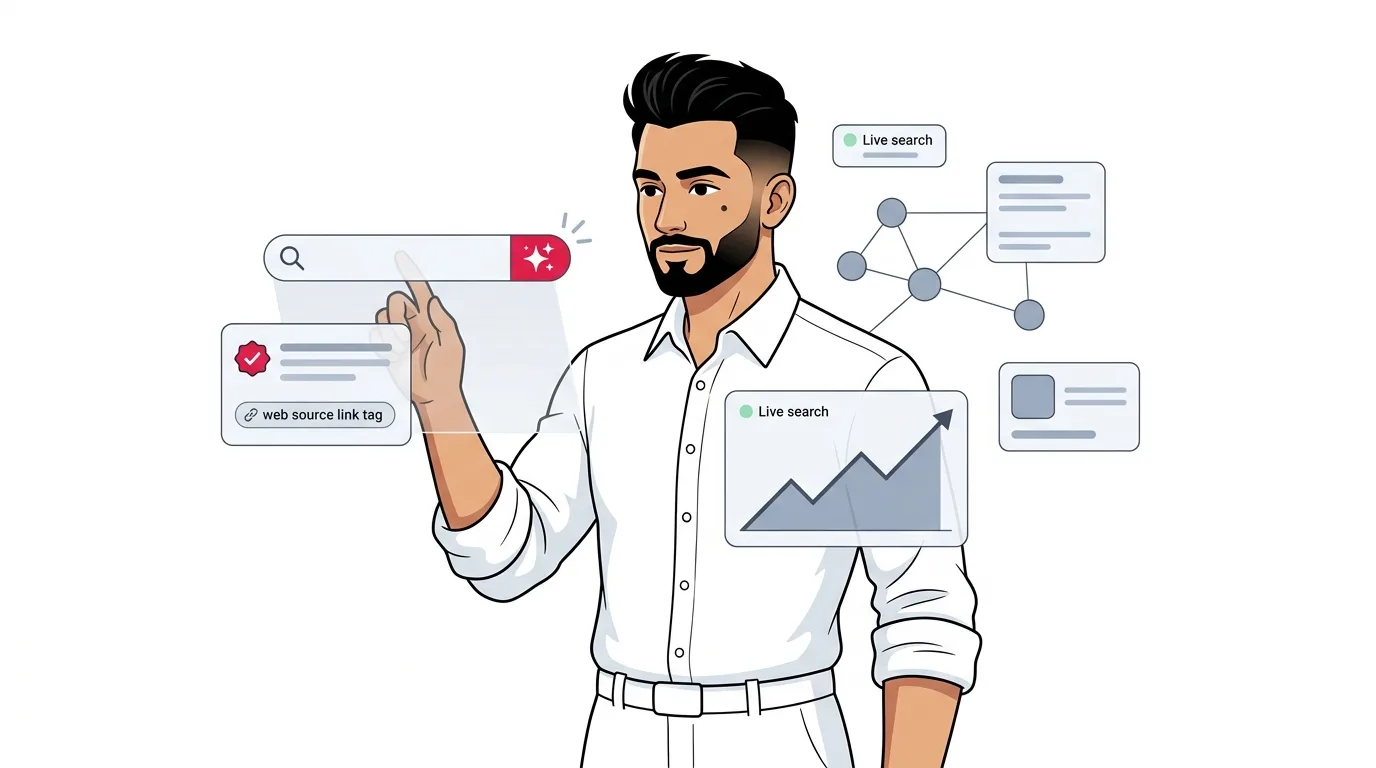
Learning how to rank in chatgpt search requires leaving behind traditional blue-link ranking habits and optimizing for live conversational synthesis. Instead of competing for ten static organic spots on a crowded search engine results page, your goal is to become the trusted, citable entity that OpenAI's models retrieve, analyze, and cite when answering user prompts in real time.
When a user asks ChatGPT a question with web search enabled, the system does not simply run a keyword lookup. It expands the user's prompt, queries underlying search indexes like Bing, crawls fresh pages using technical web crawlers, and synthesizes an authoritative answer complete with interactive source bubbles and domain chips.
This comprehensive guide breaks down the underlying retrieval pipeline of ChatGPT Search, the exact crawler configurations you need in your robots.txt file, semantic content structuring techniques, and the digital PR strategies required to win consistent citation visibility in 2026.
Key Takeaways for ChatGPT Search Optimization
- OAI-SearchBot is mandatory: Blocking OAI-SearchBot in your robots.txt completely eliminates your chances of appearing in live ChatGPT search citations.
- Bing Indexation is the foundation: ChatGPT Search relies heavily on Bing's web index for query retrieval and URL discovery.
- Direct answer formatting wins: Placing concise, factual answers (2 to 3 sentences) immediately beneath H2/H3 headers dramatically increases model extraction rates.
- Third-party consensus matters: ChatGPT cross-references external platforms like Reddit, Trustpilot, G2, and industry roundups before recommending any commercial brand.
How ChatGPT Search Actually Works (The Retrieval Pipeline)
To rank inside ChatGPT, you must understand what happens behind the scenes between the moment a user types a prompt and the moment the model streams its answer. The architecture functions as a multi-stage system governed by RAG for SEO and neural passage retrieval.
Here is the exact four-step pipeline OpenAI uses for web search queries:
- Query Intent & Expansion: ChatGPT analyzes the user's input to determine whether real-time web retrieval is necessary. If needed, it rewrites the prompt into multiple targeted search queries behind the scenes.
- Candidate Document Retrieval: The search engine (powered primarily by Bing and partner feeds) retrieves a pool of high-relevance candidate URLs matching the expanded queries.
- Real-Time Extraction via OAI-SearchBot: For rapidly evolving or fresh queries, OpenAI's live search crawler fetches the most recent DOM text from candidate pages.
- Neural Reranking & Synthesis: The LLM reads the retrieved text chunks, evaluates factual consistency, extracts relevant data points, and synthesizes the response, appending clickable citation chips next to each claim.
Unlike traditional search engines that score pages primarily on backlink equity and keyword density, ChatGPT evaluates information utility, clarity, and factual consensus. For an in-depth comparison of AI answer mechanics, review our breakdown on Google AI Overviews optimization.
ChatGPT Search vs. Traditional Google SEO: Key Differences
Many digital marketers mistakenly treat ChatGPT Search like standard SEO. While technical health and crawlability remain vital, the ranking dynamics differ fundamentally across several core dimensions.
| Dimension | Traditional Google SEO | ChatGPT Search (GEO / AEO) |
|---|---|---|
| Target Placement | 10 organic blue links, featured snippets, People Also Ask | Inline citations, linked domain chips, sidebar source cards |
| Primary Web Crawler | Googlebot (Desktop & Smartphone) | OAI-SearchBot & Bingbot |
| Core Ranking Metric | PageRank, backlink quantity, organic CTR | Entity consensus, factual density, Information Gain |
| Keyword Matching | Exact and semantic phrase matches in headings and body | Vector embeddings and conceptual topic coverage |
| Conversion Quality | Variable intent; high volume with lower average conversion | Extremely high intent; pre-qualified conversational buyers |
OpenAI Crawlers Explained: The Crucial robots.txt Blueprint
One of the most widespread blunders webmasters make is treating all OpenAI bots as a single entity. OpenAI maintains three distinct user agents, and confusing them can instantly de-index your website from ChatGPT Search.
1. OAI-SearchBot (Live Search Indexer)
This crawler is used strictly to index web content for ChatGPT Search features. It does not train foundation models. If you block OAI-SearchBot, your pages will never be retrieved or cited in live ChatGPT answers.
2. GPTBot (Foundation Model Training Scraper)
GPTBot collects large-scale web data to train future OpenAI foundation models (like GPT-5). You can safely disallow GPTBot if you wish to protect proprietary intellectual property without hurting your live search presence.
3. ChatGPT-User (On-Demand User Fetcher)
This user agent fires only when a logged-in ChatGPT user manually submits a specific URL into the prompt box asking the model to read or summarize that specific page.
Recommended robots.txt Configuration for ChatGPT Search
If your goal is to maximize live search citations while maintaining control over training data, use the following production-tested configuration:
# Allow ChatGPT Search to index and cite your content
User-agent: OAI-SearchBot
Allow: /

# Allow live user-requested page fetches
User-agent: ChatGPT-User
Allow: /

# Optional: Opt out of future AI model training datasets
User-agent: GPTBot
Disallow: /

# Ensure Bingbot can crawl your entire site
User-agent: Bingbot
Allow: /
For enterprise sites with complex crawl configurations, our technical sitemap and robots.txt audit services help verify crawler permissions across edge networks and Cloudflare Workers.
5 Core Pillars to Win ChatGPT Search Citations
Securing consistent recommendations inside ChatGPT requires a multi-layered approach known as Generative Engine Optimization (GEO). Implement these five foundational pillars to maximize your citation share of voice.
Pillar 1: Complete Bing Webmaster Tools & IndexNow Integration
Because OpenAI partners directly with Microsoft and relies heavily on Bing's infrastructure for live retrieval, your site must achieve perfect indexation within Bing Webmaster Tools.
Submit your XML sitemap index to Bing immediately. Furthermore, implement the IndexNow protocol on your CMS so that newly published or modified URLs are pushed to Bing's crawlers within seconds of publication.
Pillar 2: Direct "Answer-First" Inverted Pyramid Formatting
Large language models operate by predicting token probabilities. When extracting information, they look for self-contained, fact-dense sentences that require zero contextual translation.
Structure your article content using the inverted pyramid model:
- Place a crisp, 2-to-3 sentence answer directly beneath every H2 and H3 heading.
- Avoid conversational filler phrases like "In today's fast-paced world" or "Let's dive right in."
- Use clear bullet points and ordered lists to summarize multi-step processes or key feature sets.
- Use HTML tables for comparative data, pricing specifications, and technical benchmarks.
Pillar 3: High Information Gain & Proprietary Data Density
ChatGPT has already memorized generic web definitions. If your article merely rephrases Wikipedia or competitor top results, the LLM will synthesize the answer without citing your URL.
To force a citation, you must provide Information Gain. This includes:
- Original research, survey findings, or industry benchmark studies.
- Specific real-world pricing ranges and turnaround timelines.
- Authentic case study results with verifiable percentage improvements.
- Direct quotes and contrarian insights from recognized subject-matter experts.
Pillar 4: Semantic Schema Markup & Entity Reconciliation
While traditional SEO schema focuses on winning Google rich snippet stars, GEO schema focuses on entity disambiguation. Large language models use JSON-LD structured data to map who you are, what you offer, and how your brand connects to established Knowledge Graphs.
Ensure your pages deploy rich @graph schema containing:
Organizationschema with explicitsameAslinks pointing to your Wikidata entity, Wikipedia page, LinkedIn company profile, and Crunchbase record.ArticleorBlogPostingschema linking the author's verified entity URL.aboutandmentionsarrays referencing canonical Wikidata entity URIs.
To dive deeper into modern schema differences, read our guide on the difference between SEO schema and GEO schema, or explore our specialized semantic SEO consulting services.
Pillar 5: Digital PR & Third-Party Brand Consensus
When a user asks ChatGPT: "What is the best SEO software for small agencies?", the model does not rely solely on software homepages. It searches third-party discussion platforms, reviews, and expert roundups to establish consensus.
To become ChatGPT's recommended answer, your brand must be actively present across:
- Reddit & Specialized Forums: Authentic mentions in niche subreddits carry enormous weight in conversational AI responses.
- Software Review Platforms: Verified listings on G2, Capterra, Trustpilot, and Gartner.
- Curated Industry Roundups: Features in reputable industry newsletters, Substack publications, and digital publications.
Real-World Example: Anatomy of a Winning ChatGPT Citation
To see how these principles function in practice, consider what happens when a user submits a high-intent commercial prompt:
// Sample User Prompt in ChatGPT Search
"Compare the best technical SEO agency services for enterprise SaaS migration in 2026. Include pricing benchmarks and key deliverables."
When processing this query, ChatGPT Search executes the following internal workflow:
- Entity Decomposition: The model extracts the core entities: Technical SEO Agency, Enterprise SaaS Migration, Pricing Benchmarks, and Deliverables.
- Secondary Retrieval Queries: It dispatches queries such as
"enterprise saas seo migration pricing 2026"and"top technical seo agencies saas migrations case studies"to Bing. - Source Filtration: It filters retrieved pages, heavily downranking thin affiliate listicles that lack pricing numbers or verifiable case studies.
- Passage Extraction: It locates a table titled "Enterprise Migration Deliverables & Retainer Cost Matrix" on an authoritative agency site that implements clean schema markup.
- Response Generation & Citation: The model outputs a bulleted comparison quoting the exact retainer ranges (,500 to ,000/month) and appends an inline citation chip directly to the agency's service page.
The lesson is clear: websites that publish transparent, hard data formatted in accessible tables win citations, while vague marketing prose is completely ignored.
The Technical Foundation: Server-Side Rendering & Edge Latency
Search engines powered by LLMs operate under strict timeout limits. When OAI-SearchBot crawls candidate URLs, it cannot wait 5 seconds for heavy client-side JavaScript frameworks to hydrate the DOM.
Follow these technical guidelines to eliminate crawler friction:
- Server-Side Rendering (SSR) or Static Site Generation (SSG): Ensure all headings, text paragraphs, and structured data exist in the raw HTML payload delivered by your server.
- Sub-500ms Time to First Byte (TTFB): Host assets on global edge CDNs (like Cloudflare Pages or Workers) to ensure instant retrieval globally.
- Avoid Blocking AI Subnets: Configure your web application firewall (WAF) so that IP ranges associated with OpenAI and Bing are not subjected to JavaScript challenge pages or CAPTCHA gates.
- Validate Clean Semantic HTML: Use clean HTML5 tags (
<article>,<header>,<main>,<section>) rather than deeply nested unsemantic<div>containers.
Implementing the llms.txt Standard for OpenAI Crawlers
The emerging llms.txt specification provides AI crawlers with a lightweight, markdown-formatted directory of your site's most important pages, documentation, and conceptual definitions.
Placing an llms.txt file at your domain root (e.g., https://shazzseo.com/llms.txt) helps AI agents quickly identify primary topical hubs without crawling thousands of auxiliary asset files.
# ShazzSEO Knowledge & Service Index
> ShazzSEO provides semantic AI search optimization, technical SEO fixes, and automated agent workflows.

## Core Capabilities
- [Semantic AI SEO Services](https://shazzseo.com/services/semantic-seo/): Entity disambiguation, Knowledge Graph integration, and schema architecture.
- [AI SEO Automation](https://shazzseo.com/services/ai-seo-automation/): Autonomous auditing and internal linking workflows.
- [Technical SEO Fixes](https://shazzseo.com/services/technical-seo/): Core Web Vitals, indexation recovery, and crawl budget governance.

## High-Authority Guides
- [Google AI Overviews Guide](https://shazzseo.com/google-ai-overviews-optimization-guide/): Mechanics of Google AIO synthesis.
- [SEO Schema vs GEO Schema](https://shazzseo.com/difference-between-seo-schema-and-geo-schema/): JSON-LD structured data for LLM discovery.
- [Autonomous SEO Agent Architecture](https://shazzseo.com/how-i-built-an-autonomous-ai-seo-agent/): Engineering multi-agent audit workflows.
Step-by-Step Optimization Workflow for Content Teams
Follow this repeatable checklist whenever optimizing existing pages or publishing new assets targeting ChatGPT search queries:
- Audit Server-Side Rendering (SSR): Ensure all core text and links render in the raw server HTML response. Client-side JavaScript rendering can cause timeout issues during fast AI retrieval sweeps.
- Add Explicit Definition Blocks: Under your primary H2 tags, define core terms immediately using objective, authoritative language.
- Verify OAI-SearchBot Accessibility: Test your robots.txt file and ensure your edge CDN (e.g., Cloudflare Bot Management) is not silently challenging OpenAI user agents.
- Deploy Entity-Rich JSON-LD: Validate your structured data using the Schema.org validator to confirm zero syntax errors.
- Track Mentions Across AI Prompts: Benchmark your baseline visibility by querying ChatGPT with target buying prompts and recording citation frequency.
For organizations looking to automate these technical audits at scale, explore our insights on how to build an autonomous AI SEO agent and our full-suite AI SEO automation solutions.
How to Track and Measure Your ChatGPT Search Traffic
Measuring visibility inside AI search engines requires a combination of web analytics and synthetic prompt sampling.
1. Web Analytics Tracking in GA4
Monitor your Google Analytics 4 traffic acquisitions under Referral channels. Filter for sessions originating from:
chatgpt.comandroid-app://com.openai.chatgptios-app://com.openai.chatgpt
Users arriving from these referral sources typically exhibit longer session durations, lower bounce rates, and substantially higher conversion rates due to their high conversational intent.
2. Synthetic Prompt Benchmarking (Citation Share of Voice)
Select 30 to 50 conversational prompts your target customers use when evaluating solutions in your niche. Run these queries weekly across ChatGPT Search and calculate your Citation Share of Voice (SoV): the percentage of prompts where your domain is cited as a source or directly recommended in the text.
Frequently Asked Questions About ChatGPT Search SEO
1. Does ChatGPT Search favor paid advertisers or partners?
OpenAI has explicitly stated that organic search citations within ChatGPT Search are determined algorithmically based on relevance, freshness, and factual authority. While OpenAI has content partnerships with major publishers (such as Axel Springer, AP, and Condé Nast), any public website adhering to standard web crawl guidelines can rank and earn citations.
2. How fast does ChatGPT index newly published content?
When pages are submitted through the IndexNow protocol and indexed in Bing, they can appear in live ChatGPT search queries within hours or even minutes of publication. For evergreen content, it typically takes several days for OAI-SearchBot to crawl and incorporate fresh pages into the broader retrieval corpus.
3. Can you use hidden text or prompt injections to trick ChatGPT?
No. OpenAI employs sophisticated input sanitization and safety filters to prevent prompt injection and adversarial manipulation. Attempting to hide instructions in white text or HTML comments is easily detected by modern neural rerankers and will result in complete domain disqualification.
4. Does optimizing for ChatGPT Search hurt traditional Google SEO?
Not at all. In fact, the two strategies reinforce each other. Generative Engine Optimization requires fast page speeds, clean schema markup, high Information Gain, and authentic third-party consensus—all of which directly support Google's Helpful Content guidelines and Core Web Vitals requirements.
5. How does ChatGPT handle gated or paywalled content?
ChatGPT Search respects standard HTTP status codes and paywall directives. If an article requires a login or subscription, OAI-SearchBot cannot crawl behind the paywall unless authorized via an enterprise partnership. For maximum citation visibility, keep your primary definitions and data summaries publicly accessible in the main body text.
6. What is the difference between ChatGPT Search and Perplexity AI?
While both systems use Retrieval-Augmented Generation to synthesize answers from the live web, Perplexity operates primarily as an academic research and discovery engine with exhaustive inline footnotes. ChatGPT Search integrates conversational continuity, task completion, and personalized dialogue history, placing heavy emphasis on conversational brand consensus.
Industry-Specific ChatGPT Search Optimization Playbooks
Different business verticals require tailored execution when optimizing for ChatGPT Search. Below are field-tested implementation playbooks for the three most competitive sectors in 2026.
1. B2B SaaS & Enterprise Software
B2B technology buyers heavily leverage ChatGPT to conduct initial vendor discovery, feature matrix comparisons, and procurement research before ever speaking to a sales representative.
- Transparent Pricing Documentation: Publish public pricing calculators or detailed tier comparisons ($/user/month or enterprise baseline retainers). ChatGPT consistently prioritizes pages with clear figures over "Contact Sales" walls.
- Competitor Alternative Pages: Build objective comparison hubs (e.g., "Platform A vs. Platform B vs. ShazzSEO") featuring structured comparison tables with verified feature checklists.
- G2 and Capterra Profile Alignment: Ensure category tags and software feature badges on review platforms match your website's semantic schema
aboutentities.
2. eCommerce & Direct-to-Consumer (DTC) Brands
ChatGPT Search has integrated live shopping capabilities, enabling users to ask for personalized product recommendations with explicit budget constraints (e.g., "Recommend non-comedogenic mineral sunscreens under with zero white cast").
- Granular Product Schema: Implement comprehensive
Productstructured data includingoffers,price,priceCurrency,availability, andaggregateRating. - Attribute-Dense Bullet Points: List exact technical specifications (ingredients, dimensions, battery life, fabric weight) in bulleted format near the top of product descriptions.
- Return Policy and Warranty Visibility: State return terms, shipping speeds, and warranty guarantees clearly; ChatGPT evaluates customer assurance signals when making commercial buying recommendations.
3. Local Service Providers & Multi-Location Chains
When users search for local solutions (e.g., "emergency commercial HVAC repair in Chicago"), ChatGPT synthesizes recommendations by evaluating web proximity and local review sentiment.
- LocalBusiness Structured Data: Ensure every location page includes valid
LocalBusinessschema specifyinggeocoordinates,openingHoursSpecification, and service radius. - Unfiltered Google & Yelp Sentiment: Maintain an active review generation strategy; negative review spikes on major aggregators directly suppress AI recommendation rates.
- Service Menu Tables: List service categories with transparent starting price estimates on dedicated location landing pages.
The Future of ChatGPT Search: Multimodal Retrieval & Voice Agents
As conversational search evolves through 2026 and into 2027, two major technological shifts are redefining how websites are evaluated for citations:
1. Multimodal Document Understanding
OpenAI's frontier models now process visual and graphical data alongside raw text. Infographics, architectural flowcharts, and comparison matrices embedded on your website are parsed directly by vision tokens during deep web retrieval sweeps.
To capture multimodal citations, include clear vector diagrams, descriptive alt text, and caption summaries beneath all technical illustrations. Avoid embedding critical numerical data exclusively inside flattened bitmap images without accompanying HTML table equivalents.
2. Advanced Voice Mode Conversational Syntax
With hundreds of millions of daily prompts submitted via voice in ChatGPT mobile apps, user queries have become significantly longer and more conversational. A user who once typed "best technical seo agency" now asks: "Hey ChatGPT, I'm planning a headless Shopify store migration next quarter and I'm terrified of losing our organic traffic. Can you recommend a technical SEO consultant who specializes in edge architecture and explain what their process looks like?"
To rank for voice-driven conversational prompts, ensure your content addresses natural question structures, outlines step-by-step methodologies, and answers long-tail situational scenarios throughout every guide.
Conclusion & Strategic Next Steps
ChatGPT Search is fundamentally transforming how buyers discover information, compare vendors, and choose services. Businesses that adapt early by implementing clean crawler directives, entity-based schema architectures, and authoritative answer formatting will capture the highest-converting search traffic of the next decade.
If you are ready to audit your brand's AI search presence and engineer an end-to-end Generative Engine Optimization strategy, explore our semantic SEO services or contact us directly for an enterprise audit.
I engineer semantic Knowledge Graph authority, sub-second edge speeds, and AI search visibility (ChatGPT, Perplexity, Google AI Overviews) for growth-focused websites worldwide.
Explore Semantic SEO Services →