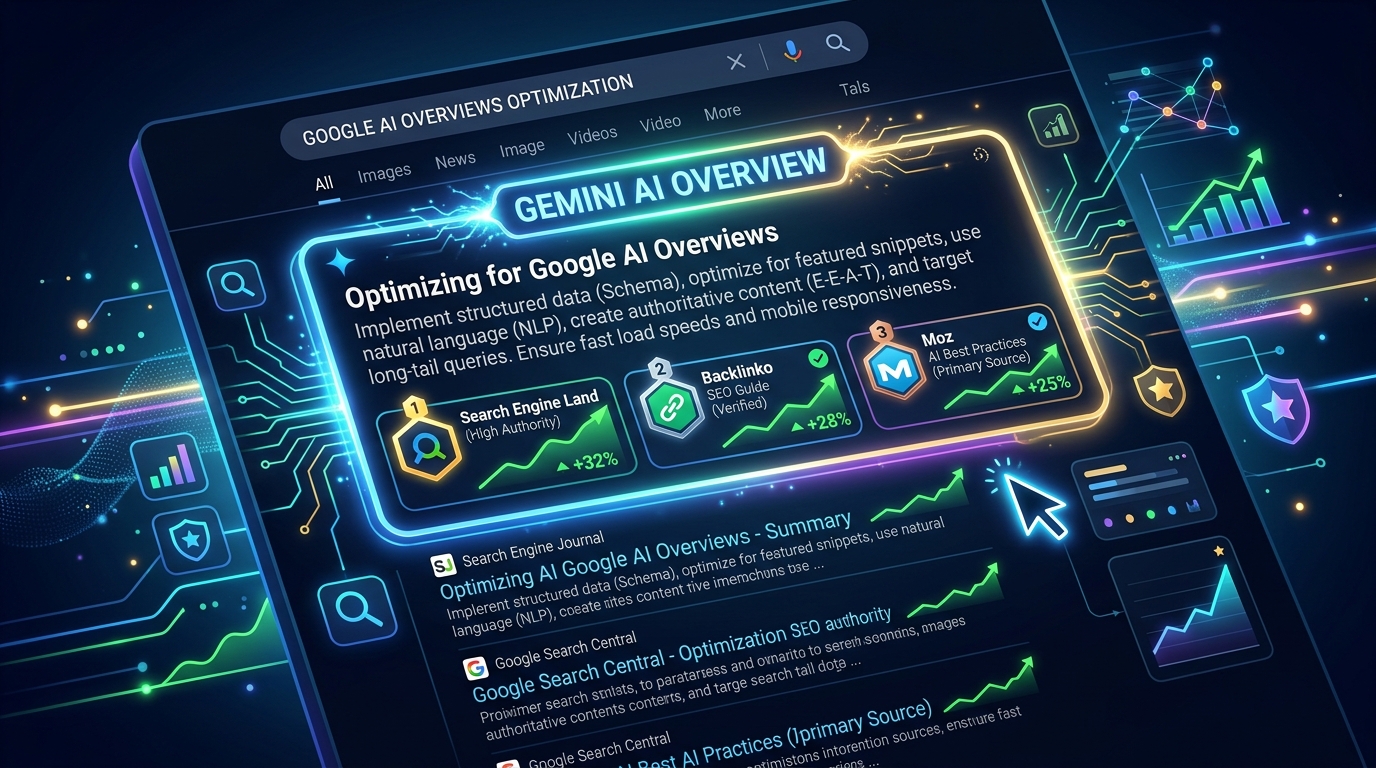
Google AI Overviews (formerly Search Generative Experience / SGE) have fundamentally reshaped the organic search landscape in 2026. Appearing at the very top of high-intent search queries, AI Overviews synthesize multi-source answers into rich generative snapshots, pushing traditional organic blue links down the page.
To win organic search visibility today, SEOs and content architects must understand how Google’s Gemini-powered retrieval systems select, evaluate, and cite web pages inside AI Overviews. Ranking in AI Overviews is not about stuffing keywords—it is about passage extractability, entity triangulation, and high Information Gain scores.
How Google AI Overviews Select Sources: The RAG Architecture
Google’s AI Overview engine executes a two-stage retrieval-augmented generation (RAG) pipeline before generating a response:
- Candidate Passage Retrieval: Google queries its semantic vector index (powered by MUM and Gemini embeddings) to surface high-relevance paragraphs across indexed documents. Rather than evaluating the entire page as a monolithic unit, the algorithm scores individual text passages for semantic density and direct relevance.
- Information Gain Scoring: Passages containing original statistics, direct step-by-step methodologies, verified entity attributes, or proprietary data tables are prioritized over generic paraphrased text that repeats consensus SERP content.
- Source Citation Selection: Google selects 3 to 5 authoritative primary source domains to display as clickable citation badges alongside the AI-generated snapshot.
7 Rules to Win Citations in Google AI Overviews
1. Adopt the “Inverted Pyramid” Passage Structure
Lead with the direct, definitive answer in the first 40 to 50 words immediately beneath an H2 or H3 heading. Avoid preamble, conversational filler, or introductory throat-clearing. State the definition, process, or core fact directly, and then elaborate on technical nuances in subsequent paragraphs.
2. Maximize Semantic Table Density
AI search models love structured HTML comparison tables. When comparing software features, pricing tiers, specifications, or methodologies, format the data in a clean HTML <table> with descriptive headers. LLMs parse tables easily and frequently convert table rows directly into AI Overview bullet points.
3. Implement Precise Entity Triangulation
Clearly define relationships between Subject, Predicate, and Object in your writing without relying on ambiguous pronouns. Instead of writing “It helps them improve their ranking”, write “Internal linking helps search crawlers discover orphan URLs and distribute PageRank authority”.
4. Deploy Nested Schema.org Markup
Structure your pages with multi-layered JSON-LD schema (including TechArticle, FAQPage, HowTo, and Organization). Providing explicit machine-readable metadata makes it effortless for Googlebot and Gemini parsers to verify factual claims.
5. Publish Proprietary First-Party Data & Audit Figures
Google’s Information Gain patent specifically rewards documents that introduce novel data points to the index. If your article includes original testing numbers (e.g., “In our audit of 450 enterprise URLs…”), Google’s retrieval engine cites your domain as the primary source of truth.
6. Ensure Flawless Core Web Vitals & Server-Side Rendering
Fast-loading, server-rendered pages allow Google’s AI crawlers to parse text content instantly without waiting for client-side JavaScript execution. Ensure your INP is under 200ms and LCP is under 2.5s.
7. Target Long-Tail Conversational Queries
AI Overviews trigger most frequently on complex, multi-part, and question-based queries (e.g., “how to fix crawl budget issues on ecommerce websites with faceted navigation”). Build content clusters that thoroughly answer nested sub-questions.
Comparison: Traditional SERP Ranking vs. AI Overview Citation
| Dimension | Traditional Blue Link SEO | Google AI Overview (AIO) Optimization |
|---|---|---|
| Core Metric | Keyword rankings & organic clicks | Passage citation share & AI snapshot presence |
| Evaluation Unit | Entire page URL authority | Individual 50-word semantic passages & tables |
| Content Requirement | Thorough keyword coverage | High Information Gain & proprietary data |
| Crawler Priority | Standard Googlebot indexing | Fast HTML extractability with zero JS delays |
Frequently Asked Questions (FAQ)
Do AI Overviews decrease organic click-through rates?
For simple informational queries (e.g., “what is the time in London”), AI Overviews reduce clicks. However, for high-intent, technical, and commercial comparison queries, being cited as a featured source in an AI Overview generates highly qualified, high-converting referral traffic.
Can you block your site from AI Overviews without losing Google rankings?
Using Google’s nosnippet, max-snippet, or data-nosnippet tags can restrict text from appearing in AI Overviews. However, blocking snippets often reduces overall SERP visibility. A superior strategy is optimizing for high-intent conversion queries where users click through for deep tools or services.
How do you track whether your brand appears in AI Overviews?
While Google Search Console aggregates impressions across all search features, specialized GEO tracking platforms and custom Python automation scripts (scraping SERP feature layout flags) allow brands to track exact AI Overview citation percentages across keyword clusters.
Conclusion & Strategic Takeaways
Generative search is not replacing SEO; it is rewarding high-caliber, authoritative, and structurally clean content. By structuring your articles around direct answers, rich semantic data, and unique insights, you position your brand at the absolute forefront of Google AI Overviews in 2026.