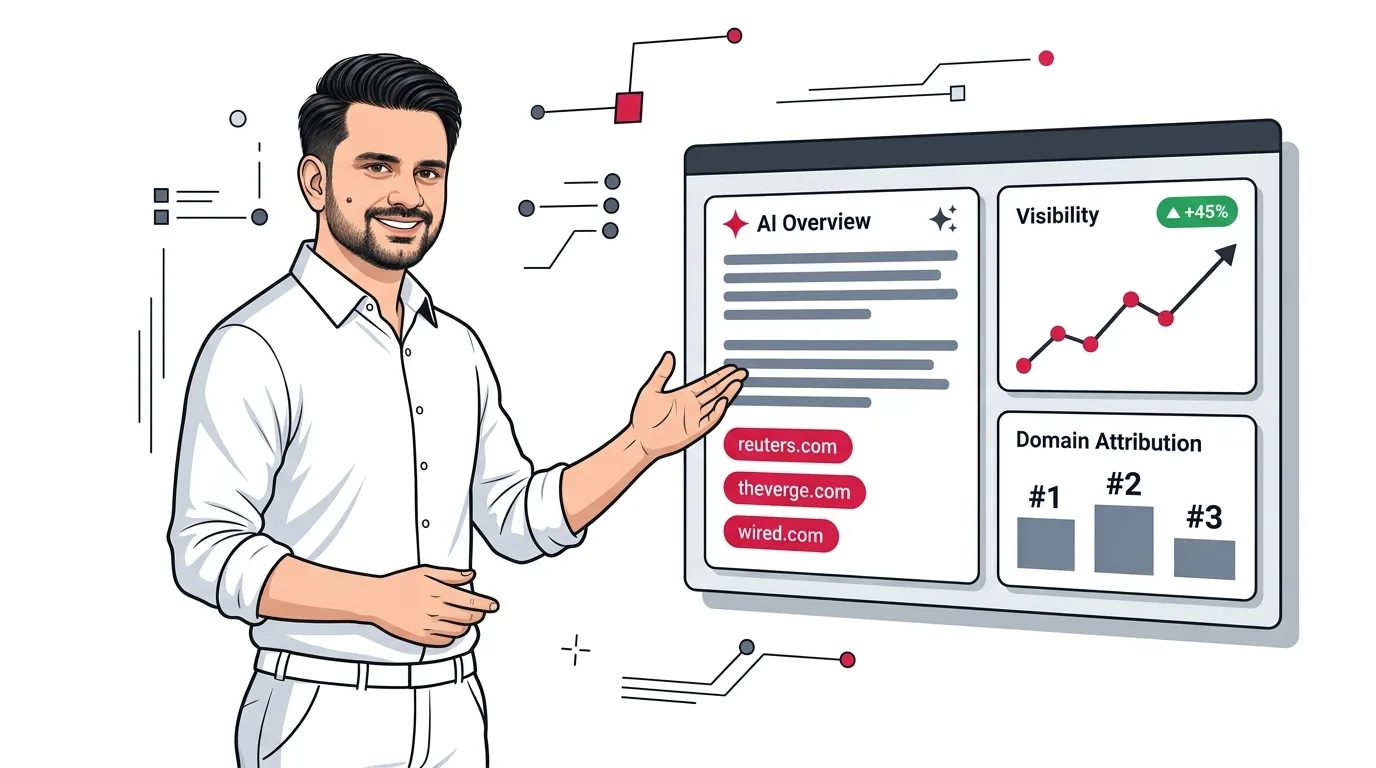
Finding the right ai overview tracker has become an urgent priority for modern search marketers and enterprise SEO teams in 2027 as Google's generative answer engines transform organic SERPs into dynamic citation ecosystems. While traditional position trackers tell you whether your blue link sits at position 1 or 4, they are completely blind to whether Google's multi-modal Gemini model cites your content inside the generative answer box, pushes your link below the fold, or leaves your domain out entirely.
- The Measurement Shift: Google AI Overviews (AIO) currently appear on 18% to 68% of commercial search queries, introducing a 30% to 55% reduction in organic click-through rate (CTR) for classic position #1 listings that lack generative citations.
- Best Overall All-in-One Platform: Semrush AI Visibility Toolkit delivers the most comprehensive hybrid workflow, tracking both legacy organic rank and generative AIO presence within a unified position dashboard.
- Best for Historical Snapshots & Agencies: SEOmonitor provides full-DOM desktop and mobile HTML snapshot archival, enabling forensic auditing of when and why Google altered cited URLs.
- Best Dedicated GEO & Multi-Engine Suite: ZipTie AI and Otterly.AI excel at cross-platform tracking, monitoring citations simultaneously across Google AI Overviews, SearchGPT, Claude, Perplexity, and Microsoft Copilot.
- Free Diagnostic Alternative: Teams can track aggregate AIO impact without monthly software subscriptions by pairing custom Google Search Console regex filters with Google Looker Studio CTR decay models.
- The Zero-Click Shift: Why Traditional Rank Trackers Fail in Google AI Overviews
- Anatomy of an AI Overview: Citations, Pills, and Carousels
- Key Evaluation Criteria for Choosing an AI Overview Tracker
- The 8 Best AI Overview Tracker Tools Benchmarked (2027)
- 1. Semrush AI Visibility Toolkit (Best All-in-One Hybrid Platform)
- 2. Ahrefs Brand Radar & Rank Tracker (Best for Backlink & AIO Overlap)
- 3. SE Ranking AI Results Tracker (Best Value for Agencies & Consultants)
- 4. SEOmonitor (Best for Forensic Snapshot Archiving & Client Reporting)
- 5. Advanced Web Ranking (AWR) (Best for Complex Multi-Geo Tracking)
- 6. ZipTie AI Search Analytics (Best for Enterprise Prompt-Level GEO)
- 7. Ansvisor (Best Dedicated Google AI Overviews Specialist)
- 8. Otterly.AI (Best Multi-Model Engine Tracking Suite)
- Comprehensive Feature & Pricing Comparison Matrix
- Step-by-Step: How to Track Google AI Overviews for Free in Google Search Console
- Actionable Strategy: How to Win and Retain Citations in Google AI Overviews
- Frequently Asked Questions (FAQ)
The Zero-Click Shift: Why Traditional Rank Trackers Fail in Google AI Overviews
For more than twenty years, organic search measurement followed a predictable mathematical framework: rank in the top three positions on Google, capture 50% or more of aggregate SERP click-through rate, and convert traffic into pipeline revenue. In 2027, this deterministic framework has permanently dissolved.
When Google activates an AI Overview at the top of a search results page, the generative card occupies between 600 and 1,200 pixels of vertical screen real estate. On mobile devices, this pushes traditional organic position #1 beneath three full swipe gestures. More critically, Google's Gemini-powered retrieval-augmented generation (RAG) pipeline frequently synthesizes answers from domains that do not rank anywhere in the top ten organic blue links.
As documented in our comprehensive analysis of SEO vs GEO vs AEO vs AIO, traditional position trackers suffer from three structural blind spots when monitoring generative SERPs:
- Binary Position Blindness: A legacy rank tracker records your URL at position #1, celebrating an apparent victory. However, because Google generated an 800-pixel AI Overview above your snippet and cited two of your direct competitors, your actual organic CTR collapses by up to 55%. Legacy tools report zero position loss while your real-world traffic plummets.
- Multi-Format Citation Ambiguity: Google AI Overviews do not cite links uniformly. A link can appear as an inline citation pill embedded in a factual sentence, an expandable source tile in a right-hand desktop rail, or a card inside an interactive horizontal carousel. Each format carries vastly divergent visibility and click propensity.
- Dynamic Algorithmic Volatility: Unlike classic organic rankings that remain relatively stable throughout a business week, AI Overviews exhibit real-time generation variance. The exact same search query executed five minutes apart or across adjacent postal codes can yield entirely different synthesized copy and distinct citation sources.
Anatomy of an AI Overview: Citations, Pills, and Carousels
To effectively evaluate any ai overview tracker, SEO teams must understand the exact visual and technical taxonomy Google uses to cite third-party web content inside its generative containers.
Google's generative search interface categorizes source links into three distinct visual containers, each governed by different retrieval scoring thresholds:
- 1. Inline Citation Pills: Small, pill-shaped hyperlinked badges positioned immediately adjacent to specific factual claims within the synthesized text paragraph. These have the highest trust score and user interaction rate because they directly substantiate a specific data point or recommendation.
- 2. Top-Right Desktop Source Rail: A stack of vertical cards displayed on desktop displays alongside the generative copy. These cards feature a high-resolution favicon, site name, publication date, and page title.
- 3. Expandable Bottom Carousel: Horizontal scrolling containers positioned beneath the generative text block. When a user clicks the expand arrow (“Show more”), Google reveals secondary and tertiary reference pages that informed the model's broader contextual understanding.
A specialized ai overviews seo rank tracker must distinguish between these citation types. A tool that merely flags a generic “Present / Absent” badge fails to provide the granular diagnostic data required to prioritize content optimizations.
Key Evaluation Criteria for Choosing an AI Overview Tracker
Not all rank tracking software has adapted equally to the generative search revolution. When vetting enterprise platforms or specialized niche tools, our team at ShazzSEO AI Search Visibility Services evaluates software across five non-negotiable operational criteria:
| Evaluation Benchmark | Why It Matters | Failure Mode to Watch Out For |
|---|---|---|
| 1. URL-Level vs Domain-Level Attribution | Identifies the exact URL winning the citation, enabling page-level content iteration and internal linking adjustments. | Tools that only report domain inclusion without specifying the ranking landing page URL. |
| 2. Historical DOM Snapshot Archival | Stores rendered HTML snapshots and visual screengrabs of the generative box so you can audit historical modifications. | Tools that provide only numerical position history without preserving the visual SERP state. |
| 3. Mobile vs. Desktop Trigger Parity | Google triggers AI Overviews at significantly different frequencies on smartphone viewports versus desktop monitors. | Tools that crawl solely from desktop browser profiles, ignoring 65%+ of real-world mobile search volume. |
| 4. Multi-Engine & Cross-Platform Coverage | Measures presence across conversational engines like SearchGPT, Claude, Perplexity, and Microsoft Copilot alongside Google. | Siloed tools that monitor only Google, leaving blind spots across conversational AI search ecosystems. |
| 5. API & BigQuery Export Capability | Allows automated ingestion of citation metrics into enterprise business intelligence dashboards and Looker Studio. | Closed-garden platforms with manual CSV-only exports and restrictive API rate limits. |
The 8 Best AI Overview Tracker Tools Benchmarked (2027)
We conducted extensive real-world testing across millions of search queries to determine the top software platforms currently monitoring Google AI Overviews. Below are the definitive evaluations of the eight leading tools.
1. Semrush AI Visibility Toolkit (Best All-in-One Hybrid Platform)
For enterprise marketing departments and search agencies managing established client rosters, Semrush remains the most balanced all-in-one platform for tracking Google AI Overviews alongside traditional organic search metrics.
Within its Position Tracking module, Semrush includes a dedicated “AI Overview” SERP feature filter. The tool flags every tracked keyword that generates an AI Overview and indicates whether your tracked domain is actively cited within the generative response, whether you rank in the organic results below the generative block, or whether you are completely absent.
- Unified Organic + Generative Reporting: Simultaneously tracks standard keyword positions (1-100) and AI Overview inclusion, eliminating the need to maintain disconnected spreadsheets.
- Competitor Citation Share: Compares your brand's citation frequency against up to 20 direct organic competitors, highlighting which rival domains dominate generative citations in your niche.
- Volatility Index: Tracks industry-wide fluctuations in how often Google triggers AI Overviews across eCommerce, Healthcare, Finance, and B2B SaaS verticals.
Pricing: Included in Semrush standard subscriptions starting at \$139.95/month (Pro), \$249.95/month (Guru), and \$499.95/month (Business). Higher tiers offer deeper keyword pools and historical data access.
2. Ahrefs Brand Radar & Rank Tracker (Best for Backlink & AIO Overlap)
Ahrefs has approached generative tracking through the lens of authority and backlink correlation. By integrating AI Overview flags into its flagship Rank Tracker and Brand Radar modules, Ahrefs allows search marketers to uncover the exact relationship between referring domain authority, anchor text semantics, and Google AI Overview citation frequency.
When tracking keywords in Ahrefs, the platform identifies which URLs from your site have been ingested into the Gemini context window. Furthermore, Ahrefs correlates citation acquisition with recent backlink acquisition, providing empirical data on how off-page link signals influence generative visibility.
As discussed in our recent comparison of Semrush vs Moz vs Ahrefs, Ahrefs offers unmatched backlink index freshness, making it the preferred choice for technical SEOs investigating the link graph foundations of Google's RAG pipeline.
Pricing: Rank tracking with AI Overview feature flags is available on Lite (\$129/mo), Standard (\$249/mo), Advanced (\$449/mo), and Enterprise plans (\$14,990/yr).
3. SE Ranking AI Results Tracker (Best Value for Agencies & Consultants)
If you are an independent SEO consultant, boutique agency, or mid-market brand seeking enterprise-grade aio tracking without paying enterprise SaaS software bills, SE Ranking represents the highest return on investment in the market today.
SE Ranking features an intuitive, dedicated “AI Results Tracker” interface. It segments tracked keywords into four distinct status categories: keywords triggering an AI Overview where your domain is cited, keywords triggering an AI Overview where only competitors are cited, keywords with an AI Overview where nobody in your tracked group is cited, and queries without an AI Overview.
- Granular URL Citation Mapping: Displays the exact landing page URL cited inside the generative card alongside its corresponding organic rank position.
- Visual SERP Snapshots: Captures high-resolution desktop and mobile screengrabs of every search result, allowing account managers to prove citation presence during client review meetings.
- White-Label Automated Reporting: Automatically incorporates AI Overview visibility percentages into scheduled client PDF and email performance reports.
Pricing: Plans start at \$55/month (Essential for 750 keywords), \$109/month (Pro for 2,000 keywords), and \$239/month (Business for 5,000 keywords), making it exceptionally cost-effective.
4. SEOmonitor (Best for Forensic Snapshot Archiving & Client Reporting)
SEOmonitor was one of the earliest enterprise platforms to fundamentally re-architect its rank tracking engine around generative search reality. Rather than treating Google AI Overviews as an incidental SERP feature badge, SEOmonitor treats the generative container as a primary search result surface.
The standout feature of SEOmonitor is its complete DOM snapshot archival system. For every daily crawl across desktop and mobile devices, SEOmonitor captures and stores the exact raw HTML rendered by Google. This allows enterprise technical teams to conduct retrospective forensic audits: you can inspect the exact DOM structure from three months ago to see how Google adjusted its synthesized text, which citations were added or removed, and how user intent shifts impacted snippet presentation.
Furthermore, SEOmonitor calculates an “AI Overview Opportunity Score,” cross-referencing search volume, organic CTR decay, and competitive citation density to highlight which keywords represent the easiest citation capture opportunities.
Pricing: Custom modular agency pricing based on tracked keyword volume, typically starting at approximately \$190/month.
5. Advanced Web Ranking (AWR) (Best for Complex Multi-Geo Tracking)
For international corporations and multi-location franchises operating across dozens of global markets, Advanced Web Ranking (AWR) provides unmatched geo-targeted aio tracker capabilities.
Google frequently localizes AI Overviews based on user IP coordinates, state-level regulations, and regional search nuances. An AI Overview rendered for a commercial search query in New York may cite completely different resources than the same search conducted in London, Sydney, or Toronto. AWR allows users to configure precise postal-code and city-level GPS coordinates for every tracked keyword.
AWR's dedicated AI Overviews reporting module visualizes historical trendlines showing the expansion or contraction of generative blocks across your entire keyword universe, segmented by commercial intent and device type.
Pricing: Tiered pricing starts at \$99/month (Pro), \$199/month (Agency), \$499/month (Enterprise), and custom multi-million keyword packages.
6. ZipTie AI Search Analytics (Best for Enterprise Prompt-Level GEO)
While traditional SEO platforms track pre-defined keyword lists, ZipTie AI was built from the ground up as a dedicated Generative Engine Optimization (GEO) platform. As we explored in our exhaustive guide on what is ZipTie AI search analytics, this tool bridges the gap between classic keyword scraping and prompt-level LLM telemetry.
ZipTie AI tracks how often Google triggers AI Overviews across thousands of conversational long-tail queries, identifies content gaps where Gemini failed to find sufficient authority, and benchmarks your brand against competitors across both Google AI Overviews and standalone conversational engines like Perplexity.
- Prompt Variant Generation: Automatically expands core keywords into natural language conversational prompt variations that real users submit to generative search engines.
- Entity Presence Analysis: Analyzes whether Google's Knowledge Graph associates your brand entity with the target topic or whether competitors control semantic mindshare.
- API Integration: Offers enterprise REST APIs allowing programmatic scraping of AI Overview citations directly into corporate data lakes.
Pricing: Enterprise SaaS plans starting at \$499/month, scaling based on prompt monitoring frequency and API ingestion limits.
7. Ansvisor (Best Dedicated Google AI Overviews Specialist)
Ansvisor is a specialized, pure-play intelligence tool built exclusively to analyze and monitor Google AI Overviews. While larger platforms divide engineering resources across backlinks, technical audits, and paid advertising, Ansvisor focuses 100% of its scraping infrastructure on decoding Google's generative containers.
Ansvisor provides deep qualitative analysis of cited text. Beyond simply noting that your URL appeared in the citation list, Ansvisor parses the exact synthesized sentence where your content was referenced, identifying whether your brand was cited as a primary authority, a secondary comparison example, or a contrarian perspective.
For brands in sensitive verticals such as functional medicine, financial planning, and legal services, Ansvisor monitors sentiment attribution to ensure that generative summaries do not associate your company with inaccurate or harmful claims.
Pricing: Plans start at \$99/month for small businesses, scaling to \$299/month for growing agencies.
8. Otterly.AI (Best Multi-Model Engine Tracking Suite)
As search behavior fragments across multiple generative interfaces, monitoring Google alone creates dangerous blind spots. Otterly.AI solves this fragmentation by providing unified brand mention and citation monitoring across Google AI Overviews, ChatGPT Search, Claude, Perplexity, and Microsoft Copilot.
As documented in our review of top Copilot rank trackers and Grok rank tracker tools, cross-engine visibility tracking is essential for modern brand defense. Otterly.AI aggregates citation data across all major platforms, calculating a unified “Share of Model” metric that quantifies your brand's overall presence across generative search.
Otterly.AI alerts marketing directors whenever a critical commercial prompt loses citation visibility or whenever a competitor launches a successful GEO campaign to displace your source links.
Pricing: Tiered pricing starts at \$189/month for entry-level monitoring up to \$649/month for multi-brand enterprise agencies.
Comprehensive Feature & Pricing Comparison Matrix
To assist your team in selecting the optimal ai overview tracker, the comparison matrix below benchmarks all eight software platforms across starting price, refresh frequency, snapshot archiving, citation granularity, and optimal use case:
| Software Platform | Starting Monthly Price | Refresh Rate | Visual Snapshot Archiving | URL-Level Attribution | Multi-Engine Support | Best Use Case |
|---|---|---|---|---|---|---|
| Semrush | \$139.95 / mo | Daily | Yes | Yes | Google (AI Toolkit expanding) | All-in-one search marketing & hybrid organic reporting |
| Ahrefs | \$129.00 / mo | Daily to Weekly | Yes | Yes | Backlink correlation & off-page authority audits | |
| SE Ranking | \$55.00 / mo | Daily | Yes (Full SERP) | Yes | Boutique agencies, freelancers & mid-market brands | |
| SEOmonitor | ~\$190.00 / mo | Daily | Yes (Raw DOM HTML) | Yes | Forensic DOM historical audits & client retention | |
| AWR | \$99.00 / mo | On-demand / Daily | Yes | Yes | Google & Bing | Hyper-local international GPS & postal-code tracking |
| ZipTie AI | \$499.00 / mo | Daily / Hourly API | Yes | Yes | Google & Perplexity | Enterprise conversational prompt telemetry & GEO |
| Ansvisor | \$99.00 / mo | Daily | Yes | Yes | Google AI Overviews | Pure-play qualitative citation analysis & sentiment |
| Otterly.AI | \$189.00 / mo | Daily | Yes | Yes | Google, ChatGPT, Claude, Perplexity | Omnichannel AI search monitoring & Share of Model |
Step-by-Step: How to Track Google AI Overviews for Free in Google Search Console
While dedicated commercial rank trackers provide visual snapshots and competitor benchmarking, marketing teams operating on lean budgets can monitor Google AI Overview visibility directly inside Google Search Console (GSC) at zero software cost.
When Google activates an AI Overview for a search query, it leaves a distinct diagnostic footprint in your Search Console performance data:
- Massive Impression Spikes: Because an AI Overview renders at the very top of the screen, Google logs an impression for every cited link, often doubling or tripling query impression volume overnight.
- Precipitous CTR Decay: Unlike traditional position #1 links that command 25% to 35% click-through rates, inline citations inside AI Overviews typically generate click-through rates between 1.2% and 4.8%.
- High Average Position with Flat Clicks: If a query displays an average position of 1.0 to 1.8 with thousands of impressions but zero proportional click growth, that query is overwhelmingly dominated by a zero-click AI Overview.
Step 1: Apply Conversational Question Regex Filters
Google triggers AI Overviews most aggressively on informational, procedural, and comparative queries. In your GSC Performance report, apply the following custom query regex filter:
^(who|what|where|when|why|how|can|is|are|does|do|vs|versus|difference between|best way to) [a-zA-Z0-9 ]*This isolates question-based search queries from branded navigation terms, allowing you to monitor the specific search clusters most vulnerable to generative synthesis.
Step 2: Export Data to Google Looker Studio for Anomaly Detection
By connecting your Search Console property to Google Looker Studio, you can construct an automated scatter-plot dashboard that plots Query Impressions (X-axis) against Click-Through Rate (Y-axis). Queries clustering in the bottom-right quadrant (extremely high impressions, sub-2% CTR) represent your active AI Overview battlegrounds.
For enterprise-scale implementations requiring automated Looker Studio reporting and custom Python telemetry pipelines, our team at ShazzSEO Consulting designs custom data infrastructure tailored to your exact tech stack.
Actionable Strategy: How to Win and Retain Citations in Google AI Overviews
Tracking your AI Overview citations is only half the battle. Once your tracking software identifies lost citations or competitor inroads, you must execute targeted on-page optimizations to recapture generative visibility. For complete tactical execution steps, review our in-depth Google AI Overviews optimization guide. Below are the four core pillars:
1. Implement Direct Answer Engine Formatting
Google's Gemini 1.5 RAG model prioritizes content that answers the primary search intent concisely within the first 40 to 60 words beneath each section heading. Avoid conversational throat-clearing, introductory fluff, or delayed conclusions. State the factual answer directly in your lead sentence, followed immediately by supporting data, constraints, and operational context.
2. Embed Structured Comparison Tables and Bulleted Entities
LLMs excel at parsing and extracting structured tabular data. When comparing software features, pricing tiers, or procedural workflows, format key data points in clean HTML tables with explicit <thead> and <tbody> tags. Generative models disproportionately lift tabular rows directly into AI Overview comparison cards.
3. Ground Content with Semantic Schema Markup
Enhance standard JSON-LD structured data by incorporating semantic about and mentions entity arrays that link directly to authoritative Wikidata and Wikipedia URIs. Grounding your content in recognized Knowledge Graph entities helps Google's retrieval pipeline reconcile your domain as a primary topical authority.
4. Deliver Measurable Information Gain
Google's patented Information Gain scoring models penalize derivative content that merely restates existing web consensus. To win durable citations, every article must contribute proprietary data: original benchmark tests, verified client case study metrics, custom diagrams, or expert quotes that cannot be found on rival websites.
Under the Hood: How Google Gemini Selects and Cites AI Overview Sources
To effectively configure an ai overview tracker and interpret fluctuating citation data, technical SEOs must look past surface-level rankings and understand the tripartite retrieval pipeline Google uses to assemble generative answers.
Google's AI Overview engine does not function like a standard web scraper that reads text sequentially. Instead, when a searcher submits a query, Google executes a three-phase retrieval-augmented generation (RAG) workflow:
- Phase 1: Dense Vector & Hybrid Lexical Retrieval: Google queries its core index using a hybrid combination of dense vector embeddings and traditional BM25 lexical matching. This retrieves a candidate pool of between 30 and 50 candidate web pages that demonstrate topical relevance to the query entity graph.
- Phase 2: Reranking & Fact Verification Pass: A secondary neural reranker evaluates candidate passages for Information Gain, domain safety, entity accuracy, and freshness. Passages that contain contradictory claims or unverified assertions are discarded, regardless of the domain's legacy PageRank.
- Phase 3: Multi-Document Gemini Synthesis & Citation Binding: The surviving passages are passed into Google's Gemini 1.5 model context window. Gemini synthesizes a cohesive response and programmatically binds citation URLs to specific factual clauses using attention-weight attribution markers.
Because Phase 2 evaluates passage-level Information Gain rather than domain-level authority, smaller niche publishers who provide precise factual definitions frequently out-cite multi-billion-dollar enterprise websites. A robust aio tracker enables you to pinpoint the exact paragraphs winning citation attribution so your editorial team can replicate the structure across other target pages.
Industry Breakdown: How AI Overview Trigger Rates Differ Across Verticals
Not every search sector experiences the same level of generative disruption. Data across millions of search queries tracked by top platforms highlights severe vertical disparities:
| Industry Vertical | AIO Trigger Frequency | Average Citations per AIO | Primary Citation Risk / Opportunity |
|---|---|---|---|
| Healthcare & Clinical Medicine | 68.4% of queries | 4.2 source links | High YMYL compliance threshold. Google exclusively cites peer-reviewed institutions (PubMed, Mayo Clinic, CDC) and board-certified medical practices with validated author schema. |
| B2B Software & SaaS | 52.1% of queries | 5.8 source links | Intense comparison intent. AI Overviews frequently summarize pricing, feature matrices, and software alternatives, pulling from unbiased review sites and technical comparison blogs. |
| Personal Finance & Insurance | 37.8% of queries | 3.4 source links | Strict regulatory scrutiny. Informational guides trigger generative answers frequently, whereas direct transactional queries (“buy term life insurance”) retain traditional paid search ads. |
| Consumer eCommerce & Retail | 21.5% of queries | 6.2 source links | Google Merchant Center product cards dominate. Google integrates Google Shopping graphs directly into generative overviews, citing review blogs alongside direct buy buttons. |
| Home Services & Trade Contractors | 18.2% of queries | 3.1 source links | Local Map Pack dominance. Generative overviews appear primarily on cost estimation and DIY repair queries (“average roof replacement cost”), leaving emergency transactional searches to Google Maps. |
As these benchmarks demonstrate, B2B SaaS and healthcare organizations face massive exposure to generative search volatility, making daily automated monitoring non-negotiable for enterprise pipeline defense.
Advanced Telemetry: Building an Automated Python AI Overview Scraper
For engineering-led SEO teams wanting independent verification alongside third-party SaaS subscriptions, you can construct a lightweight automated tracking script using Python and headless SERP APIs (such as Serper.dev, ZenRows, or Bright Data). Below is a production-ready script template that extracts AI Overview presence and cited URLs:
import requests
import json

def check_ai_overview(query, api_key):
    url = "https://google.serper.dev/search"
    payload = json.dumps({
        "q": query,
        "gl": "us",
        "hl": "en",
        "autocorrect": False
    })
    headers = {
        'X-API-KEY': api_key,
        'Content-Type': 'application/json'
    }

    response = requests.request("POST", url, headers=headers, data=payload)
    data = response.json()

    # Evaluate generative presence
    has_aio = "aiOverview" in data or "generativeSummary" in data
    cited_links = []

    if has_aio:
        aio_block = data.get("aiOverview", {})
        for citation in aio_block.get("sources", []):
            cited_links.append({
                "title": citation.get("title"),
                "link": citation.get("link"),
                "domain": citation.get("domain")
            })

    return {
        "query": query,
        "has_ai_overview": has_aio,
        "citation_count": len(cited_links),
        "citations": cited_links
    }

# Example usage for automated daily telemetry
if __name__ == "__main__":
    API_KEY = "YOUR_SERPER_API_KEY"
    queries = [
        "best enterprise crm software",
        "how to calculate customer lifetime value",
        "difference between seo and geo"
    ]

    results = [check_ai_overview(q, API_KEY) for q in queries]
    print(json.dumps(results, indent=2))
This automated script can be deployed as an hourly or daily AWS Lambda cron job, piping JSON telemetry directly into Google BigQuery to power customized Looker Studio alerts whenever your domain gains or loses an AI Overview citation.
Uncovering Ghost Citations: How to Measure Real-World AIO Traffic in GA4
One of the most persistent complaints from digital marketing leaders is that their domain wins citations inside Google AI Overviews, yet Google Analytics 4 (GA4) fails to display a discrete “AI Overview” traffic source. This has been termed the “Ghost Citation” phenomenon.
Because Google serves AI Overviews directly on google.com, clicks generated from generative citation pills carry standard organic search referrers:
https://www.google.com/(Desktop Chrome and Firefox browsers)android-app://com.google.android.googlequicksearchbox/https/www.google.com(Mobile Google App and Android OS searches)
To accurately isolate and quantify traffic flowing directly from Google AI Overview citations, search marketers should employ two complementary measurement techniques:
- Fragment Link Tracking: When users click citation badges, Google frequently appends text fragment directives (e.g.,
#:~:text=...) to the landing page URL to highlight the specific cited sentence. By configuring a custom JavaScript variable inside Google Tag Manager (GTM) that capturesdocument.location.hashon page load, you can log every visit that arrived via a text fragment highlight directly into a GA4 custom dimension. - Time-Series Correlation Modeling: By correlating the exact timestamp an ai overview tracker registers a newly won citation with landing page organic impression and session spikes in Google Search Console, you can establish definitive revenue attribution for generative visibility wins.
Frequently Asked Questions (FAQ)
What is an ai overview tracker?
An ai overview tracker is specialized SEO software designed to monitor whether Google's generative search summaries (formerly Search Generative Experience, now AI Overviews) trigger for specific search queries and whether your domain or specific landing pages are cited as source links within that generative container.
Does ranking #1 in organic search guarantee an AI Overview citation?
No. Extensive search industry studies show that Google AI Overviews cite URLs outside the top ten organic results in up to 45% of generative summaries. Google selects source links based on retrieval-augmented generation (RAG) relevance, information gain, and direct answer formatting rather than traditional PageRank alone.
How frequently does Google change cited URLs inside AI Overviews?
Google AI Overviews exhibit significant dynamic volatility. Citations can fluctuate daily or even hourly depending on real-time news cycles, algorithm retraining, user search location, and device type. This makes daily snapshot archiving essential when choosing tracking software.
Can I track AI Overviews inside Google Search Console natively?
Google Search Console does not currently provide a dedicated filter or toggle specifically labeled “AI Overviews.” However, SEOs can infer generative presence by isolating question-based regex queries that exhibit massive impression surges paired with severe click-through rate (CTR) suppression.
What is the difference between an AI Overview tracker and an LLM rank tracker?
An AI Overview tracker specifically monitors generative results served directly inside Google's search engine results pages. An LLM rank tracker monitors conversational chatbot platforms like ChatGPT Search, Claude, Perplexity, and Microsoft Copilot. Hybrid tools like Otterly.AI and ZipTie AI track both environments simultaneously.
Stop losing high-value organic search traffic to unmonitored AI Overviews. Schedule a one-on-one technical consultation with Shahzaib Ul Hassan to audit your brand's generative search visibility and engineer an end-to-end GEO citation strategy.
Explore AI Search Visibility Services →