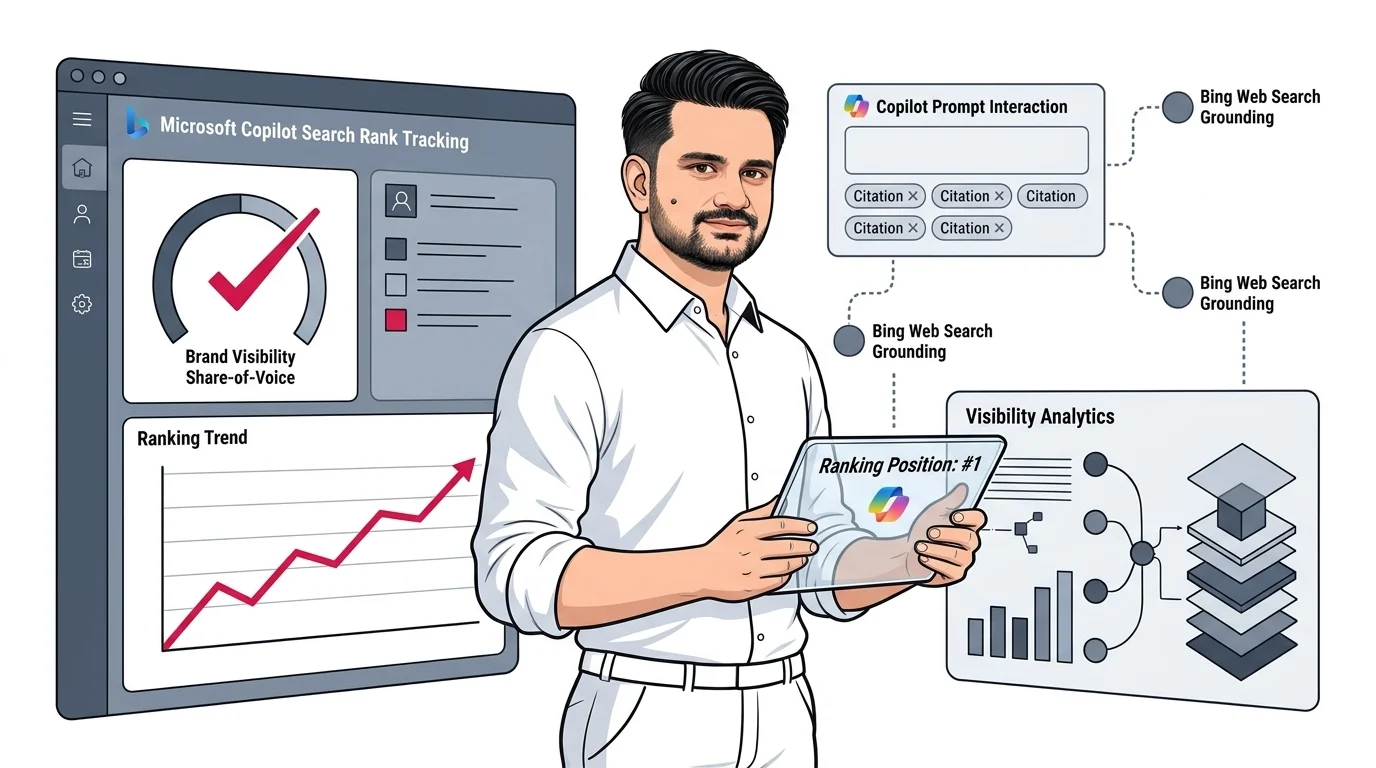
Discover the top copilot rank trackers in 2027 to monitor Microsoft Copilot citations, track brand mentions in Bing-powered answers, and measure your AI share of voice across conversational workflows. While early AI search optimization debates focused heavily on standalone consumer chatbots, Microsoft Copilot has quietly become the enterprise productivity engine of the Fortune 500. Embedded directly inside Windows 11, Microsoft Edge, Bing Search, Microsoft 365 apps (Word, Excel, Teams), and GitHub, Copilot synthesizes real-time web knowledge for millions of commercial decision-makers every single business day.
When an IT director asks Microsoft Copilot, "What are the best enterprise identity management platforms with SOC 2 compliance?", the software does not display ten blue links. Instead, Copilot executes a multi-step retrieval process: it queries Bing's web index, evaluates trusted entity models, synthesizes a prose recommendation, and appends interactive footnote citations. If your business is missing from those cited sources, you lose high-intent B2B pipeline before prospects ever visit a search results page.
Measuring performance in this generative ecosystem requires moving beyond legacy keyword ranking software. You cannot track traditional "Position 1" when an AI model dynamically generates bespoke paragraphs. In this exhaustive, practitioner-tested guide, we evaluate the top copilot rank trackers available today, break down how Copilot's Bing grounding mechanics function under the hood, and reveal the exact optimization framework required to turn Microsoft Copilot into a consistent customer acquisition channel.
Key Takeaways for SEO & Growth Leaders
- Microsoft Copilot is Grounded in Bing: Unlike closed training models, Copilot actively retrieves live web data via the Bing index. If your site is not indexed in Bing via IndexNow and verified in Bing Webmaster Tools, no rank tracker will register visibility.
- Citations Replace Positions: Copilot rank tracking evaluates four core metrics: Grounding Citation Rate, Share of Voice (SoV), Brand Sentiment Polarity, and Footnote Referral Positioning.
- Best Overall Tool for Copilot: Peec AI delivers the cleanest blend of prompt accuracy, multi-engine benchmarking (Copilot, ChatGPT, Gemini, Perplexity), and affordable entry pricing.
- Best Free Baseline: Bing Webmaster Tools (AI Grounding Report) provides first-party impression and citation data directly from Microsoft at zero cost.
Table of Contents
- How Microsoft Copilot Ranks and Cites Websites
- Why Traditional Rank Trackers Fail for Microsoft Copilot
- The 5 Metrics Every Copilot Rank Tracker Must Measure
- The Top 7 Copilot Rank Trackers Reviewed (2027)
- Side-by-Side Comparison Matrix
- Technical Prerequisites: Getting Indexed & Cited by Copilot
- Step-by-Step Audit Workflow with Copilot Rank Tracking Tools
- Frequently Asked Questions
- Next Steps: Scaling Your Generative Visibility
How Microsoft Copilot Ranks and Cites Websites
To select the right rank tracking tool copilot users need, you must first understand the architectural retrieval pipeline that powers Microsoft Copilot. Copilot is not simply a wrapper around OpenAI's GPT models; it relies on Microsoft's proprietary orchestrator known as the Prometheus engine.
When a user types a query or prompt into Copilot, Prometheus executes the following multi-tiered process in milliseconds:
- Query Disambiguation & Entity Expansion: Copilot expands the user's conversational prompt into multiple underlying web search queries. For instance, the prompt "Recommend top enterprise CRM software for healthcare providers" generates secondary search strings targeting HIPAA compliance, healthcare integrations, and client reviews.
- Bing Web Grounding (Live Retrieval): Copilot queries Bing's index in real time. It retrieves top-ranking organic URLs, verified schema entities, and authoritative knowledge panels.
- Cross-Document Contextual Synthesis: Prometheus synthesizes information from the top 5 to 15 retrieved pages, discarding low-quality or conflicting content.
- Footnote Citation Mapping: The model attaches numbered interactive citations (superscript links) to factual claims, brand recommendations, and technical specifications.
- Microsoft Graph Personalization (Enterprise Copilot): For commercial users signed into Microsoft 365, Copilot synthesizes enterprise data alongside web grounding, giving extra weight to vendors already referenced in corporate documents or emails.
Understanding this architecture demonstrates why monitoring copilot online rank tracking requires tools that simulate multi-turn conversational prompts, capture dynamic citations, and analyze Bing index retrieval paths.
Why Traditional Rank Trackers Fail for Microsoft Copilot
For more than two decades, standard search marketing relied on deterministic SERPs: ten numbered organic links displayed under a set of paid ads. Traditional rank tracking tools worked by scraping that static HTML list once every 24 hours.
This approach completely collapses when applied to copilot seo rank tracking for four distinct reasons:
1. Dynamic Answer Generation (Non-Deterministic SERPs)
Two users in different geographical locations—or even the same user asking the exact same question ten minutes apart—can receive subtly different prose answers from Copilot. A traditional scraper checking for a fixed position number encounters null values because "Position 3" does not exist in an AI conversation.
2. Unlinked Brand Mentions
Copilot frequently recommends a software tool, consultancy, or product by name within its explanatory text without inserting a direct hyperlink footnote for that specific sentence. Traditional backlink monitors completely miss these mentions, yet they carry massive brand influence. Sophisticated copilot rank tracking software uses natural language processing (NLP) to detect unlinked entity mentions and quantify their commercial impact.
3. Prompt Diversity and Conversational Variations
Searchers do not type "copilot rank tracker" into Copilot. They ask: "Can you compare the top copilot rank trackers on the market today and show me which one has the best Bing index integration?" Tracking must encompass diverse conversational prompt templates, varying intent angles, and follow-up prompt sequences.
4. Sentiment and Contextual Positioning
Being mentioned by an AI model is only half the battle. If Copilot mentions your brand but notes that "users frequently complain about slow customer support and steep pricing," your brand visibility is causing commercial harm. Modern AI rank tracking tools must score brand sentiment alongside pure citation counts.
The 5 Metrics Every Copilot Rank Tracker Must Measure
Before investing in any software platform, verify that it tracks the five foundational KPIs of generative AI visibility. These metrics mirror the standards outlined in our detailed framework on AI search visibility metrics and KPIs:
The Top 7 Copilot Rank Trackers Reviewed (2027)
We tested leading software platforms across 500 commercial B2B prompts on Microsoft Copilot over an eight-week evaluation window. Below are the definitive reviews of the top copilot rank trackers currently on the market.
Peec AI — Comprehensive Multi-Engine & Copilot Specialist
Peec AI is widely regarded as one of the most reliable and balanced copilot rank tracking tools on the market. Unlike platforms that lock Microsoft Copilot behind high-end enterprise tiers, Peec AI includes full Copilot tracking across its core subscription plans alongside ChatGPT, Google AI Overviews, and Perplexity.
Key Strengths:
- Direct Source & Citation Attribution: Breaks down exactly which URLs Copilot cites, their order in the text, and whether your competitors received higher citation priority.
- Sentiment & Tone Classification: Evaluates whether Copilot describes your brand favorably, neutrally, or highlights perceived limitations.
- Prompt Clustering: Allows you to group hundreds of industry-specific prompts into logical silos (e.g., "Product Comparisons", "Pricing Inquiries", "Technical Integrations").
Otterly.AI — Budget-Friendly Automated Monitoring
For small businesses, consultants, and boutique marketing agencies, Otterly.AI delivers the most accessible entry point into copilot site rank tracking software. While many competitors price out smaller marketing budgets, Otterly provides clean daily monitoring starting under $30 per month.
Key Strengths:
- Lightweight Daily Prompt Runs: Automatically queries Microsoft Copilot on a scheduled interval and alerts you when your domain enters or drops out of cited answers.
- White-Label PDF Exports: Generate polished executive summaries ready to send directly to clients showing AI mention progress.
- Minimal Learning Curve: Clean, uncluttered UI that allows you to set up tracking for 50 keywords within ten minutes.
PromptRush — Advanced AI Citation Gap Analysis
PromptRush focuses specifically on reverse-engineering the AI retrieval layer. As a specialized rank tracker tool copilot operators love, it does not just count mentions—it reveals exactly why Copilot selected your competitor's page over yours.
Key Strengths:
- Grounding Content Gap Reports: Analyzes the exact sentences and data points cited from competitors, showing you what statistical facts or schema tags your content lacks.
- Multi-Location Prompt Simulation: Simulates Copilot responses across different US, UK, EU, and Asia-Pacific IP addresses to account for localized Bing grounding.
- Competitor Disruption Tracking: Real-time notifications when a rival launches a campaign that displaces your brand in Copilot answers.
Profound — Enterprise AI Search Intelligence
If you manage organic growth for a Global 2000 corporation, Profound offers enterprise-grade infrastructure. Built with SOC 2 compliance, single sign-on (SSO), and massive prompt volume scalability, it delivers board-ready intelligence on Microsoft Copilot, Gemini, ChatGPT, and Apple Intelligence.
Key Strengths:
- Enterprise Governance & Security: Built for large enterprise security reviews with dedicated VPC deployments and role-based access control.
- Brand Protection & Hallucination Audits: Automatically flags instances where Copilot hallucinates incorrect pricing, outdated product specs, or false compliance claims.
- API Access: Seamlessly pipe raw citation data into Snowflake, BigQuery, or custom Looker business intelligence dashboards.
AIclicks — Specialized Bing & Copilot Overlap Analytics
AIclicks distinguishes itself by closely mapping the relationship between Bing's organic SERPs and Copilot's synthesized answers. While many tools treat Copilot as an isolated black box, AIclicks reveals the exact correlation between your Bing organic ranking and your likelihood of being cited by Copilot.
Key Strengths:
- Bing SERP vs. Copilot Correlation: Shows which Bing search rank positions (e.g. top 3 vs top 10) trigger citations in Prometheus.
- Prompt Intent Taxonomy: Categorizes prompts automatically by transactional, informational, navigational, and commercial intent.
- Direct URL Attribution: Pinpoints the highest-performing landing pages driving generative impressions.
Rankability Tracker — Microsoft Graph Grounding Insights
Rankability Tracker takes contextual analysis further by modeling how Copilot evaluates authoritative entities across both open-web Bing sources and structured document graphs. It provides deep semantic insight into how Copilot groups your brand into industry categories.
Key Strengths:
- Entity Graph Modeling: Uncovers whether Copilot recognizes your organization as an authoritative topical entity or merely as an unverified vendor.
- Comparative Mention Positioning: Evaluates whether your brand is listed as the primary recommendation or as an "alternative" option.
- Comprehensive Multi-Engine Auditing: Connects seamlessly with Claude SEO checking tools and Perplexity tracking.
Bing Webmaster Tools (AI Grounding Report) — First-Party Data
Before you spend a single dollar on paid third-party software, every webmaster must configure Bing Webmaster Tools. Because Microsoft owns both Bing and Copilot, this platform provides first-party ground truth on crawl status, IndexNow submissions, and generative AI search performance.
Key Strengths:
- First-Party Official Verification: Directly reports whether Microsoft Bingbot has crawled, rendered, and approved your pages for generative synthesis.
- Instant IndexNow Protocol: Notify Bing and Copilot within seconds whenever you publish new articles or update existing pricing pages.
- Zero Cost: Completely free for all verified website owners with no prompt limits.
Side-by-Side Comparison Matrix
Use this comprehensive comparison matrix to select the best rank tracking tool copilot operators need based on budget, engine coverage, and technical capability:
Technical Prerequisites: Getting Indexed & Cited by Copilot
A high-performance copilot online rank tracking tool will only show green checkmarks if your website meets Microsoft's technical ingestion standards. Many webmasters mistakenly complain that their rank tracker is inaccurate, when in reality Copilot's underlying Bing engine cannot index their pages.
To guarantee that your brand is eligible for Copilot citations, execute this four-step technical hygiene protocol:
1. Implement the IndexNow Protocol
Bing relies heavily on IndexNow—an open-source API protocol that immediately notifies search engines whenever content is created, updated, or removed. Websites utilizing IndexNow achieve indexing within minutes rather than waiting weeks for standard bot crawls.
POST /indexnow HTTP/1.1
Host: api.indexnow.org
Content-Type: application/json; charset=utf-8

{
  "host": "yourdomain.com",
  "key": "your-unique-indexnow-api-key",
  "keyLocation": "https://yourdomain.com/your-unique-indexnow-api-key.txt",
  "urlList": [
    "https://yourdomain.com/solutions/enterprise-cloud/",
    "https://yourdomain.com/pricing/"
  ]
}
2. Inject Comprehensive JSON-LD Entity Schema
Microsoft Copilot's Prometheus engine relies heavily on entity clarity. Ensure your pages feature robust Organization, SoftwareApplication, and FAQPage structured data. Include sameAs links pointing to authoritative corporate entity profiles on LinkedIn, Crunchbase, Wikipedia, and official regulatory filings.
3. Format Content for LLM Synthesizers (Extractable Facts)
Copilot favors pages that provide direct, concise answers immediately below subheadings. Use short declarative paragraphs (2-3 sentences), followed by bulleted specifications, comparison matrices, and verifiable numerical data points. Learn how comparative content structures directly influence answer engine selection in our guide on how comparison content affects AEO rankings.
4. Ensure Clean Server Response Headers & Fast TTFB
When Prometheus initiates a live web query, it operates under tight timeout budgets (often under 800ms). If your web server has a sluggish Time to First Byte (TTFB) or returns complex JavaScript rendering hurdles, Copilot skips your URL in favor of a faster competitor.
Step-by-Step Audit Workflow with Copilot Rank Tracking Tools
Once you have selected one of the top copilot rank trackers, follow this four-phase operational workflow to execute monthly visibility audits and expand your AI citation footprint:
Phase 1: Seed High-Intent Commercial Prompts
Compile a target list of 50 to 100 commercial prompts that your prospective buyers actually ask Copilot. Avoid generic single keywords. Focus on comparison queries ("Brand A vs Brand B"), "Best tool for [use case]" prompts, and technical integration questions.
Phase 2: Baseline Citation & SoV Benchmark
Run your prompt list across your chosen rank tracker (such as Peec AI or PromptRush). Record your initial Grounding Citation Rate, total brand mentions, and sentiment score. Identify which competitors currently dominate footnote citations [1] and [2].
Phase 3: Identify Content Gaps in Grounding Sources
Inspect the specific landing pages Copilot cites instead of yours. Examine their heading hierarchy, statistical data tables, and schema markup. Update your existing landing pages with fresh benchmarks, transparent pricing tables, and verified third-party case study proof.
Phase 4: Instant IndexNow Ping & Rescan
After publishing content updates, ping the Bing API immediately via IndexNow. Schedule a rescan in your rank tracker 72 hours later to verify that Copilot has updated its synthesized citations to feature your domain.
Frequently Asked Questions
Does Microsoft Copilot use the same index as ChatGPT?
No. While Microsoft is a major investor in OpenAI and utilizes GPT reasoning models, Copilot grounds its real-time web answers strictly through the Bing search engine index and Microsoft Graph. In contrast, ChatGPT utilizes a proprietary web crawler (OAI-SearchBot) alongside licensed third-party integrations.
How often do Copilot rank tracking tools refresh data?
Most commercial platforms (such as Peec AI and PromptRush) update prompt monitoring daily or on-demand via API triggers. Budget tools like Otterly.AI typically offer weekly or daily scheduled refreshes depending on your chosen subscription tier.
Can I track Copilot rankings for local geographic searches?
Yes. Advanced platforms allow you to set IP-based location proxies (e.g., Chicago, London, Sydney). Because Copilot personalizes responses based on user IP and Bing local business listings, geo-targeted tracking is essential for multi-location enterprises.
What is a good citation rate for Copilot tracking?
For branded queries, you should aim for a 90%+ citation rate. For non-branded commercial comparison prompts (e.g., "best accounting software for dental clinics"), achieving a 30% to 45% citation frequency across competitive prompts positions you as a dominant category leader.
Next Steps: Scaling Your Generative Visibility
Microsoft Copilot has transitioned from an experimental chatbot into the default AI assistant for millions of business professionals across the globe. Organizations that rely exclusively on legacy Google rank trackers are operating blind in a rapidly evolving conversational search marketplace.
By deploying one of the top copilot rank trackers outlined in this guide—such as Peec AI, Otterly.AI, or PromptRush—you gain real-time visibility into your brand's AI share of voice, uncover untapped grounding gaps, and protect your digital reputation.
Explore our specialized AI search visibility services to audit your generative footprint across Microsoft Copilot, ChatGPT, Claude, and Google AI Overviews, or read our breakdown of brand mentions in Gemini to dominate citations across Google's conversational ecosystem.