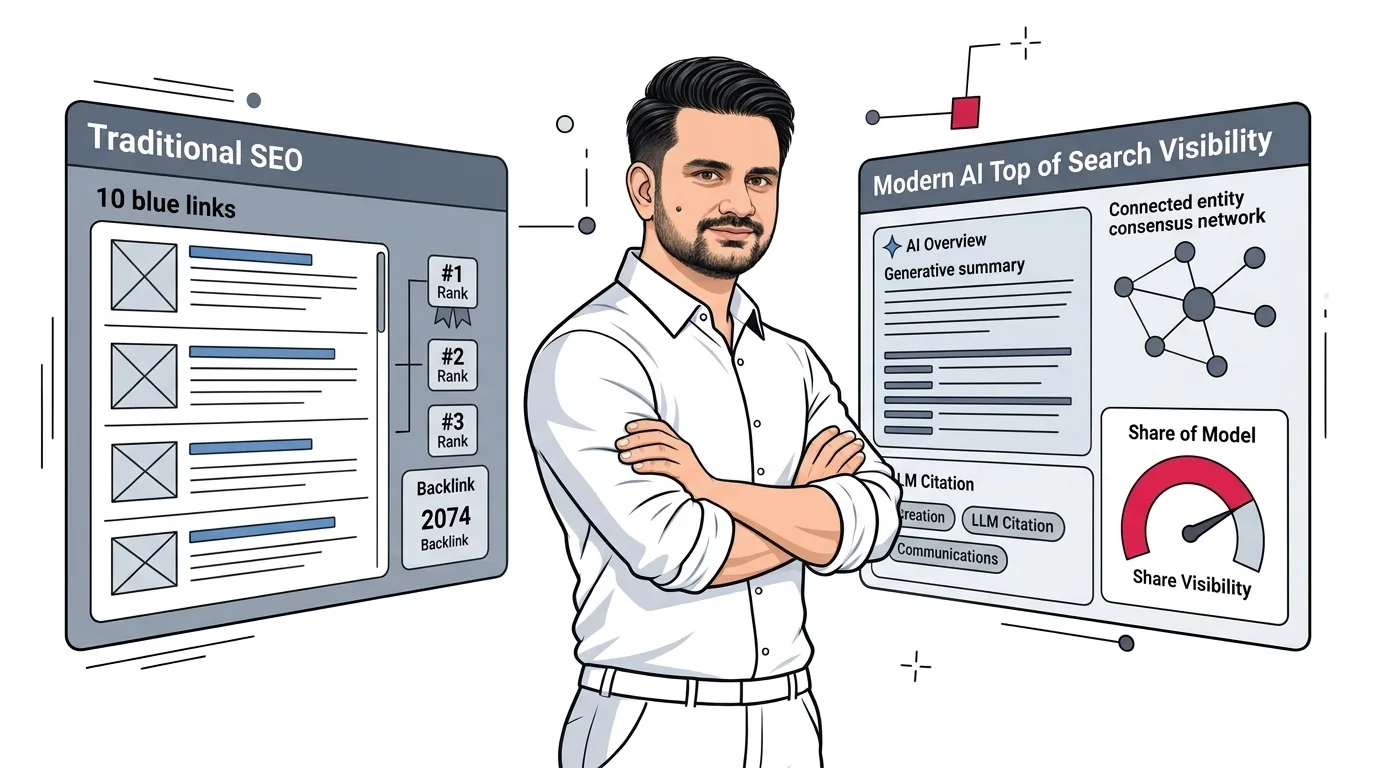
When modern growth leaders evaluate top of search on visibility strategy vs traditional seo, they confront a radical shift in how consumers and B2B buyers discover brands. In 2026, securing a rank #1 spot in traditional "10 blue links" no longer guarantees business visibility: a modern top of search visibility strategy vs traditional seo framework accounts for zero-click answers, Google AI Overviews, and conversational engines like ChatGPT and Perplexity to move from page-level keyword ranking to omnipresent entity visibility.
For more than two decades, search engine optimization followed a simple formula: identify target keywords, optimize HTML title tags and body text, build external backlinks, and climb organic rank positions. However, search behavior has fundamentally decoupled. Today, over 60% of Google searches end without a user clicking through to any website (Zero-Click Searches), while AI-synthesized answer boxes occupy the entire above-the-fold screen space on mobile and desktop devices.
In this strategic evaluation, we compare Traditional SEO against a Top of Search Visibility Strategy (incorporating Generative Engine Optimization and Answer Engine Optimization), dissect the mechanics of how AI models source consensus brand recommendations, and outline the unified hybrid framework necessary to dominate modern search.
The Changing SERP: Why Rank #1 Is No Longer Enough
To rigorously evaluate top of search on visibility strategy vs traditional seo, you must examine how the Search Engine Results Page (SERP) has evolved over the past 24 months. In previous eras, ranking position #1 placed your snippet at the top of the browser viewport, capturing 28% to 35% of all organic clicks.
Today, a desktop or mobile search query for a commercial or technical phrase presents a drastically altered visual hierarchy:
- Sponsored Ads (Google Ads): Two to four paid ads frequently take up the top 300 pixels of vertical space.
- Google AI Overview (AIO): A generative multi-paragraph synthesis directly answering the user’s query with embedded citation pills, interactive carousels, and follow-up prompt pills.
- Local Map Pack / Merchant Grid: Geographical maps or product cards displaying reviews, pricing, and operating hours.
- People Also Ask (PAA) Accordions: Four to eight interactive question drawers.
- Traditional Organic Result #1: Pushed far "below the fold," often requiring two to three full thumb scrolls on a mobile smartphone to become visible.
According to empirical clickstream studies conducted by SparkToro, more than 60% of all Google searches now conclude as "Zero-Click Searches": the user gets their complete answer from AI Overviews or featured snippets without clicking through to a single external website. Under this reality, merely ranking #1 in organic links is insufficient; brands must capture the top of search visibility layer.
Defining the Two Paradigms: Traditional SEO vs. Visibility Strategy
While both disciplines share the ultimate objective of driving qualified commercial pipeline, their operational mechanics and targets are fundamentally distinct.
What is Traditional SEO?
Traditional SEO is an indexing and ranking science focused on individual web pages. Its primary unit of currency is the URL, and its primary measurement of success is rank position and organic click traffic. Traditional SEO optimizes title tags, meta descriptions, heading structures, internal linking silos, and external backlink profiles to convince search engine crawlers that a specific URL matches a specific keyword intent.
What is a Top of Search Visibility Strategy?
A Top of Search Visibility Strategy (often encompassing Generative Engine Optimization / GEO and Answer Engine Optimization / AEO) is an entity-centric marketing discipline. Its primary unit of currency is the Brand Entity, and its primary measurement of success is Share of Model (SoM), AI citation frequency, and synthesized recommendation inclusion.
A visibility strategy does not merely optimize pages on your website; it manages your brand's digital consensus across the entire web ecosystem (forums, Reddit threads, industry review hubs, Wikidata, digital PR publications, and podcasts) so that Large Language Models (LLMs) and search algorithms recognize your brand as the definitive authority to recommend.
Master Comparison Matrix: Mechanics, KPIs & Value Delivery
To clearly see the structural differences between these two methodologies, review this comprehensive comparison matrix:
| Strategic Dimension | Traditional SEO | Top of Search Visibility Strategy |
|---|---|---|
| Primary Target | Individual URLs & specific keyword queries | Brand Entity & Semantic Web Consensus |
| Primary Surfaces | Google 10 blue links, Bing web results | Google AI Overviews, Perplexity, ChatGPT, Gemini |
| Core Discovery Engine | Inverted index lookup & PageRank link graphs | Vector embeddings & Retrieval-Augmented Generation (RAG) |
| Primary Unit of Value | Organic Clicks & Sessions on site | Brand Mentions, AI Citations & Direct Inquiries |
| Query Type Focus | Short-to-mid tail keywords (e.g., "b2b crm software") | Complex prompts (e.g., "Compare HIPAA-compliant CRMs for dental clinics") |
| Off-Page Focus | Backlinks with exact anchor text (DoFollow links) | Third-party corroboration, Reddit sentiment, expert quotes |
| Core Success Metric | Average Keyword Position & GA4 Organic Sessions | Share of Model (SoM) & AI Citation Frequency |
The Decoupling of Traditional Rankings and AI Citations
One of the most profound discoveries in recent search research is the decoupling phenomenon. When Google first launched generative search features, early analysts assumed that the AI would simply pull summaries from the top 3 ranking organic pages.
Empirical tracking across hundreds of thousands of AI Overviews proved this assumption false:
- Over 50% of URLs cited in Google AI Overviews do not rank in the traditional organic Top 10 for that query.
- Conversational engines like Perplexity and ChatGPT Search cite third-party review platforms (G2, Trustpilot), community forums (Reddit, Stack Overflow), and specialized niche blogs far more frequently than corporate homepages with high Domain Rating (DR).
- A company can spend $10,000 per month climbing to rank #2 on Google organic results, yet be completely excluded from the AI Overview that summarizes the top solution to users.
Why does this happen? Because generative engines do not rank pages by PageRank; they rank information by semantic relevance, factual consensus, and information density. If an LLM encounters conflicting claims or generic corporate fluff, it excludes the source in favor of consensus-verified data. Read our technical deep-dive on RAG for SEO and retrieval pipeline mechanics to understand how AI engines select their citations.
How a Top of Search Visibility Strategy Works Mechanically
Transitioning from a traditional keyword mindset to a top of search visibility strategy requires mastering three distinct technical layers:
5.1. Entity Corroboration & Web Consensus Networks
Large Language Models do not "believe" what a company says about itself on its own website. If your homepage claims "We are the #1 cybersecurity consultancy in Chicago", an LLM treats that as an unverified self-assertion.
To win AI citations, that claim must be corroborated across independent third-party sources:
- Consistent business entities on Crunchbase, LinkedIn, Wikidata, and industry accreditation bodies.
- Active, positive sentiment in peer discussions across Reddit, Hacker News, and Quora.
- Unbiased editorial coverage in verified trade publications and podcasts.
- When an LLM synthesizes an answer, it evaluates vector distance across these corroborating sources. When multi-source consensus confirms your authority, your brand is selected as the recommended entity.
5.2. Information Gain & First-Hand Primary Data
Traditional SEO often rewarded "skyscraper content": finding the top 5 articles on Google and writing a longer, 4,000-word compilation of the same facts. In an AI-first search environment, this tactic is suicidal.
AI search models already possess the world's common knowledge. They do not cite pages that regurgitate known definitions. They cite pages with high Information Gain: proprietary benchmarks, primary survey data, real-world pricing breakdowns, client case studies, and contrarian expert perspectives. Every guide must provide unique data that exists nowhere else on the internet.
5.3. Structured JSON-LD & Retrieval-Augmented Generation (RAG)
For an AI engine to extract information effortlessly, your content must be structurally accessible. LLMs and vector embedding pipelines process structured JSON-LD schema markup with near-zero compute latency compared to parsing unstructured HTML tables and scripts.
Deploying linked entity schemas (e.g., nesting Organization, Person, Service, and FAQPage within a single @graph) enables AI crawlers to map your founders, commercial offerings, and customer reviews directly into their entity knowledge graphs.
Measuring Success: "Share of Model" vs. Traditional Rank Tracking
When you evaluate top of search on visibility strategy vs traditional seo, reporting metrics must undergo a fundamental upgrade. Tracking keyword rankings alone provides a dangerous illusion of security.
The New Metric: Share of Model (SoM)
Share of Model (SoM) measures the percentage of times your brand is recommended or cited when target buyer personas prompt AI engines (Google Gemini, Perplexity, ChatGPT) with commercial queries in your niche. If you test 100 conversational prompts in your sector and your brand is recommended in 35 answers, your Share of Model is 35%.
A mature enterprise search report in 2026 tracks three complementary measurement tiers:
- Traditional Organic Health (Foundation): Google Search Console clicks, impressions, and indexation status.
- Top of Search Inclusion (Visibility Layer): Featured snippet ownership, AI Overview citation rates, and Google Map Pack visibility.
- Generative Engine Mindshare (Conversion Layer): Brand citation frequency inside Perplexity Pro, ChatGPT Search, and Claude conversational workflows.
Strategic Risks: What Happens If You Ignore Either Approach?
A dangerous mistake made by marketing leaders is declaring that "traditional SEO is dead" and abandoning classic search engineering entirely. The truth is that relying exclusively on either approach creates catastrophic strategic vulnerabilities:
The Danger of Only Doing Traditional SEO
If you only practice traditional SEO, your website will suffer from progressive click starvation. Even if your team successfully pushes your pages to position #1, rising zero-click answers, AI Overviews, and interactive shopping grids will intercept up to 70% of potential visitors before they ever reach your link. Over a 24-month horizon, your organic CAC will rise while pipeline volume decays.
The Danger of Abandoning Traditional SEO for "Pure AI Optimization"
If you ignore traditional SEO to chase trendy "AI visibility hacks", your digital foundation will collapse. Large language models and AI retrieval engines rely directly on Google's search index to find sources. If your website has crawl errors, broken canonical tags, slow Core Web Vitals, or poor mobile responsiveness, AI crawlers cannot ingest your data. Traditional technical SEO is the foundation upon which all AI visibility is built.
To learn the realistic timeline for building these foundations, read our analysis on how long SEO takes to show results, and explore the essential questions to ask when hiring an SEO company.
The Unified Hybrid Framework: How Winning Brands Combine Both
The elite growth brands in 2026 do not choose between traditional SEO and top of search visibility; they deploy a Unified Hybrid Search Framework. This approach utilizes traditional search engineering to capture high-intent transactional search, while leveraging entity consensus to dominate AI-synthesized answer layers.
The 4 Pillars of the Unified Hybrid Framework
- Pillar 1: Flawless Technical Architecture (The Crawl Layer): Ensure sub-second server response times, zero Cumulative Layout Shift (CLS), clean canonical mapping, and structured JSON-LD schema. If search bots cannot parse your site cleanly, nothing else matters.
- Pillar 2: Topic Clusters & Long-Tail Intent (The Long-Tail Layer): Build focused, interconnected topical silos that answer specific user problems without keyword stuffing. Master our proven long-tail keyword strategy for niche websites to build undeniable domain relevance.
- Pillar 3: Primary Information Gain & E-E-A-T (The Citation Layer): Infuse every published guide with verifiable case studies, proprietary dataset findings, and named expert authorship. Give AI models a compelling reason to cite you as the authoritative source.
- Pillar 4: Digital PR & Cross-Web Consensus (The Entity Layer): Actively manage your brand footprint across external industry review hubs, podcast appearances, and authentic community discussions. Ensure third-party consensus aligns with your core commercial positioning.
Frequently Asked Questions (FAQ)
Will AI Overviews completely replace traditional organic website clicks?
No. While AI Overviews handle quick informational and definitional queries without a click, users conducting deep B2B research, purchasing complex software, booking specialized services, or requiring trusted legal and financial execution continue to click through to authoritative websites. However, they click on the brands cited inside the AI summary.
Can you optimize directly for ChatGPT or Perplexity?
Yes. By deploying clear entity schema markup, earning mentions across trusted third-party consensus databases (Wikidata, Reddit, industry review platforms), and structuring content with direct question-and-answer summaries, you increase the mathematical probability of LLM retrieval pipelines selecting your content.
Is a Top of Search Visibility Strategy more expensive than traditional SEO?
A visibility strategy typically requires a slightly higher investment because it combines traditional technical SEO with Digital PR, brand entity management, and primary research data production. However, it delivers significantly higher ROI by insulating your business against zero-click traffic decay and algorithmic disruptions.
Conclusion & Strategic Executive Summary
When you evaluate top of search on visibility strategy vs traditional seo, the conclusion is clear: traditional keyword ranking is a necessary but no longer sufficient condition for digital dominance in 2026.
Traditional SEO provides the technical infrastructure and page-level indexation that search engines require. A Top of Search Visibility Strategy elevates your brand entity into AI Overviews, generative search citations, and cross-web consensus recommendations. Brands that unite both disciplines capture the entire search funnel—from conversational discovery to final commercial conversion.
Ready to engineer an authoritative, AI-proof search presence for your business? Explore our specialized AI search visibility consulting services, or review our verified client case studies to see how we drive compounding organic revenue.
Is Your Brand Visible Where Modern Buying Decisions Happen?
Don't let zero-click search or generative AI erode your organic pipeline. ShazzSEO designs advanced technical architectures and entity consensus strategies to ensure your brand dominates the top of search.