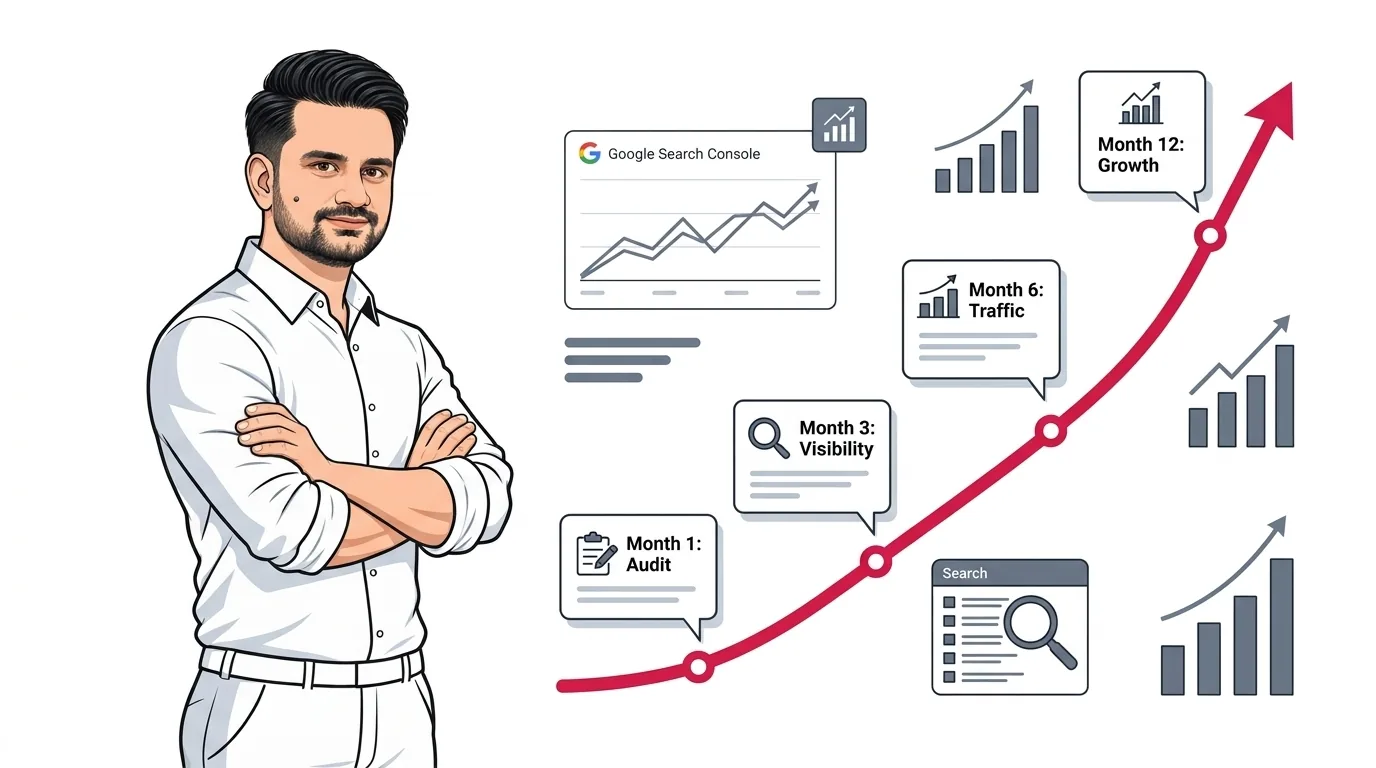
Wondering how long does seo take before your business sees meaningful traffic and qualified leads in 2026? When it comes to seo how long does it take depends on domain age, competition, and technical health, but industry benchmarks from Google, Ahrefs, and Semrush show measurable results start within 3 to 6 months, while compounding ROI accelerates across 6 to 12 months.
Every business owner investing in organic search wants an honest, realistic answer before committing their budget. Unlike paid ads that turn on and off like a light switch, search engine optimization functions like compound interest. The early work feels invisible while technical foundations and entity trust are established, but once rankings mature, organic visibility delivers consistent customer acquisition without ongoing ad costs.
In this comprehensive guide, we examine empirical research across millions of URLs, dissect Google’s official ranking timeline guidance, explain the four distinct stages of the SEO lifecycle, and provide actionable strategies to safely accelerate your results.
How Long Does SEO Take? The Realistic Answer in 2026
To give an unvarnished answer: for most commercial websites, SEO takes between 3 to 6 months to show measurable traffic increases and early leads, and 6 to 12 months to achieve meaningful, compounding return on investment (ROI).
Google’s official developer and search advocate guidance confirms this timeline. When interviewing vendors, prepare the right questions to ask when hiring an SEO company to ensure they have realistic, white-hat timelines. In Google’s official video guide on hiring SEO agencies, former Google Search Quality advocate Maile Ohye states: "In most cases, SEOs need four months to a year to help your business first implement improvements and then see potential benefit."
Why does it take this long? Because Google must crawl your changes, process entity relationships, test user engagement signals, evaluate historical backlink velocity, and confirm that your domain consistently delivers authoritative information before awarding permanent first-page rankings.
The 4 Phases of SEO Performance Growth
- Phase 1 (Month 1): Technical infrastructure, architecture repair, canonical alignment, and zero traffic movement.
- Phase 2 (Months 2–3): Search Console impression expansion and movement from position 50+ to 20+.
- Phase 3 (Months 4–6): First-page breakthroughs for targeted long-tail phrases and noticeable organic traffic inflection.
- Phase 4 (Months 6–12+): Authority maturation, competitive head-term rankings, and compounding conversion volume.
What the Industry Data Says: Ahrefs, Semrush & Google Studies
Large-scale empirical studies by major search intelligence platforms provide objective statistical proof of how search rankings mature over time.
The Ahrefs Study: How Long Does It Take to Rank in Google?
In one of the largest empirical SEO studies ever conducted, Ahrefs tracked 2 million random newly published pages over one year. The findings reveal the true nature of search competition:
- Only 5.7% of all newly published pages ranked in Google’s Top 10 for at least one search query within their first year of publication.
- Even among that high-performing 5.7%, reaching page one took an average of 61 to 182 days (2 to 6 months).
- The average Top 10 ranking page in Google is 2+ years old (roughly 730 days), and the average #1 ranking page is almost 3 years old.
- Pages with high Domain Rating (DR 60+) broke into the Top 10 significantly faster than fresh domains with DR under 20.
The Semrush Ranking Factor Findings
Semrush data analyzing keyword difficulty across hundreds of thousands of SERPs confirms that keyword difficulty (KD) directly dictates the ranking timeline:
- Low-Difficulty Keywords (KD < 20): Often reach the first page within 60 to 90 days when supported by thorough content depth.
- Medium-Difficulty Keywords (KD 20–50): Require an average of 120 to 180 days (4 to 6 months) and strong topical clustering.
- High-Difficulty Commercial Head Terms (KD 50+): Almost universally require 9 to 18 months of steady backlink acquisition and established domain authority.
This is why pursuing a deliberate long-tail keyword strategy is essential for new and growing domains. Long-tail phrases bypass the 12-month waiting period and generate revenue within the first 90 days.
The 4 Distinct Stages of the SEO Lifecycle
Understanding what actually happens behind the scenes during an organic search campaign prevents business owners from cancelling campaigns prematurely right before rankings explode.
Stage 1: Month 1 (Technical Auditing, Architecture & Index Cleanup)
Month one is strictly engineering and diagnostic. No client should expect traffic surges in week three. During this phase, an experienced consultant audits the codebase, discovers crawl bottlenecks, eliminates redirect chains, resolves canonical conflicts, and configures tracking.
Deliverables in Month 1 typically include:
- Full technical site crawl (via Screaming Frog or custom Python scripts) to resolve 404s, 500s, and redirect loops.
- XML sitemap reorganization, robots.txt directives, and canonical tag mapping.
- Core Web Vitals optimization (LCP, CLS, INP) to ensure page speed meets Google standards.
- Keyword universe mapping and semantic cluster architecture blueprint.
Stage 2: Months 2–3 (Indexation, Entity Disambiguation & Impressions)
In months two and three, Google’s crawlers re-index updated technical templates and begin reading newly deployed topic clusters. The most significant early indicator appears in Google Search Console: total impressions begin climbing steadily, even while organic clicks remain modest.
What happens in Search Console during this stage:
- Your target URLs move from unindexed or position 80+ into positions 25 to 45.
- Google tests your pages for secondary search queries and semantic long-tail variations.
- Knowledge Graph entity reconciliation occurs: Google begins recognizing your business entity, services, and geographical footprint.
Stage 3: Months 4–6 (Traffic Inflection & Early Conversions)
Months four through six represent the inflection point. URLs that sat on page three or four begin breaking into the top 10 positions. Organic click lines in Google Analytics 4 (GA4) show an upward angle, and phone calls, form submissions, or e-commerce checkouts begin originating from organic search.
Key milestones in Stage 3:
- Primary cluster URLs reach page one (positions 4 to 10) for low-to-medium difficulty keywords.
- Featured snippets, People Also Ask (PAA) boxes, and Google AI Overviews begin citing your content.
- Internal link equity starts flowing effectively from cluster pages upward to pillar landing pages.
Stage 4: Months 6–12+ (Topical Flywheel & Compounding Pipeline)
Past month six, the flywheel effect takes over. Because Google has recorded months of positive user engagement, clean crawl logs, and growing topical authority, new content published during this phase indexes and ranks within days rather than months.
By month 12, established campaigns achieve:
- Top 3 positions for primary commercial service keywords.
- Broad non-branded organic reach that generates steady daily inbound pipeline.
- Substantial resilience against routine core algorithm updates.
- Significantly lower customer acquisition cost (CAC) compared to Google Ads or social pay-per-click.
6 Critical Factors That Dictate Your SEO Timeline
When clients ask when it comes to seo how long does it take, the exact timeframe is determined by six fundamental operational variables:
| Variable | Fastest Timeline Scenario | Slowest Timeline Scenario | Impact on Speed |
|---|---|---|---|
| 1. Domain History | 5+ year old domain with clean backlink profile | Brand-new domain registered last week | Massive (2x to 4x faster) |
| 2. Competition Level | Niche B2B software or local service market | National fintech, insurance, or legal niche | Severe (6 mo vs 24 mo) |
| 3. Technical Foundation | Clean semantic HTML, sub-second TTFB, 0 CLS | Bloated JS framework, 5s load time, redirect loops | High (Can block indexation) |
| 4. Content Velocity | 8–12 comprehensive cluster guides per month | 1 generic 500-word post every 60 days | Accelerates Authority |
| 5. Backlink Profile | Natural mentions from industry publishers & PR | Zero referring domains or spam directory penalties | Determines Ceiling |
| 6. Implementation Speed | Technical fixes approved and deployed within 48h | Dev teams take 3 months to push title changes | Direct Project Lag |
New Websites vs. Established Websites: Timeline Comparison Matrix
One of the biggest misunderstandings in search marketing is treating a newly launched domain the same as an established website with ten years of brand history. Their growth trajectories are fundamentally different.
The New Website Timeline (The Evaluation Period)
When you launch a brand-new domain, Google does not know who you are, whether your content is reliable, or if your domain will still exist in six months. In the SEO community, this is commonly referred to as the "Google Sandbox period."
During the first 3 to 6 months for a new site:
- Google crawls conservatively to conserve crawl budget.
- Pages might index but hover on positions 60 to 90 while Google measures query intent and bounce rates.
- Focusing on high-volume keywords during this stage is wasted effort; targeting ultra-specific low-difficulty long-tail queries is the only way to establish initial trust.
The Established Website Timeline (The Striking-Distance Advantage)
If your website already has an established domain age, existing backlinks, and domain authority, SEO results can occur remarkably fast: often within 14 to 45 days.
For established domains, professional SEO consultants look for "striking distance" keywords: queries currently ranking between positions 11 and 25. By updating the on-page copy, adding missing semantic entities, improving mobile UX, and injecting contextual internal links, these URLs frequently jump onto page one in a matter of weeks.
Explore our specialized technical SEO consulting to learn how rapid architecture fixes unlock immediate ranking gains on older domains.
Early Signs Your SEO Is Working (Before Revenue Appears)
Because revenue and lead volume are lagging indicators, watching revenue during months one to three will make you feel like nothing is happening. Instead, look for these five leading indicators in Google Search Console and server logs:
- Google Search Console Total Impressions Surge: Total impressions almost always spike 6 to 10 weeks before organic clicks increase. Rising impressions mean Google is testing your pages across thousands of search queries.
- Average Position Drift (Right to Left): Your average keyword positions move steadily from position 70 toward position 20.
- Googlebot Crawl Frequency Increases: Checking your server access logs reveals Googlebot is crawling your domain daily rather than weekly, indicating growing algorithmic priority.
- Expansion of Non-Branded Queries: Search Console starts showing clicks from users searching for your services rather than your company name.
- Perplexity and AI Overview Citations: Modern search engines cite your content in generative summary boxes. Read our complete guide to RAG for SEO and AI search visibility to learn how retrieval pipelines evaluate sources.
5 Common Traps That Delay SEO Results
When campaigns take 12 months without showing any traction, it is rarely because "SEO does not work." It is almost always because the site fell into one of these five common traps:
- Cancelling the Campaign at Month 3: Cancelling at month three is like buying plane tickets, taxiing down the runway, and jumping out of the plane right before takeoff. Month three is when the heaviest technical groundwork finishes and the curve begins to turn upward.
- Publishing Content on a Broken CMS Architecture: Publishing 50 blog posts on a site with massive JavaScript render blocking, broken canonicals, or 6-second mobile load times yields zero results. Technical SEO must come first.
- Chasing Unrealistic Head Terms: If your brand has a domain rating of 12, trying to rank for "business insurance" or "crm software" is mathematically futile. You must conquer topical clusters and long-tail variants first.
- Redesigning Without 301 Redirect Mapping: Rebuilding a website and changing URL structures without meticulous 1-to-1 301 redirects instantly destroys years of earned search equity. We have seen companies lose 80% of their organic pipeline overnight from botched migrations.
- Flooding the Domain with AI-Generated Fluff: Google’s Helpful Content and core update algorithms aggressively devalue thin, regurgitated content that adds zero information gain. Every published article must contain unique expert insight or first-hand experience.
How to Safely Accelerate Your SEO Timeline
While you cannot force Google’s algorithms to act overnight, proven technical and architectural strategies can significantly compress your growth timeline:
- Target Striking Distance Keywords First: Filter Google Search Console for keywords ranking in positions 8 to 20 with high impressions. Refreshing these pages delivers organic traffic in 30 days rather than 6 months.
- Deploy Tight Topical Silos: Rather than writing random blog posts on unrelated subjects, publish 5 to 8 interconnected guides covering one tight topic cluster simultaneously. Interlink them with descriptive anchor text to build immediate topical authority.
- Fix Core Web Vitals and Mobile CLS: Eliminating Cumulative Layout Shift (CLS) and reducing Interaction to Next Paint (INP) ensures Google’s mobile crawler rates your user experience favorably.
- Build Digital PR and Founder Authority: Pair on-page SEO with genuine brand mentions on podcast interviews, press features, and industry publications to pass entity signals to Google's Knowledge Graph.
Review our verified SEO case studies to see how strategic technical fixes and topical clustering drove dramatic organic revenue growth across real-world client websites.
Frequently Asked Questions (FAQ)
Can SEO produce results within 30 days?
Yes, but primarily on established websites with existing domain authority that have unoptimized striking-distance keywords (positions 11–20) or easily resolved technical crawl blocks. For brand-new domains, ranking competitive keywords within 30 days is statistically near zero.
Why does Local SEO rank faster than National or International SEO?
Local SEO (such as ranking in Google’s Local Map Pack) typically produces results in 4 to 12 weeks because you are competing only against local businesses within a tight geographic radius, rather than competing nationally against global brands and directory giants.
What happens to my traffic if I stop doing SEO?
Unlike paid advertising which drops to zero traffic the moment you stop paying, organic search results retain momentum. However, without ongoing content publishing, technical maintenance, and link acquisition, competitors will gradually overtake your positions over a period of 6 to 18 months.
How much does professional SEO cost per month?
Reputable, experienced SEO agencies and technical consultants typically charge between $1,500 and $7,500+ per month depending on site complexity, market competition, and publishing volume. Cheap $200/month services almost universally use automated spam links that risk permanent Google algorithmic penalties.
Conclusion & Strategic Takeaways
Understanding how long does seo take allows business leaders to allocate marketing budgets intelligently. SEO is not a sprint or a lottery ticket; it is a foundational business asset that compounds value year after year.
Expect early diagnostic and impression gains in months 1 to 3, noticeable organic traffic inflection in months 3 to 6, and compounding, scalable commercial returns across months 6 to 12+.
Ready to build a predictable, high-converting organic search pipeline for your company? Explore our complete SEO consulting services or reach out today for a comprehensive organic audit.
Build an Unshakable Search Engine Advantage
Stop guessing when organic traffic will arrive. ShazzSEO engineers rigorous technical foundations, topical authority architectures, and conversion-focused content strategies designed to produce sustainable ROI.