If you have watched your traditional organic click-through rates shift over the past twelve months, you already know the ground has moved. Search is no longer just a retrieval system matching strings of keywords to indexed documents; it has evolved into a synthesis engine.
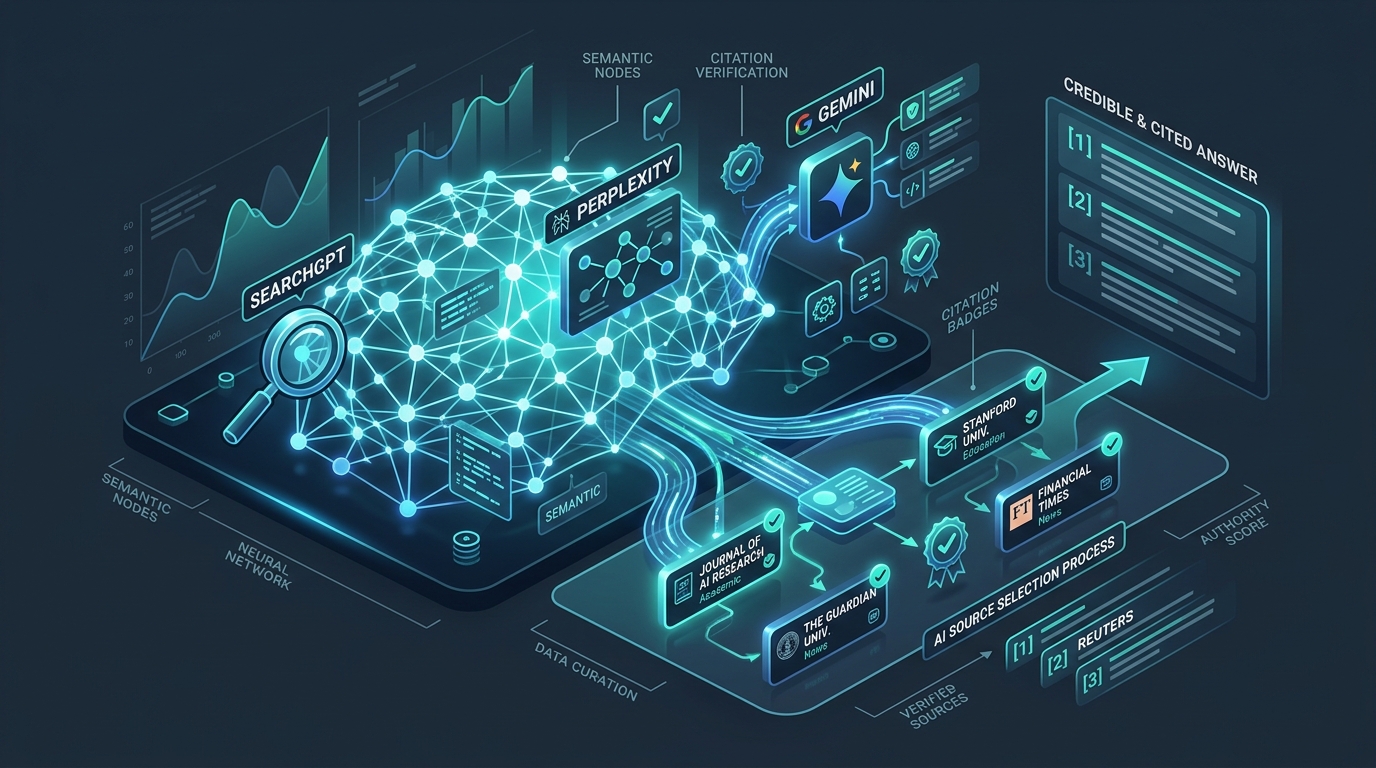
Whether it is Google’s AI Overviews, Perplexity Pro, OpenAI’s SearchGPT, or Gemini, the fundamental question for modern search marketing is no longer “How do I rank #1 on the SERP?” It is “Why does an LLM choose one domain as a cited source while completely ignoring ten others?”
In this guide, we break down the exact retrieval and extraction mechanics that AI search models use to select reference citations, and how you can architect your content to become the authoritative source AI models rely on in 2026.
1. The RAG Pipeline: How AI Engines Actually “Read” Your Site
To understand why an AI search engine cites your page, you have to understand Retrieval-Augmented Generation (RAG). When a user enters a prompt, the engine does not perform a classical keyword match. Instead, it executes a multi-stage pipeline:
- Query Expansion & Intent Decomposition: The LLM breaks the user query into multiple sub-questions and semantic vector representations.
- Vector & Hybrid Retrieval: The engine queries its index (using a blend of BM25 keyword matching and dense vector embeddings) to retrieve top candidate passages.
- Reranking & Context Chunking: The most semantically dense chunks (200–500 token segments) are scored for factual density, information gain, and authority.
- LLM Synthesis & Citation Insertion: The model generates the final answer and anchors citations directly to the exact chunks that provided verifiable facts.
If your content is bloated with conversational fluff or lacks distinct, attributable claims, the reranker discards your chunk before it ever reaches the synthesis window.
2. The 3 Primary Signals That Trigger AI Citations
Signal 1: Information Gain (The Death of Paraphrased Content)
In 2026, LLMs have already ingested the general web. They already know definitions, basic histories, and generic summaries. When an AI search engine evaluates candidate sources, it prioritizes Information Gain—content that provides unique data points, proprietary case studies, first-hand experiments, or novel frameworks.
If your article simply summarizes the top 5 ranking articles on Google, your information gain score is near zero. AI models will not cite a summary when they can cite the primary source.
Signal 2: Entity Triangulation & Semantic Clarity
AI models reason in Entities and Relationships (Nodes and Edges in a Knowledge Graph). When discussing a topic, ensure every technical term, metric, brand, and methodology is clearly defined without ambiguous pronouns (e.g., using “Google’s Gemini 1.5 Pro architecture” instead of “it”).
Signal 3: High Chunk Extractability (Structured Answers)
LLM context windows prioritize high-density formatting:
- Markdown Tables: Comparing features, pricing, metrics, and benchmarks.
- Definition-First Paragraphs: Direct, 40–50 word authoritative answers placed immediately under H2 and H3 headings.
- Ordered Step-by-Step Lists: Procedural workflows with clear conditions and outcomes.
3. Traditional SEO vs. Generative Engine Optimization (GEO)
Dimension |
Traditional SEO (2018–2023) |
Generative Engine Optimization (2026) |
|---|---|---|
Primary Target |
Web Crawlers (Googlebot) |
LLM Embeddings & RAG Retrieval Rerankers |
Ranking Unit |
Full URL / Page |
Specific Passage / 300-Token Chunk |
Optimization Focus |
Keyword frequency & Backlinks |
Information Gain, Entity Precision & Unlinked Brand Mentions |
Conversion Goal |
SERP Blue Link Click |
Direct AI Citation & Source Attribution |
4. The 5-Step Playbook to Earn AI Citations Today
For an introductory framework, read the AI GEO guide. For reporting limitations, see how to measure AI Overview and AI Mode visibility in Search Console.
- Lead with Bottom-Line Answers: Never bury the core answer 500 words down. Put the direct answer in the first two sentences under every major heading.
- Publish Original Data & Benchmarks: Run internal tests, audit samples, or proprietary polls. AI models love citing specific statistical percentages (e.g., “In an audit of 830 URLs…”).
- Implement Clear Schema Markup: Use Schema.org JSON-LD (Article, TechArticle, FAQPage, Organization) to make your entity definitions machine-readable without ambiguity.
- Maintain a Clean llms.txt File: Provide an organized markdown index at
/llms.txtthat clearly lists your core service offerings, case studies, and documentation for autonomous AI scrapers. - Build Digital PR & Unlinked Mentions: LLMs associate authority by tracking how often your domain name co-occurs alongside relevant topic clusters across podcasts, interviews, forums, and tier-1 publications.
Final Thoughts: The Future Belongs to the Primary Source
The era of creating 3,000-word articles filled with generic filler to satisfy keyword algorithms is over. In an AI-first search landscape, brevity, factual accuracy, and original insight win every single time.
When you publish content that genuinely solves problems with unique expertise and verifiable facts, AI search engines will not just crawl your website—they will actively cite you as the definitive authority in your niche.