A payment arriving through Payoneer is not automatically an export receipt, and it is not automatically disqualified either. The correct treatment depends on what you sold, where the customer was located, how the funds moved into Pakistan, how the receiving bank recorded the transaction and whether you can connect the original invoice to the final bank credit. This guide explains the evidence chain Pakistani freelancers should build before describing Payoneer withdrawals as export income.
Why the payment platform does not decide the tax treatment
Payoneer is a payment intermediary. It can receive marketplace earnings, direct client payments, refunds, transfers between your own accounts and other types of funds. Those transactions do not all have the same commercial meaning. Classification starts with the underlying transaction: who paid, what service was delivered, where the customer belongs and whether the receipt was realized in Pakistan as export proceeds.
For example, a web developer may receive USD from a foreign client through Payoneer after completing a contracted project. That can look like an export of services. A transfer from the developer’s own overseas account, a family remittance or a refund may enter through a similar interface but is not the same transaction. Your records must establish substance rather than relying on the payment label.
The five-part evidence test
1. A real non-resident customer
Keep the client’s legal name, country, email, contract and marketplace order. If a marketplace is the payer of record, retain the order page and payout statement that connects the marketplace deposit to the work delivered.
2. A clearly described exported service
Your invoice should describe the actual service, delivery period, currency, amount and customer. “Online work” is too vague. Use a defensible description such as technical SEO consulting for September 2026, WordPress development for the named project or video editing for a specified campaign.
3. A traceable Payoneer transaction
Download the transaction confirmation and monthly statement. Preserve the gross client payment, marketplace commission, Payoneer fee, currency conversion and net amount. If the bank receives less than the invoice, the fee reconciliation explains the difference.
4. A traceable credit into Pakistan
Keep the withdrawal confirmation and Pakistani bank statement showing the same date, reference and net amount. Do not mix several unrelated payouts into one unexplained figure. A clear reconciliation table can connect invoice value, platform fee, Payoneer fee and bank credit.
5. Appropriate bank documentation
Ask the receiving bank whether it can issue a PRC or e-PRC and which purpose code it recorded. Do not edit or invent a code yourself. A certificate that classifies a transaction differently from the service should be queried promptly with the bank. The bank’s treatment can affect withholding and the evidence available for a return.
Payoneer-to-bank routes are not always identical
A withdrawal can reach a bank through different partners and settlement arrangements. In one case the bank may see an identifiable inward remittance; in another it may see a local-currency credit from a payment partner. Do not assume that two users pressing the same withdrawal button receive identical documentation. Before routing a large year of revenue, test a smaller payment and ask the branch or remittance department what certificate it can provide.
Export income, foreign remittance and home remittance are different ideas
People often use these terms interchangeably. A family transfer is not business revenue. Business revenue from a foreign customer is not made tax-free merely because it arrived from abroad. An export-of-services claim should be supported by the service, customer and realization evidence. Use the description that matches the transaction rather than whichever label sounds most favourable.
What about money left in Payoneer?
Funds held in a Payoneer balance raise timing, realization and disclosure questions that depend on the facts and current rules. They may also form part of a person’s closing assets for wealth-statement purposes. Keep year-end statements and obtain advice about the correct year of recognition instead of waiting until a notice or account review.
Document checklist for every payout
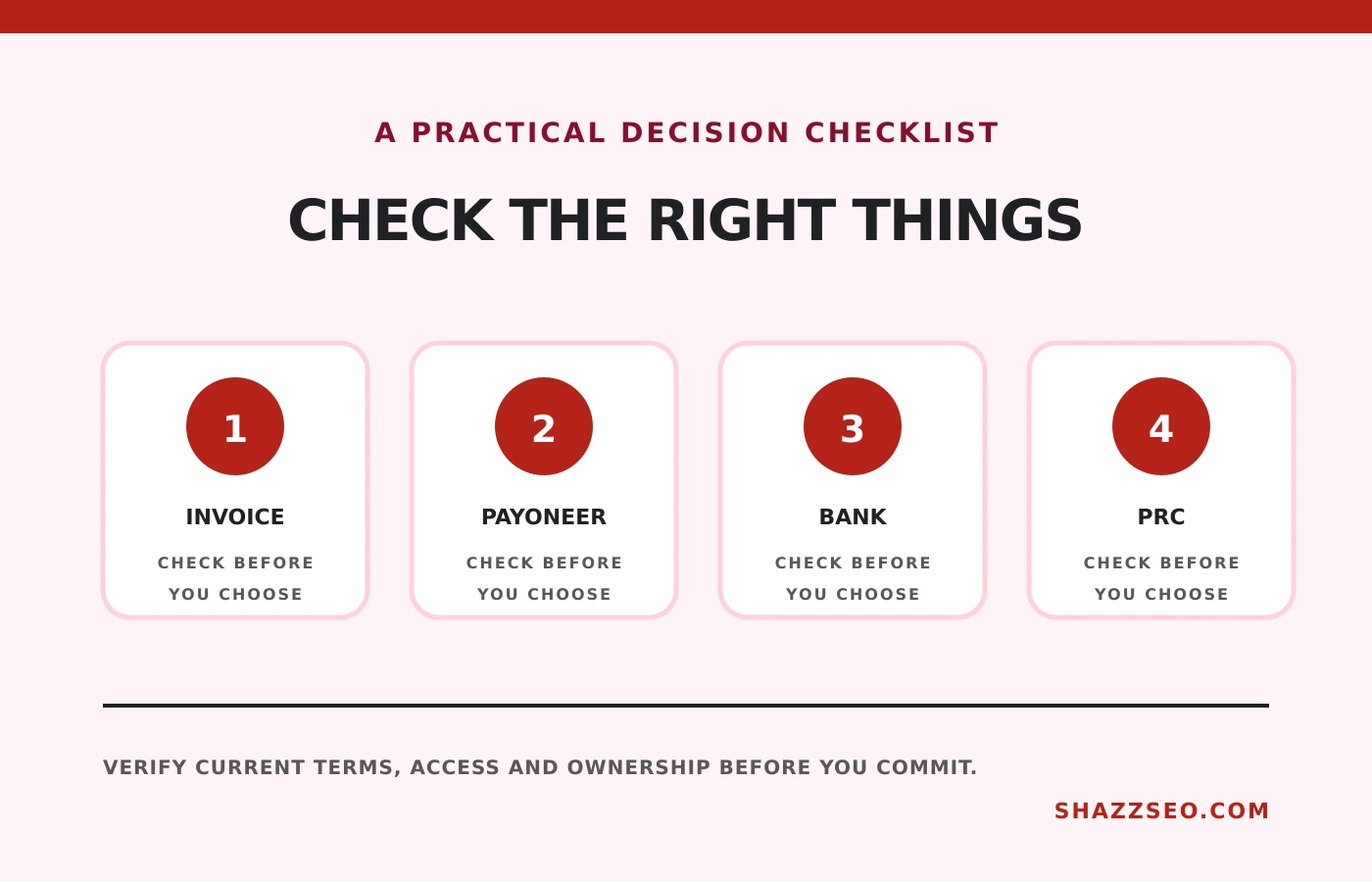
- Signed contract, marketplace order or client purchase record
- Invoice showing customer, country, service, currency and date
- Proof of delivery or accepted milestone
- Marketplace payout report, if applicable
- Payoneer transaction confirmation and monthly statement
- Fee and exchange-rate reconciliation
- Withdrawal confirmation
- Pakistani bank statement
- PRC or e-PRC and recorded purpose code, where issued
- Bank withholding or tax deduction certificate
- Current PSEB registration evidence where relevant
A simple reconciliation example
Record |
Illustrative amount |
Evidence |
|---|---|---|
Client invoice |
USD 1,000 |
Invoice and contract |
Marketplace fee |
USD 100 |
Payout statement |
Payoneer or transfer fee |
USD 15 |
Payoneer statement |
Net withdrawal |
USD 885 equivalent |
Withdrawal receipt |
Bank credit |
PKR equivalent |
Statement and PRC/e-PRC |
The numbers are illustrative. The objective is to explain every difference rather than forcing the bank credit to equal the invoice.
Questions to ask the bank before relying on the route
- Will this Payoneer withdrawal be recorded as an inward service-export remittance?
- Can the bank issue a PRC or e-PRC for it?
- Which purpose code will be used and who can correct an error?
- Will withholding appear on a certificate?
- Can the proceeds be connected to an ESFCA, if you qualify?
- Which documents should be supplied before or after the credit?
Keep the bank’s written reply. Call-centre guidance is useful, but written confirmation is easier to rely on during reconciliation.
How to report the income responsibly
Give your tax professional the gross invoices, fees, net receipts, certificates and year-end Payoneer balance. Ask them to confirm whether the activity qualifies under the current export-of-services and final-tax provisions, whether PSEB registration is relevant, and how provincial sales-tax obligations affect you. Do not copy last year’s rate or another freelancer’s return.
For the wider recordkeeping process, use the related guides on e-PRCs for Pakistani freelancers, documenting Fiverr and Upwork income for FBR and showing a Payoneer balance in a wealth statement.
Frequently asked questions
Does Payoneer issue an e-PRC?
The receiving Pakistani bank normally controls bank-side realization documentation. Ask that bank what it can issue for the specific route.
Is a Payoneer screenshot sufficient?
No. Use downloadable statements plus the invoice, payout record, withdrawal confirmation, bank credit and available PRC or e-PRC.
Should I report gross or net earnings?
Keep both. The gross invoice and separately recorded fees create a transparent reconciliation. The correct tax base depends on the applicable regime and professional advice.
Can a local Payoneer settlement still be export income?
The underlying service may be exported, but the realization evidence may be more difficult. Obtain written guidance from the receiving bank and your adviser.
Does PSEB registration solve every problem?
No. Registration may be relevant to a concession, but it does not replace genuine services, correct banking records, filing compliance or documentary evidence.
Final takeaway
Treat Payoneer as one link in the payment chain, not as proof by itself. Build an unbroken file from foreign customer and service delivery to Payoneer statement, fees, Pakistani bank credit and bank certificate. Get the route confirmed before moving large amounts, and have the current tax treatment reviewed for your exact activity.
This article provides general recordkeeping information, not legal, tax or accounting advice. Pakistani tax and foreign-exchange rules, rates and banking procedures can change.