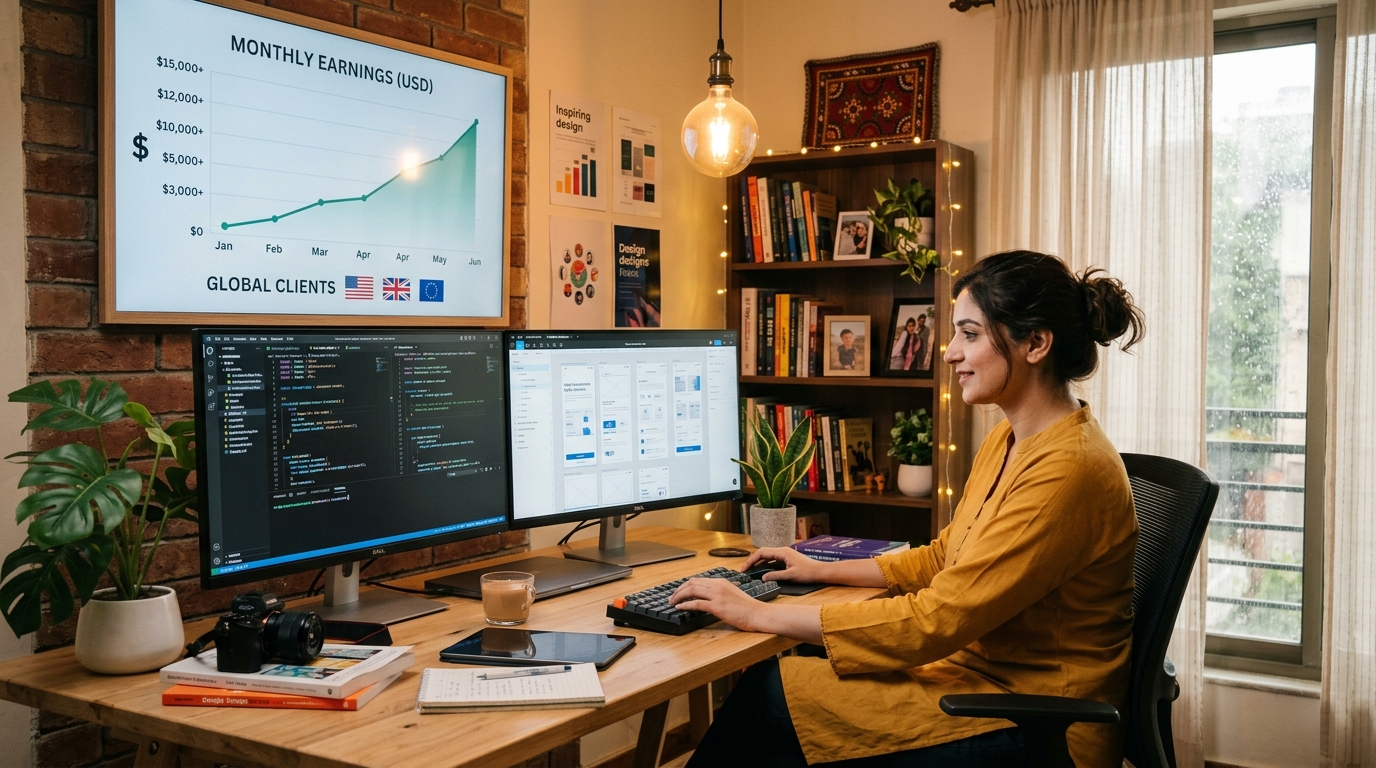
Freelancing in Pakistan has evolved far beyond low-cost data entry and basic content writing. In 2026, Pakistani freelancers competing in global international markets earn anywhere from $2,000 to $10,000+ per month by mastering specialized, high-leverage technical and creative skills.
If you want to maximize your freelance earnings in USD, GBP, and EUR, this guide reveals the Top 10 Highest-Paying Freelance Skills in Pakistan for 2026, complete with average hourly rates, required tools, and roadmap to get clients.
1. AI Automation & Agent Engineering (LangChain, n8n, Make)
Businesses worldwide are desperate to automate customer support, lead routing, and database workflows using autonomous AI agents. Pakistani engineers building custom n8n pipelines, Python LangChain agents, and custom GPT integrations command premium retainers.
- Average Hourly Rate: $50 – $120 / hr
- Key Tools: Python, n8n, Make.com, OpenAI/Anthropic APIs, LangChain.
2. Full-Stack Web Development (Next.js, React, Node, Laravel)
Building high-performance SaaS applications and custom web portals remains one of the largest budget categories on Upwork and direct client contracting.
- Average Hourly Rate: $40 – $90 / hr
- Key Tools: Next.js 15, TypeScript, Tailwind CSS, PostgreSQL, Laravel.
3. Technical SEO & Generative Engine Optimization (GEO)
With Google AI Overviews and SearchGPT transforming search, companies pay top dollar for SEO specialists who understand crawl budget optimization, Schema markup, entity architecture, and GEO citations.
- Average Hourly Rate: $45 – $100 / hr
- Key Tools: Screaming Frog, Google Search Console, Ahrefs, Python for SEO.
4. UI/UX & Product Design (Figma, Framer)
Modern startups demand interactive, conversion-focused design systems. Designers who can create design systems in Figma and publish production sites in Framer or Webflow earn substantial fixed-price project fees ($1,500 – $5,000 per site).
- Average Hourly Rate: $35 – $80 / hr
5. Cloud DevOps & Kubernetes Architecture (AWS, Docker, CI/CD)
Managing scalable cloud infrastructure, Docker container orchestration, and automated CI/CD deployment pipelines.
- Average Hourly Rate: $50 – $110 / hr
6. Mobile App Development (Flutter, React Native)
Cross-platform mobile apps for iOS and Android built from a single codebase.
- Average Hourly Rate: $35 – $75 / hr
7. Short-Form Video Editing & Motion Graphics (Premiere Pro, After Effects)
Creating viral, high-retention video content for TikTok, YouTube Shorts, and Instagram Reels for international brands and personal creators.
- Average Hourly Rate: $30 – $65 / hr
8. Copywriting & AI Text Humanization
Transforming raw AI drafts into compelling, high-converting sales copy that bypasses AI detectors and ranks on Google.
- Average Hourly Rate: $35 – $70 / hr
9. Cyber Security & Smart Contract Auditing
Conducting penetration testing, vulnerability assessments, and web3 security checks.
- Average Hourly Rate: $60 – $150 / hr
10. Media Buying & Performance Marketing (Google Ads, Meta Ads)
Running ROAS-driven paid acquisition funnels for e-commerce brands and B2B SaaS platforms.
- Average Hourly Rate: $40 – $85 / hr
A defensible way to choose a high-income skill
No skill guarantees a dollar income. Marketplaces reward a combination of technical competence, proof, communication, positioning and repeatable delivery. Before committing months to a trend, test it against real job descriptions and client briefs.
- Collect 30 recent jobs from two platforms or company career pages.
- Record required tools, seniority, deliverables and repeated business problems.
- Choose one narrow service and create three portfolio examples using realistic constraints.
- Ask experienced practitioners to critique the work.
- Offer a small paid pilot, measure delivery time and document the result.
- Expand only after buyers repeatedly request adjacent work.
Hourly-rate ranges on marketplace profiles are asking prices, not verified earnings. Use them as directional evidence and avoid converting a high advertised rate into a monthly-income promise. For Pakistani freelancers, also compare payment access, tax documentation, time-zone demands and the cost of the required software.
Related Guides
If AI is your chosen specialization, compare AI skills courses for learners in Pakistan against the portfolio projects and client problems you want to work on.
A 90-day learning-and-market test
Spend the first 30 days learning fundamentals and reproducing guided projects. In days 31–60, build two original examples around real business constraints and publish a clear explanation of your decisions. In days 61–90, contact a small number of relevant prospects with a specific observation and offer a contained pilot.
Measure replies, calls, paid pilots, completion time and repeat requests. If nobody values the deliverable, change the offer or market before purchasing another course. The goal is not to collect tools; it is to solve a problem someone will pay to remove.
Review point: reassess the chosen skill after 90 days using market responses and completed work—not social-media hype.
Avoid switching skills every time a new tool trends online.