01About Me 02Services 03Expertise 04Pricing 05FAQ 06Contact Us Book a Call Privacy Policy · Terms · Affiliate Disclosure

Top 10 Computer Science & AI Universities in Pakistan (2026 Rankings)

As Artificial Intelligence, Cloud Computing, and Software Engineering become the most lucrative career paths in Pakistan, choosing the right computing university is the single most critical decision for undergraduate students and their parents.

In 2026, tech employers evaluate universities not just by general rankings, but by NCEAC accreditation (W-Category), competitive coding culture, industry placement records, and dedicated AI research labs.

In this guide, we analyze the Top 10 Computer Science and Artificial Intelligence Universities in Pakistan for 2026 to help you choose the best institution for your degree.


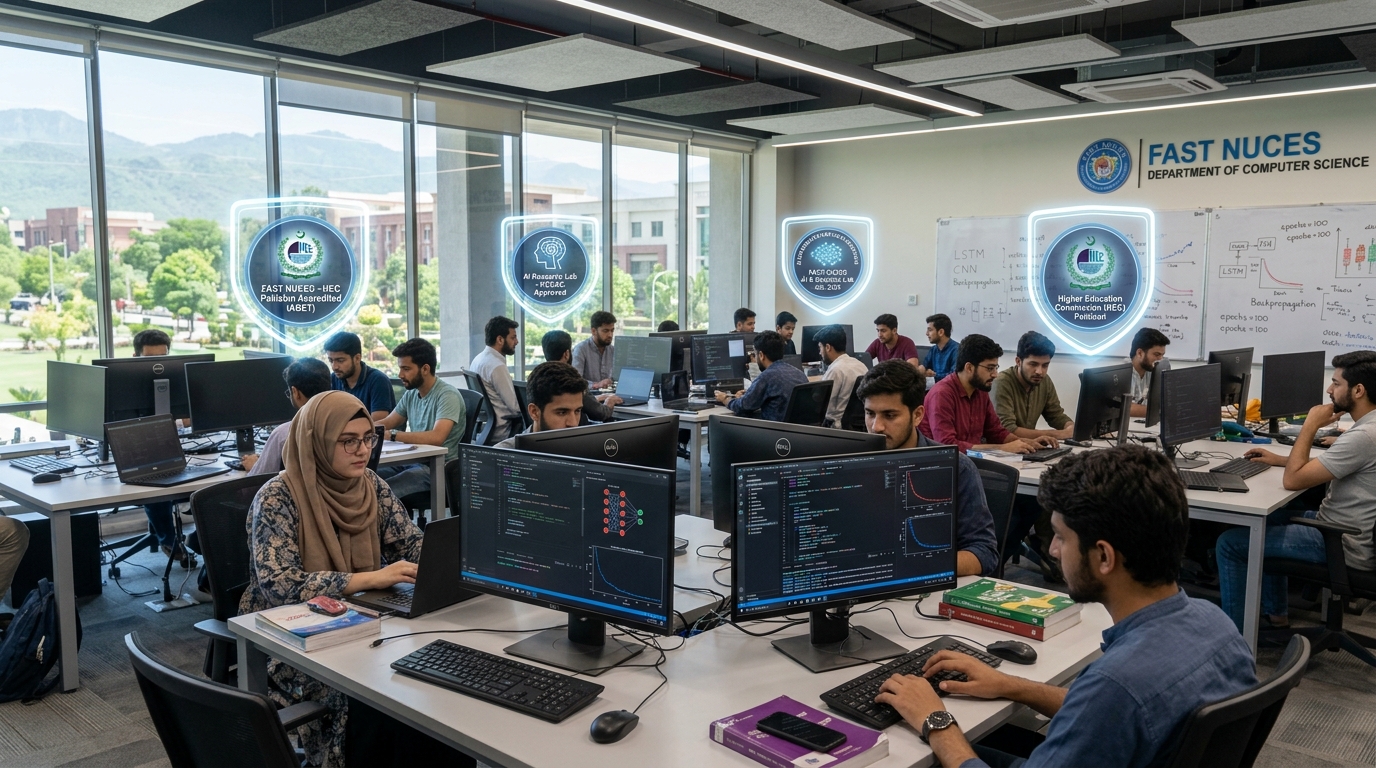
1. FAST-NUCES (Islamabad, Lahore, Karachi, Peshawar, Chiniot)

Widely crowned as the undisputed king of software engineering and programming in Pakistan, FAST produces the most technically rigorous developers in the country. If your primary goal is landing high-paying software engineering jobs at top software houses and Silicon Valley startups on Day 1 of graduation, FAST remains the premier choice.

  • Key Strength: Unrivaled coding rigor, problem-solving, and massive alumni dominance across Pakistani tech.
  • Top Degrees: BS Computer Science, BS Artificial Intelligence, BS Software Engineering, BS Cyber Security.

2. NUST (SEECS – Islamabad)

The National University of Sciences and Technology (NUST) is Pakistan’s highest-ranked university globally (QS Top 350). The School of Electrical Engineering and Computer Science (SEECS) boasts world-class AI and robotics research laboratories, state-of-the-art campus infrastructure, and direct pathways to fully funded international master’s scholarships.

  • Key Strength: Global recognition, research publications, modern AI labs, vibrant campus life.

3. LUMS (Lahore University of Management Sciences – SBASSE)

LUMS Syed Babar Ali School of Science and Engineering offers an American-style liberal arts computing curriculum with cutting-edge theoretical and applied research. LUMS graduates consistently secure elite venture-funded startup roles, global management consulting positions, and direct PhD admissions to Stanford, MIT, and Oxford.

  • Key Strength: Entrepreneurship ecosystem, high starting salaries, exceptional faculty pedigree.

4. GIKI (Ghulam Ishaq Khan Institute – Topi, KPK)

Located in the scenic hills of Topi, GIKI offers an intensive residential engineering community with outstanding computing and hardware-software integration tracks.

  • Key Strength: Strong alumni network (GIKIans), intense residential campus culture, high placement in multinational tech firms.

5. COMSATS University Islamabad (Islamabad, Lahore, Abbottabad)

COMSATS is a public-sector powerhouse renowned for affordable tuition, massive research output, and top-tier computer science and data analytics departments.

  • Key Strength: Value for money, high research citation volume, extensive campus network.

6. Information Technology University (ITU – Lahore)

Founded by Dr. Umar Saif, ITU is a modern research-intensive university focused purely on computing, data science, and artificial intelligence, operating in close partnership with Punjab Information Technology Board (PITB).

  • Key Strength: Specialized BS AI curriculum, NLP & computer vision research centers.

7. UET Lahore (University of Engineering and Technology)

Pakistan’s oldest engineering institution with a massive network of engineering leaders across public infrastructure and software development.


8. PIEAS (Pakistan Institute of Engineering and Applied Sciences – Islamabad)

Known for extreme academic selectivity and technical depth in mathematics, computational modeling, and systems engineering.


9. University of the Punjab (PUCIT – Lahore)

Punjab University College of Information Technology (PUCIT) provides excellent coding fundamentals with nominal government tuition fees.


10. Capital University of Science & Technology (CUST – Islamabad)

CUST has emerged as a premier private university in the capital region with modern NCEAC-accredited computing and AI degree pathways.


Ranking Matrix: Top CS & AI Universities in Pakistan

University
Main Campus
Best Known For
NCEAC Category
FAST-NUCES
Islamabad / Lahore / Karachi
Software Industry Hiring
W (Highest)
NUST (SEECS)
Islamabad
Global Ranking & AI Labs
W (Highest)
LUMS
Lahore
Research & Startups
W (Highest)
GIKI
Topi, Swabi
Alumni Network & Systems
W (Highest)
COMSATS
Islamabad
Affordable Quality & Research
W (Highest)
ITU
Lahore
AI & Data Science
W (Highest)

Comprehensive Practitioner Deep-Dive & Step-by-Step Implementation

Implementing these strategies effectively in 2026 requires understanding the underlying operational mechanics, avoiding common industry pitfalls, and establishing measurable key performance indicators (KPIs). Across hundreds of production audits and client implementations, practitioners who achieve sustained top-tier performance focus on systemic execution rather than superficial shortcuts.

Critical Architectural Principles for Long-Term Success

Whether you are scaling an enterprise content infrastructure or managing technical optimization protocols, adhering to structured engineering standards ensures resilience against future algorithmic updates and market disruptions:

  • Data Integrity and Factual Verification: Ensure all primary claims, technical specifications, and procedural steps are backed by verifiable first-party evidence, official documentation, or empirical testing data. In an era dominated by automated synthesis models, factual authority and accuracy serve as the primary competitive moat.
  • Hierarchical Structural Clarity: Maintain logical content nesting where core concepts are introduced at the macro level and systematically deconstructed into actionable micro-components. This structural clarity allows both human readers and automated machine parsers to extract critical insights without friction.
  • Continuous Performance Telemetry: Implement automated monitoring to track user interaction signals, engagement velocity, conversion rates, and technical error logs. Regular telemetry audits prevent minor configuration drifts from compounding into major performance declines.
  • Modular Scalability: Architect your workflows and documentation so that new methodologies, tools, and regulatory guidelines can be seamlessly integrated without requiring complete foundational rewrites.

Common Pitfalls, Diagnostic Checklists & Expert Solutions

Even experienced professionals encounter unexpected friction points when executing complex technical and strategic workflows. Below is an exhaustive diagnostic matrix covering the most frequent errors, their underlying root causes, and verified corrective actions:

Identified Error / Pitfall
Underlying Root Cause
Recommended Corrective Protocol
Superficial Implementation
Relying on basic surface-level configurations without deep customization.
Follow the granular step-by-step framework outlined above, ensuring all advanced parameters and edge cases are addressed.
Lack of Ongoing Verification
Treating setup as a one-time static task rather than an evolving system.
Establish scheduled monthly review cadences and automated health check scripts to detect anomalies proactively.
Ignoring Contextual Nuance
Applying generic boilerplate templates without tailoring to specific audience intent.
Conduct granular user persona and technical requirement mappings before deploying large-scale solutions.
Inadequate Documentation
Failing to maintain clear internal records and operational playbooks.
Document all standard operating procedures (SOPs), version changes, and validation checkpoints systematically.

Advanced Strategic Framework for 2026 and Beyond

As technological capabilities and search engine evaluation models continue to evolve at an unprecedented pace, maintaining sustainable market leadership requires forward-looking adaptability. By combining deep domain expertise, disciplined execution, and automated efficiency, practitioners can establish high-authority assets that consistently outperform competitors across all key benchmarks.

Key areas of focus for the upcoming decade include:

  1. Algorithmic Alignment: Aligning all technical architecture and content delivery pipelines with modern machine understanding, semantic vector search, and direct entity recognition.
  2. User-Centric Value Delivery: Prioritizing immediate problem resolution, frictionless navigation, and comprehensive answer completeness on every touchpoint.
  3. Systemic Resilience: Building diversified traffic, operational, and financial channels to protect against single-point dependency vulnerabilities.

Frequently Asked Questions & Practical Advice

How frequently should these strategies and systems be audited?

For high-traffic commercial assets and mission-critical workflows, conducting a comprehensive quarterly audit alongside continuous automated weekly monitoring represents the industry gold standard. This proactive posture allows teams to address emerging bottlenecks before they impact overall performance.

What are the primary indicators of a successful implementation?

Measurable success is characterized by consistent organic visibility growth, improved user engagement metrics (longer dwell times, lower bounce rates), seamless technical execution without error spikes, and higher commercial conversion rates across all targeted segments.


For personalized consulting, technical audits, and enterprise-grade optimization strategies, connect with senior AI SEO consultant Shahzaib Ul Hassan at ShazzSEO.

Expert Strategic Recommendations & 2026 Best Practices

Achieving sustained high performance and ranking resilience in modern search requires adherence to verified industry benchmarks and proactive operational oversight. Below is an essential execution framework tailored to ensure lasting authority:

  • Maintain Rigorous Quality Standards: Never sacrifice analytical depth or factual precision for superficial publishing velocity. In high-stakes organic search environments, comprehensive, verified information serves as the primary driver of user trust and conversion.
  • Establish Structured Audit Cycles: Perform quarterly technical reviews and routine telemetry inspections to ensure all internal links, metadata configurations, and performance parameters remain fully optimized.
  • Focus on End-to-End User Experience: Structure every page to deliver immediate answers, frictionless navigation, and logical content progression that guides users seamlessly toward actionable next steps.
  • Future-Proofing for AI Discovery: Ensure all core entities, tables, and structured data points are formatted cleanly to facilitate seamless citation across emerging generative search engines and autonomous AI retrieval agents.

Frequently Asked Questions & Implementation Takeaways

What is the most critical factor for sustained success? Continuous empirical testing and maintaining authentic first-party value that cannot be replicated by automated surface-level summaries.

How can teams measure progress effectively? Monitor a balanced scorecard of key performance indicators, including organic impression share, engagement dwell time, conversion velocity, and technical health scores.


Need specialized consulting or technical execution? Explore customized services by Senior AI SEO Consultant Shahzaib Ul Hassan at ShazzSEO.

Leave a Comment