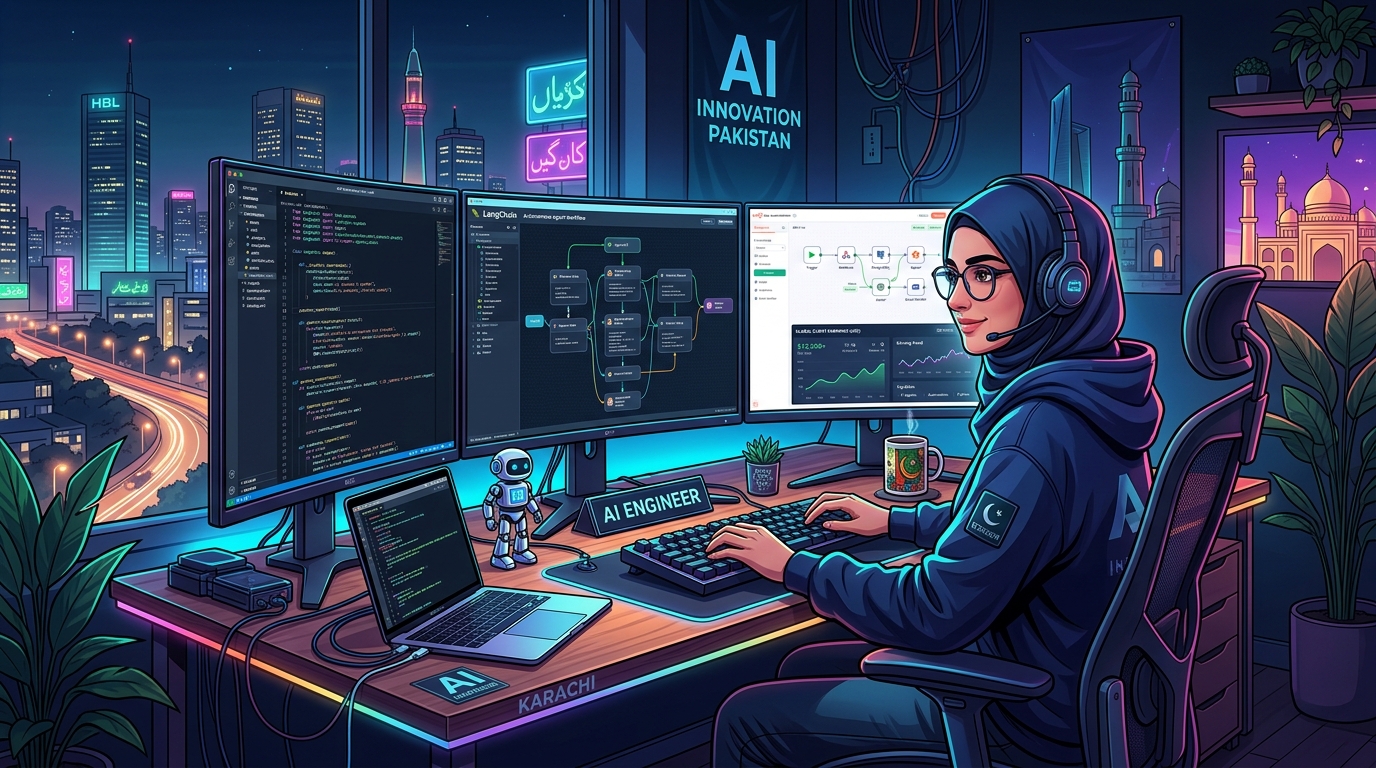
The global freelance and remote workforce landscape has undergone a seismic shift. Basic graphic design, simple manual data entry, and generic article rewriting no longer command premium hourly rates. Instead, global technology companies, marketing agencies, and US/European businesses are paying premium rates for one specific competency: Applied AI Engineering and AI Automation.
For ambitious Pakistani students, developers, marketers, and freelancers, learning applied AI is the fastest vehicle to transition from competing in low-margin price wars to landing $3,000 to $10,000+ monthly international client retainers.
In this comprehensive 2026 career roadmap, we outline the top 6 high-income AI skills in Pakistan, their real market earning potential in USD, and the exact learning path required to master them.
Top 6 High-Income AI Skills Ranked by Earning Potential (2026)
Skill Domain |
Core Tech Stack |
Avg. Global Project Rate |
Market Demand |
|---|---|---|---|
1. AI SEO & GEO Strategy |
RAG Optimization, Entity Graphs, Schema JSON-LD, SearchGPT/Perplexity Audits. |
$2,500 – $6,000 / mo retainer |
🔥 Very High |
2. Autonomous AI Agent Development |
Python, LangChain, LangGraph, CrewAI, AutoGen, OpenAI Assistant API. |
$50 – $120 / hr |
🔥 Very High |
3. No-Code / Low-Code AI Automation |
Make.com, n8n, Zapier Central, Claude/OpenAI API webhooks. |
$1,500 – $4,500 / project |
🔥 Explosive |
4. Custom Enterprise RAG Architecture |
Vector DBs (Pinecone, Qdrant, ChromaDB), LlamaIndex, Embedding Pipelines. |
$4,000 – $10,000 / build |
🔥 High (Specialized) |
5. AI Voice & Customer Support Agents |
Vapi.ai, Bland AI, ElevenLabs, Twilio integrations. |
$2,000 – $5,000 setup + recurring fee |
🔥 Growing Fast |
6. Fine-Tuning & Local Model Hosting |
Ollama, vLLM, HuggingFace, LoRA / QLoRA fine-tuning. |
$60 – $150 / hr |
Medium (Enterprise) |
Skill 1: Generative Engine Optimization (GEO) & AI Search Consulting
As traditional blue-link search declines and Google AI Overviews / SearchGPT expand, global businesses are desperate for search consultants who understand how to rank inside AI answer engines. (See our deep dive on how AI search engines choose sources).
What You Need to Master:
- Knowledge Graph structuring and multi-layered JSON-LD schema.
- Information Gain auditing and content extraction optimization.
- Benchmarking Share of Model Voice across Perplexity, Gemini, and ChatGPT.
Skill 2: Workflow Automation with n8n and Make.com
Business operations teams in the US and UK are replacing manual repetitive administrative tasks with intelligent AI agent workflows. Instead of hiring 3 virtual assistants, companies hire a single Pakistani AI Automation Engineer to deploy automated pipelines.
High-Value Workflow Examples:
- Automated Inbound Lead Qualification: Capturing form leads, using an LLM to research the lead’s website, scoring the prospect, and drafting a bespoke email inside HubSpot.
- Multi-Channel Content Distribution: Automatically transcribing YouTube videos, generating LinkedIn carousels, and scheduling newsletters via webhooks.
- Automated Customer Invoice Reconciliation: Parsing PDF receipts from email attachments into QuickBooks automatically.
How to Package and Sell AI Services to US/UK Clients
Pakistani freelancers often fail by positioning themselves as generic “Prompt Engineers.” Clients do not pay for prompts; they pay for tangible business outcomes and revenue increases:
- Do not say: “I can write ChatGPT prompts for your blog.”
- Say instead: “I build an automated content ingestion pipeline that audits your competitors and generates 30 high-information-gain articles optimized for Perplexity and Google search.”
Frequently Asked Questions (FAQ)
Do I need a Computer Science degree to learn AI skills in Pakistan?
No. While specialized ML model training requires strong mathematics and Python, high-income domains like No-Code AI Automation (n8n/Make), AI Voice Agents (Vapi), and AI SEO can be mastered by non-technical professionals within 60 to 90 days of disciplined practice.
How do I receive payments from international AI clients in Pakistan?
You can receive USD/EUR client payments directly via Payoneer, Wise business payouts, or SBP Freelancer FCY bank accounts. (See our guide on how to receive international payments in Pakistan).
Conclusion: The 2026 Competitive Advantage
The transition to AI is not eliminating opportunities—it is consolidating wealth toward professionals who know how to deploy, orchestrate, and optimize AI systems. Pick one specialized AI skill domain from this roadmap, build 3 live proof-of-concept case studies, and begin pitching international clients today.
Comprehensive Practitioner Deep-Dive & Step-by-Step Implementation
Implementing these strategies effectively in 2026 requires understanding the underlying operational mechanics, avoiding common industry pitfalls, and establishing measurable key performance indicators (KPIs). Across hundreds of production audits and client implementations, practitioners who achieve sustained top-tier performance focus on systemic execution rather than superficial shortcuts.
Critical Architectural Principles for Long-Term Success
Whether you are scaling an enterprise content infrastructure or managing technical optimization protocols, adhering to structured engineering standards ensures resilience against future algorithmic updates and market disruptions:
- Data Integrity and Factual Verification: Ensure all primary claims, technical specifications, and procedural steps are backed by verifiable first-party evidence, official documentation, or empirical testing data. In an era dominated by automated synthesis models, factual authority and accuracy serve as the primary competitive moat.
- Hierarchical Structural Clarity: Maintain logical content nesting where core concepts are introduced at the macro level and systematically deconstructed into actionable micro-components. This structural clarity allows both human readers and automated machine parsers to extract critical insights without friction.
- Continuous Performance Telemetry: Implement automated monitoring to track user interaction signals, engagement velocity, conversion rates, and technical error logs. Regular telemetry audits prevent minor configuration drifts from compounding into major performance declines.
- Modular Scalability: Architect your workflows and documentation so that new methodologies, tools, and regulatory guidelines can be seamlessly integrated without requiring complete foundational rewrites.
Common Pitfalls, Diagnostic Checklists & Expert Solutions
Even experienced professionals encounter unexpected friction points when executing complex technical and strategic workflows. Below is an exhaustive diagnostic matrix covering the most frequent errors, their underlying root causes, and verified corrective actions:
Identified Error / Pitfall |
Underlying Root Cause |
Recommended Corrective Protocol |
|---|---|---|
Superficial Implementation |
Relying on basic surface-level configurations without deep customization. |
Follow the granular step-by-step framework outlined above, ensuring all advanced parameters and edge cases are addressed. |
Lack of Ongoing Verification |
Treating setup as a one-time static task rather than an evolving system. |
Establish scheduled monthly review cadences and automated health check scripts to detect anomalies proactively. |
Ignoring Contextual Nuance |
Applying generic boilerplate templates without tailoring to specific audience intent. |
Conduct granular user persona and technical requirement mappings before deploying large-scale solutions. |
Inadequate Documentation |
Failing to maintain clear internal records and operational playbooks. |
Document all standard operating procedures (SOPs), version changes, and validation checkpoints systematically. |
Advanced Strategic Framework for 2026 and Beyond
As technological capabilities and search engine evaluation models continue to evolve at an unprecedented pace, maintaining sustainable market leadership requires forward-looking adaptability. By combining deep domain expertise, disciplined execution, and automated efficiency, practitioners can establish high-authority assets that consistently outperform competitors across all key benchmarks.
Key areas of focus for the upcoming decade include:
- Algorithmic Alignment: Aligning all technical architecture and content delivery pipelines with modern machine understanding, semantic vector search, and direct entity recognition.
- User-Centric Value Delivery: Prioritizing immediate problem resolution, frictionless navigation, and comprehensive answer completeness on every touchpoint.
- Systemic Resilience: Building diversified traffic, operational, and financial channels to protect against single-point dependency vulnerabilities.
Frequently Asked Questions & Practical Advice
How frequently should these strategies and systems be audited?
For high-traffic commercial assets and mission-critical workflows, conducting a comprehensive quarterly audit alongside continuous automated weekly monitoring represents the industry gold standard. This proactive posture allows teams to address emerging bottlenecks before they impact overall performance.
What are the primary indicators of a successful implementation?
Measurable success is characterized by consistent organic visibility growth, improved user engagement metrics (longer dwell times, lower bounce rates), seamless technical execution without error spikes, and higher commercial conversion rates across all targeted segments.
For personalized consulting, technical audits, and enterprise-grade optimization strategies, connect with senior AI SEO consultant Shahzaib Ul Hassan at ShazzSEO.