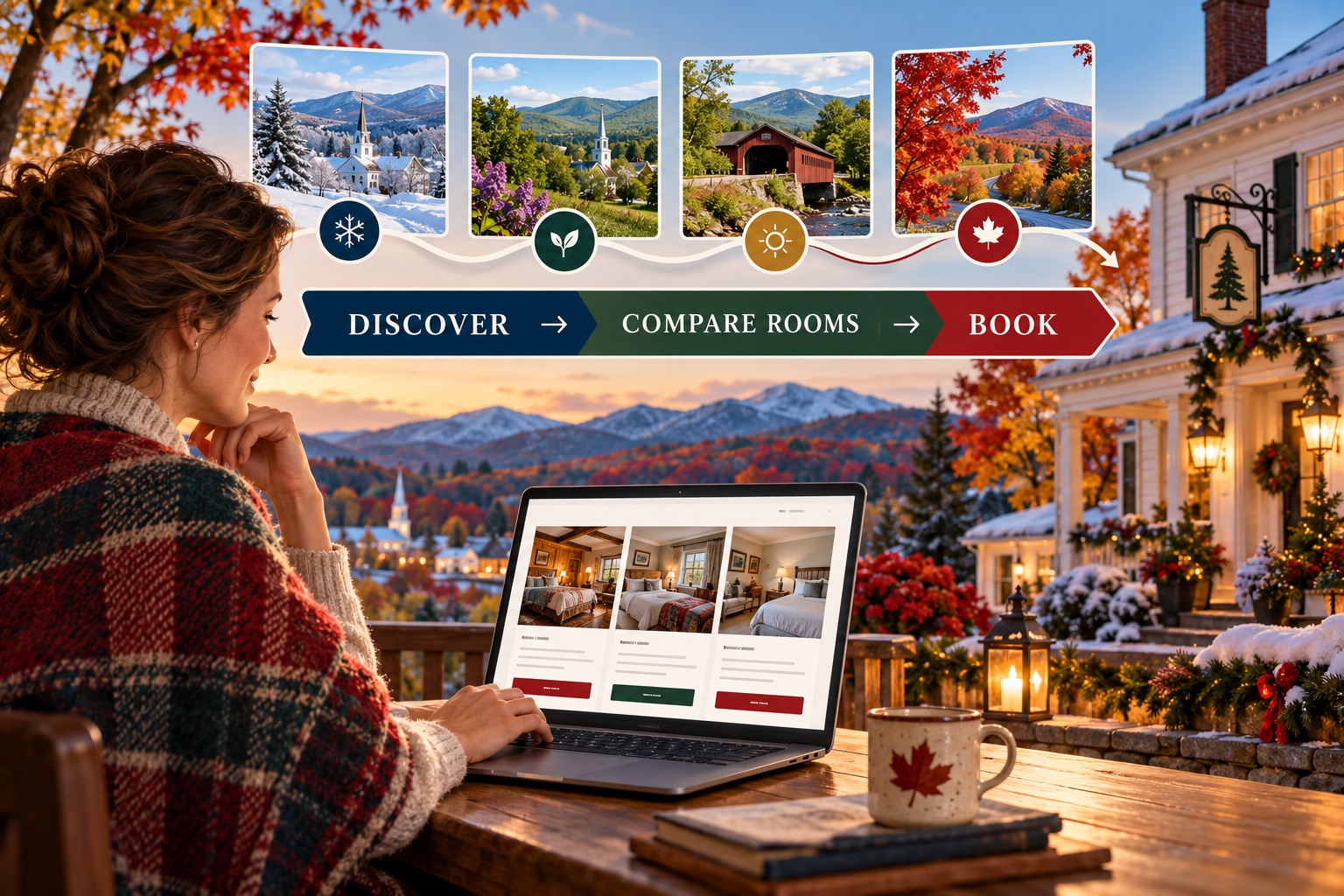
Discover
A guest searches by experience, season, destination or property type—not always by your inn’s name. Priority pages connect the stay to real reasons for visiting Vermont.
Squarespace SEO · Vermont stays and experiences
An independent inn around Stowe–Waterbury competes across ski season, summer escapes and fall foliage. The website must help a guest compare rooms, understand the setting and move into the existing booking system. I improve that direct-booking journey without pretending Squarespace is a hotel management platform.
The Squarespace constraint
Squarespace supplies stable URLs, an automatically updated sitemap and separate SEO settings for the homepage, pages and collection items. Site-wide title formats can combine variables such as the item SEO title and site title. That makes consistent publishing easier, but one incorrect format or missing item field can affect every room, package, event or journal entry.
A particularly important check is the collection-item title format. Squarespace documents that if the item variable is omitted, an item title may not appear in the browser tab even when an SEO title was entered for the item. SEO descriptions are also available for individual collection items, but search engines may choose a different visible excerpt when it better matches the query.
The workaround is not to stuff a single title field. Each meaningful stay or experience needs a clear visible name, useful description, deliberate slug, social image and internal path. Site-wide formats provide the frame; item-level information explains the actual guest experience.
Squarespace generates the sitemap and does not let owners edit it directly. Pages hidden from search and disabled content are excluded. URL mappings can preserve old paths, but permanent redirects work only after the original page no longer exists at that path. Custom code can extend supported plans, yet unnecessary scripts can create mobile or maintenance problems.
Platform references: title formats, SEO descriptions, sitemap behavior and URL mappings.
Built around guest intent
A guest searches by experience, season, destination or property type—not always by your inn’s name. Priority pages connect the stay to real reasons for visiting Vermont.
Room differences, occupancy, accessibility, breakfast, parking, pet policies and amenities should be understandable without opening several tabs or guessing from photographs.
Travel time, check-in, weather expectations, nearby activities and seasonal availability reduce uncertainty for guests arriving from outside the state or across the Canadian border.
The final call to action should explain availability and the handoff to any external reservation system. On mobile, the next step must remain obvious and trustworthy.
What is included
Search and indexation: response codes, canonicals, search visibility, sitemap inclusion and Search Console evidence are checked on important pages and representative collection items.
Titles and descriptions: homepage, page and item formats are reviewed alongside room, package, event and journal metadata. Missing or repeated output is repaired using native controls before custom code is considered.
Content and internal links: room pages, seasonal guides, destination information, policies, offers and property evidence are connected with descriptive links that help guests move naturally through the planning journey.
Structured data: existing output and any custom JSON-LD are compared with visible facts. LodgingBusiness or appropriate subtypes, Organization, Breadcrumb and page-level entities are used only where the property information supports them.
Stowe–Waterbury first
Vermont recorded an estimated 16 million visitors and $4.2 billion in visitor spending during 2024. For an independent Stowe–Waterbury inn, the practical lesson is to answer a different set of planning questions for winter, summer and foliage trips while keeping room comparison and booking simple.
Ski and snow-season guests may need drive times, road and parking expectations, equipment storage, drying space, breakfast timing, shuttle information and flexible arrival guidance. A lodge near recreation should explain the relationship honestly rather than implying slope-side access.
Hiking, cycling, lake visits, weddings, farm experiences and village weekends create different questions about trails, mud season, outdoor storage, events and family logistics. First-hand itineraries can connect a property to the trip without becoming generic destination copy.
Foliage guests often book around dates, routes and regional access. Useful pages set realistic expectations, explain minimum stays or cancellation rules and recommend nearby drives and activities without presenting uncertain peak-color timing as a guarantee.
Breakfast sourcing, farm stays, historic buildings, village walks, breweries, cheese, maple and seasonal events can distinguish an experience when the information is accurate. These details should support the property’s identity, not become a checklist of Vermont stereotypes.
Tourism context: Vermont’s official tourism research and places-to-stay guidance.
Service is delivered remotely for Vermont lodging and tourism businesses; ShazzSEO does not claim a Vermont office or local staff.
Clearly labelled sample
Sample observation: a six-room B&B gives every room its own Squarespace page and gallery. The rooms have memorable names, but their SEO titles use only those names, descriptions repeat the homepage message and the visible copy omits occupancy, bed type, accessibility and the distinction between mountain-facing and roadside rooms.
The repair would retain the property’s voice while adding scannable room facts, honest setting information, unique item titles and descriptions, a comparison link between rooms and a clear booking handoff. A “Which room suits your stay?” guide could help couples, families and guests with mobility needs choose without producing another page for every nearby town.
This is an illustrative finding, not a testimonial or a claim about an existing Vermont property.
How the engagement works
Published pricing
The Squarespace SEO overhaul starts from $999 one-time. It covers the agreed high-priority technical, metadata, room or experience content, redirect and internal-link work identified during discovery.
Monthly retainers range from $80 to $199 per month. The written scope defines pages, seasonal briefs, monitoring and reporting. It does not promise unlimited content, links, bookings or rankings.
Vermont lodging FAQs
Direct answers about room metadata, booking engines, town pages, pricing and remote delivery.
Yes. This page and service scope are designed for Vermont inns, bed and breakfasts, lodges, farm stays and tourism businesses using Squarespace. It is not a generic SEO offer for every Vermont industry.
Squarespace supports individual SEO descriptions for pages and collection items such as products, posts and events. The audit checks whether each bookable offer has distinct visible information, metadata and a useful path from the rest of the site.
No. Create a town or destination page only when it helps guests plan a genuinely different stay and contains first-hand information about access, activities, seasonality or the property’s relationship to that place. Repeated town pages are not useful.
Often. The Squarespace pages, metadata, internal links, seasonal guides and booking handoff can be improved while the existing reservation system remains in place. The handoff is tested on mobile so guests understand when they are moving to an external booking service.
A focused SEO overhaul starts from $999 one-time. Ongoing retainers range from $80 to $199 per month, based on the agreed technical, content, monitoring and reporting scope.
No. Work is delivered remotely from Pakistan for Vermont and worldwide clients through email, scheduled video calls, written implementation notes and an agreed reporting cadence.
See the site as a guest
Start with a practical check of your room pages, seasonal content and mobile reservation path.