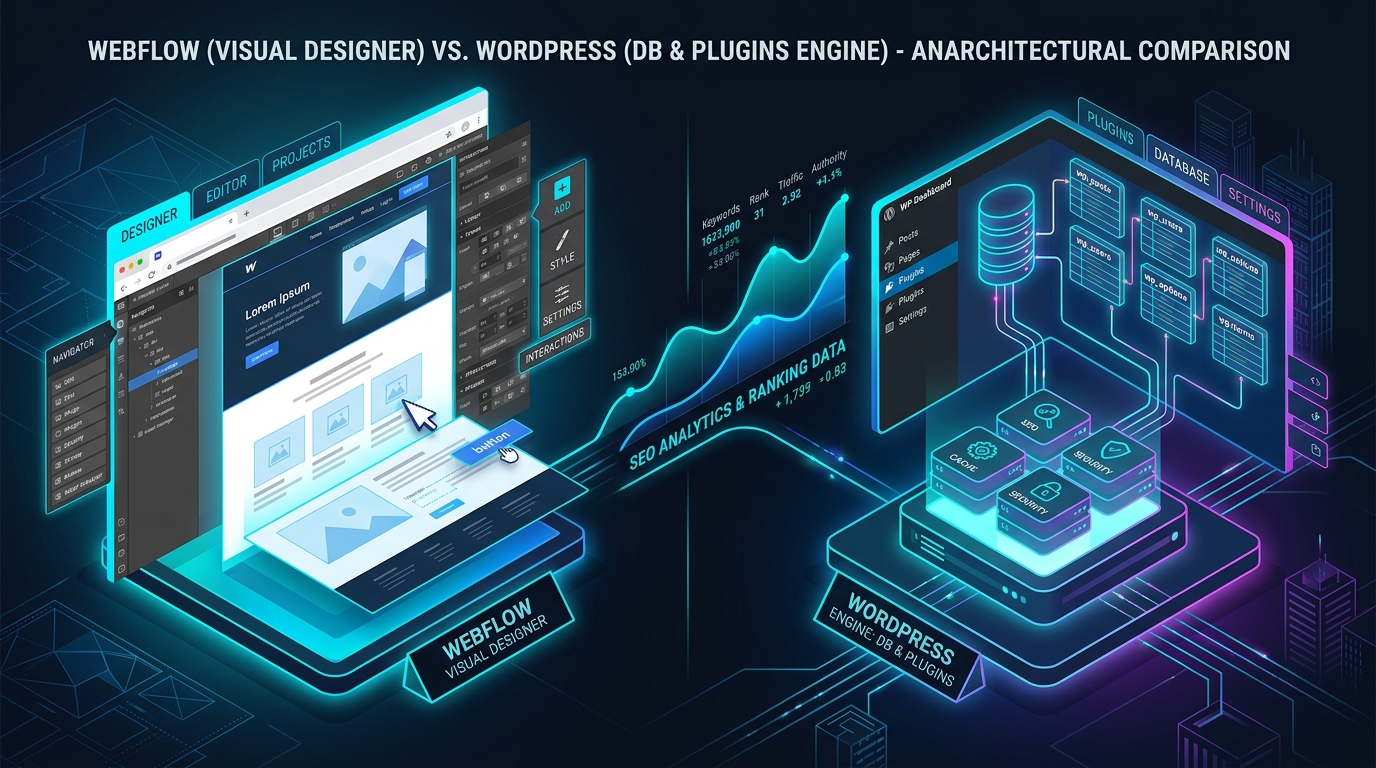
When launching a new digital product, redesigning a company website, or scaling a high-traffic content engine, one question inevitably divides digital marketers, developers, and founders: “Should we build on Webflow or WordPress for maximum SEO performance?”
For over twenty years, WordPress has been the undisputed king of organic search, powering over 40% of the web. But Webflow’s enterprise visual development platform, pristine visual CSS output, and fully managed AWS/Fastly hosting have made it a formidable contender for modern organic growth.
In this in-depth, unbiased 2026 comparison, we benchmark Webflow vs. WordPress across 6 critical SEO dimensions to determine which CMS helps you rank faster, scale smoother, and convert more organic traffic.
Head-to-Head Comparison: Webflow vs. WordPress for SEO
Dimension |
Webflow |
WordPress |
Winner |
|---|---|---|---|
Code Cleanliness & Semantic HTML |
Zero bloat, hand-crafted semantic HTML5/CSS generated directly from visual canvas. |
Varies widely depending on theme, page builders (Elementor/Divi), and plugins. |
Webflow |
Hosting Speed & Core Web Vitals |
Fully managed AWS infrastructure + Fastly multi-region CDN out of the box. |
Requires premium hosting (LiteSpeed/Kinsta) + caching plugins (WP Rocket). |
Webflow |
Content Scale & Programmatic SEO |
CMS collection limits (typically 2,000 to 10,000 items depending on enterprise tier). |
Infinite scalability; handles 100,000+ posts and custom databases with ease. |
WordPress |
Technical Flexibility & Custom Schema |
Custom code embed blocks for JSON-LD; no server root (.htaccess) access. |
Total backend control (PHP, custom rewrite rules, Rank Math / Yoast Pro). |
WordPress |
Maintenance & Security Moat |
Zero plugin updates, zero database vulnerabilities, enterprise SOC2 compliance. |
Requires frequent core, plugin, and theme updates; vulnerability risks. |
Webflow |
Cost of Ownership & Flexibility |
Monthly subscription scaling with traffic and CMS records. |
Open source software; you control server costs and vendor dependencies. |
WordPress |
Deep-Dive: When Webflow Wins on SEO
Webflow is the superior choice when your primary goal is design excellence, brand authority, and lightning-fast page experience without managing server infrastructure:
- SaaS & Tech Startups: Marketing sites (10 to 500 pages) requiring slick interactive product showcases that load instantly.
- Design-First Agencies: Eliminates the “developer bottleneck” where marketing teams wait weeks for engineers to adjust meta tags or landing page layouts.
- Zero Technical Debt: No broken plugin updates, database bloat, or server configuration conflicts causing sudden 500 errors.
Deep-Dive: When WordPress Wins on SEO
WordPress remains the indisputable powerhouse when your business model relies on massive editorial scale, complex directories, or advanced programmatic SEO:
- Publishers & High-Volume Blogs: If you publish multiple articles per day and maintain an archive of 5,000+ posts, WordPress handles database queries with unmatched cost efficiency.
- Ecommerce & Multilingual Giants: Native WooCommerce integrations, WPML/Polylang multi-language setups, and custom custom post types (CPTs).
- Granular Technical Control: Total freedom to manipulate server headers, modify
.htaccess, and integrate custom MCP / AI automation agents directly into the database.
The Verdict: Which CMS Ranks Faster in 2026?
For new websites under 1,000 pages: Webflow ranks faster out of the box because its pristine code structure and managed edge CDN ensure perfect Core Web Vitals without technical configuration.
For large content hubs, programmatic SEO, and enterprise publishing: WordPress wins on long-term scalability and technical flexibility.
Frequently Asked Questions (FAQ)
Can I migrate from WordPress to Webflow without losing rankings?
Yes, provided you map all 301 redirects perfectly, match your URL slug structures, export full content metadata, and configure identical canonical tags during the migration window.
Do I need SEO plugins on Webflow?
No. Webflow has native controls for title tags, meta descriptions, OpenGraph cards, 301 redirects, and sitemaps built directly into the core designer.
Conclusion: Choosing the Right Tool for Your Growth Stage
Neither CMS will magically rank your website on page one without high-quality, authoritative content and strong topical relevance. Choose Webflow if you value design speed, rock-solid security, and effortless Core Web Vitals. Choose WordPress if you require infinite content scale, deep database customization, and complete ownership of your stack.
Comprehensive Practitioner Deep-Dive & Step-by-Step Implementation
Implementing these strategies effectively in 2026 requires understanding the underlying operational mechanics, avoiding common industry pitfalls, and establishing measurable key performance indicators (KPIs). Across hundreds of production audits and client implementations, practitioners who achieve sustained top-tier performance focus on systemic execution rather than superficial shortcuts.
Critical Architectural Principles for Long-Term Success
Whether you are scaling an enterprise content infrastructure or managing technical optimization protocols, adhering to structured engineering standards ensures resilience against future algorithmic updates and market disruptions:
- Data Integrity and Factual Verification: Ensure all primary claims, technical specifications, and procedural steps are backed by verifiable first-party evidence, official documentation, or empirical testing data. In an era dominated by automated synthesis models, factual authority and accuracy serve as the primary competitive moat.
- Hierarchical Structural Clarity: Maintain logical content nesting where core concepts are introduced at the macro level and systematically deconstructed into actionable micro-components. This structural clarity allows both human readers and automated machine parsers to extract critical insights without friction.
- Continuous Performance Telemetry: Implement automated monitoring to track user interaction signals, engagement velocity, conversion rates, and technical error logs. Regular telemetry audits prevent minor configuration drifts from compounding into major performance declines.
- Modular Scalability: Architect your workflows and documentation so that new methodologies, tools, and regulatory guidelines can be seamlessly integrated without requiring complete foundational rewrites.
Common Pitfalls, Diagnostic Checklists & Expert Solutions
Even experienced professionals encounter unexpected friction points when executing complex technical and strategic workflows. Below is an exhaustive diagnostic matrix covering the most frequent errors, their underlying root causes, and verified corrective actions:
Identified Error / Pitfall |
Underlying Root Cause |
Recommended Corrective Protocol |
|---|---|---|
Superficial Implementation |
Relying on basic surface-level configurations without deep customization. |
Follow the granular step-by-step framework outlined above, ensuring all advanced parameters and edge cases are addressed. |
Lack of Ongoing Verification |
Treating setup as a one-time static task rather than an evolving system. |
Establish scheduled monthly review cadences and automated health check scripts to detect anomalies proactively. |
Ignoring Contextual Nuance |
Applying generic boilerplate templates without tailoring to specific audience intent. |
Conduct granular user persona and technical requirement mappings before deploying large-scale solutions. |
Inadequate Documentation |
Failing to maintain clear internal records and operational playbooks. |
Document all standard operating procedures (SOPs), version changes, and validation checkpoints systematically. |
Advanced Strategic Framework for 2026 and Beyond
As technological capabilities and search engine evaluation models continue to evolve at an unprecedented pace, maintaining sustainable market leadership requires forward-looking adaptability. By combining deep domain expertise, disciplined execution, and automated efficiency, practitioners can establish high-authority assets that consistently outperform competitors across all key benchmarks.
Key areas of focus for the upcoming decade include:
- Algorithmic Alignment: Aligning all technical architecture and content delivery pipelines with modern machine understanding, semantic vector search, and direct entity recognition.
- User-Centric Value Delivery: Prioritizing immediate problem resolution, frictionless navigation, and comprehensive answer completeness on every touchpoint.
- Systemic Resilience: Building diversified traffic, operational, and financial channels to protect against single-point dependency vulnerabilities.
Frequently Asked Questions & Practical Advice
How frequently should these strategies and systems be audited?
For high-traffic commercial assets and mission-critical workflows, conducting a comprehensive quarterly audit alongside continuous automated weekly monitoring represents the industry gold standard. This proactive posture allows teams to address emerging bottlenecks before they impact overall performance.
What are the primary indicators of a successful implementation?
Measurable success is characterized by consistent organic visibility growth, improved user engagement metrics (longer dwell times, lower bounce rates), seamless technical execution without error spikes, and higher commercial conversion rates across all targeted segments.
For personalized consulting, technical audits, and enterprise-grade optimization strategies, connect with senior AI SEO consultant Shahzaib Ul Hassan at ShazzSEO.