Understanding what is long tail keywords in seo is the single most reliable advantage for modern businesses and content publishers looking to build profitable search visibility in 2026. While enterprise corporations burn millions fighting over broad, high-volume search phrases, smarter brands quietly dominate the thousands of hyper-specific, low-competition queries that drive over 70% of all real conversions.
Most marketers mistakenly believe that search engine optimization is a competition of brute force. They target massive keywords like "shoes," "crm software," or "real estate," only to discover that these terms are locked down by multi-billion-dollar domains, massive Wikipedia entries, and aggregators with decades of accumulated backlinks. Worse yet, even if you manage to rank for a generic phrase, the traffic rarely buys anything because broad queries lack commercial clarity.
This comprehensive guide breaks down exactly what long-tail keywords are, why the traditional "word-count definition" is flawed, the critical difference between supporting and topical long-tail queries, and how to build a scalable content clustering framework that captures high-intent traffic without an enterprise budget.
1. What is Long Tail Keywords in SEO? The Real Definition
In search engine marketing, what is long tail keywords in seo refers to search queries that have comparatively low individual search volume and low competitive difficulty, but carry exceptionally high contextual specificity and user intent. When combined across an entire website, these queries represent the overwhelming majority of all search traffic generated on the internet.
The concept was originally popularized by author Chris Anderson in his 2004 Wired essay and subsequent book, The Long Tail: Why the Future of Business Is Selling Less of More. Anderson observed that online marketplaces like Amazon and Netflix made their fortunes not solely by selling massive quantities of a few blockbuster hits (the "head"), but by selling a few copies each of millions of obscure, niche titles (the "tail").
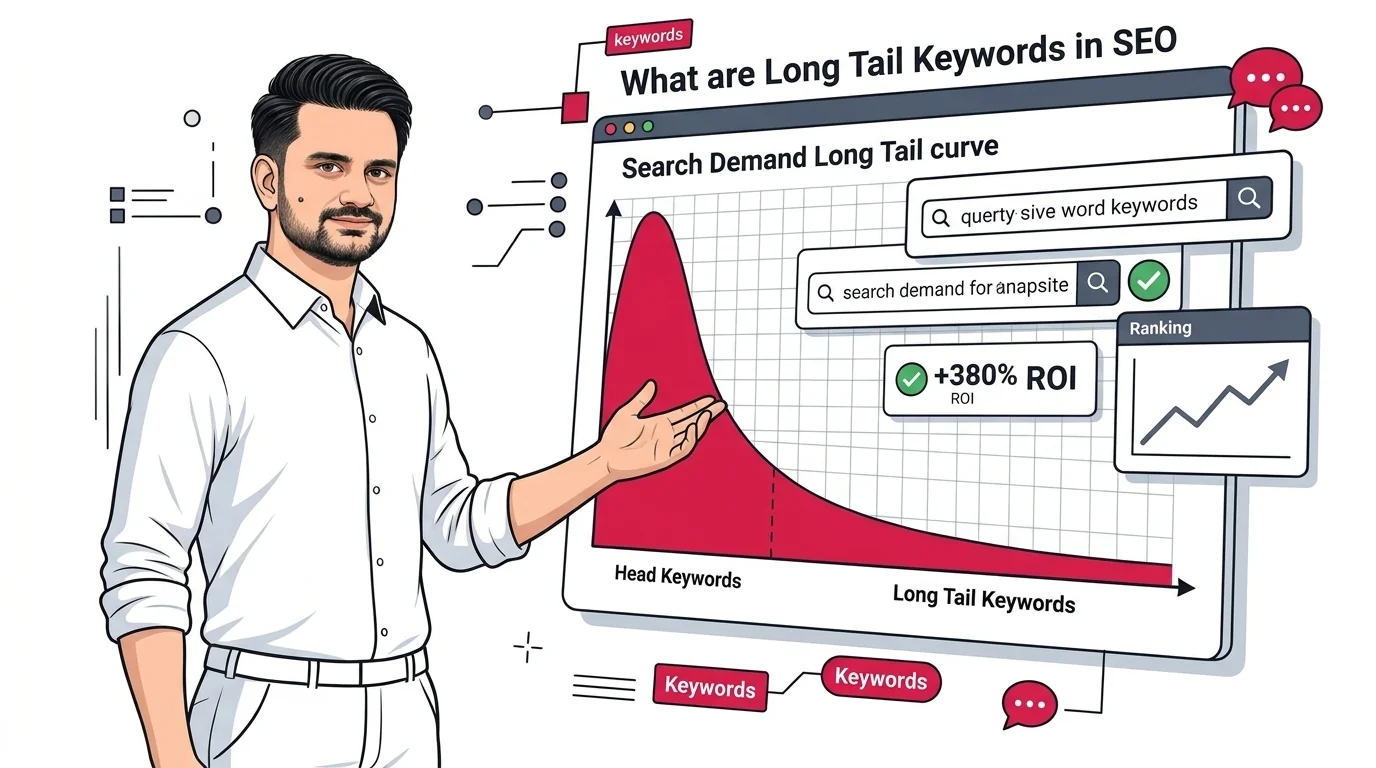
When you plot all search queries across the global internet on a graph—placing monthly search volume on the vertical Y-axis and search term popularity on the horizontal X-axis—you get a classic power-law distribution curve:
- The Head (10% to 15% of queries): A tiny handful of massive, ultra-broad keywords (e.g., "fitness," "laptops," "shoes") that generate millions of searches per month.
- The Body / Torso (15% to 20% of queries): Moderately specific phrases (e.g., "trail running shoes," "accounting software for Mac") with medium volume and moderate competition.
- The Long Tail (70% to 85% of queries): Hundreds of millions of unique, highly specific phrases (e.g., "best lightweight trail running shoes for flat feet men size 11") that receive fewer than 50 searches per month individually, but represent the vast majority of all searches made worldwide.
Core Takeaway: Long-tail keywords are not defined by how many words they contain. They are defined by their position on the search demand distribution curve. A two-word phrase can be long-tail, and a four-word phrase can be a competitive head term.
2. Debunking the Myth: Why Long-Tail Is Not Just About Word Count
One of the most persistent myths repeated in beginner SEO tutorials is that "any keyword with four or more words is a long-tail keyword." This oversimplification causes massive strategic errors and wasted content budgets.
Word count is merely a common byproduct of specificity; it is not the defining criterion. Consider the following examples analyzed across Google's search index:
- "Watch Game of Thrones online free": This phrase contains five words. However, it generates hundreds of thousands of searches every month. It sits firmly in the "head" of search demand and is fiercely contested by major streaming platforms, piracy enforcement hubs, and entertainment portals.
- "Rhubarb hydrofoil": This query contains exactly two words. Yet it has virtually zero monthly search volume and almost zero competition. Statistically, it is located deep in the long tail.
- "Duda technical SEO audit checklist": This five-word phrase has a low search volume of roughly 40 monthly searches, but every single visitor searching it is looking for an expert technical audit. It is a textbook topical long-tail keyword.
When developing a strategic keyword portfolio, do not simply apply a character or word length filter in your software. Evaluate the query's position on the demand curve, its keyword difficulty (KD), and the commercial intent embedded within the phrasing.
3. Head Terms vs. Body Terms vs. Long Tail Keywords
To visualize how user intent and search economics evolve as queries move along the demand curve, consider the following comparative matrix:
| Metric / Characteristic | Head Terms (Short-Tail) | Body Terms (Mid-Tail) | Long-Tail Keywords |
|---|---|---|---|
| Search Volume | Extremely High (10,000+ / mo) | Moderate (500 – 5,000 / mo) | Low to Very Low (10 – 250 / mo) |
| Keyword Difficulty (KD) | Severe (KD 70 – 99) | Medium (KD 30 – 65) | Low to Minimal (KD 0 – 20) |
| Search Intent Clarity | Ambiguous / Navigational | Broadly Informational | Hyper-Specific / Transactional |
| Conversion Rate (CVR) | 1.0% – 1.8% (Browsing) | 2.0% – 3.5% (Evaluating) | 7.5% – 14.0%+ (Ready to Act) |
| Time to Page 1 Ranking | 12 – 24+ Months (Heavy Backlinks) | 6 – 12 Months | 2 to 8 Weeks (Topical Authority) |
| Cost per Acquisition (CPA) | Very High (Intense Ad Bidding) | Moderate | Extremely Low / Efficient |
| Real-World Example | "Shoes" | "Running shoes" | "Best stability running shoes for overpronation 2026" |
Notice the inverse relationship between search volume and conversion rate. Someone typing "shoes" into Google could be a child looking for pictures, a student doing a history project, or a casual window shopper. But someone searching for "best stability running shoes for overpronation 2026" has an identifiable medical condition, knows what footwear category they require, and has their credit card ready.
This is why high-growth brands prioritize long-tail architecture: it delivers qualified buyers directly to solution pages while bypassing entrenched legacy monopolies. If you are wondering how long this trajectory takes to compound, review our detailed benchmark on how long does SEO take.
4. The Two Distinct Buckets: Supporting vs. Topical Long-Tail Queries
One of the biggest mistakes content creators make is treating every long-tail keyword as an excuse to write a brand-new blog post. Doing so leads directly to keyword cannibalization—where dozens of thin, near-duplicate pages on your own website compete against each other and dilute your organic rankings.
To avoid this trap, you must separate long-tail keywords into two distinct operational buckets, a methodology championed by Ahrefs and leading enterprise SEOs:
Bucket A: Supporting Long-Tail Keywords (Sub-Topics of Head Terms)
Supporting long-tail keywords are linguistic variations or sub-questions of a broader parent topic that Google already understands and consolidates into a single Search Engine Results Page (SERP). For example:
- "How to lose belly fat quickly"
- "Fastest ways to burn stomach fat"
- "Belly fat burning tips at home"
If you search Google for these three phrases, you will notice that the top 5 ranking URLs are virtually identical. Google's semantic algorithms (RankBrain, BERT, and MUM) recognize that these queries share the exact same user intent. Creating three separate 800-word articles for each phrase will confuse search crawlers and destroy your rankings.
The Fix: Target all supporting variations within one comprehensive, definitive pillar guide. Structure your H2s and H3s to address these specific angles naturally.
Bucket B: Topical Long-Tail Keywords (Unique, Stand-Alone Intent)
Topical long-tail keywords are hyper-specific queries that represent an independent problem, unique troubleshooting step, or specialized product comparison that cannot be adequately answered inside a generic overview. For example:
- "How to fix Gaggia Classic Pro group head leaking"
- "Squarespace vs Webflow for architectural portfolio SEO"
- "Cloudflare Pages custom domain sitemap not fetching fix"
When you search for these terms, the ranking pages are not generic guides about coffee makers, website builders, or Cloudflare hosting. The top results are highly specialized technical articles that address that precise circumstance directly. These queries deserve their own dedicated, focused URL.
Golden Rule of SERP Analysis: Before writing a new article for a long-tail keyword, Google the phrase. If the top 5 results are broad homepages or ultimate guides, treat the phrase as a supporting keyword. If the top results are laser-focused specific guides, treat it as a topical keyword and build a dedicated page.
5. The Power of "Zero-Volume" Keywords in 2026
In traditional keyword research, SEOs were taught to filter out any keyword showing a search volume of "0" or "0–10" in tools like Semrush, Ahrefs, or Google Keyword Planner. In 2026, ignoring zero-volume keywords is the single biggest competitive mistake you can make.
Here is the reality behind third-party keyword data:
- Google's Official 15% Rule: Google has repeatedly confirmed that 15% of all daily searches (~1.2 billion queries every single day) have never been searched before in human history. By definition, no keyword software has volume data for these searches.
- Clickstream Sampling Latency: Third-party tools estimate search volume using anonymized clickstream data packages aggregated from browser extensions and mobile apps. Highly technical, B2B, or hyper-niche queries rarely generate enough sample points to register on a monthly chart, even if dozens of decision-makers search them every week.
- Aggregated Query Flooding: When you publish a rigorous technical article targeting a zero-volume query, your page does not rank for just that one phrase. It naturally ranks for 50 to 200 related long-tail permutations, generating hundreds of targeted monthly visits that your competitors never saw coming.
If a question is being asked repeatedly by your customers in sales discovery calls, support tickets, or Reddit threads, it is a commercial goldmine regardless of what an SEO tool's volume column claims.
6. Long-Tail Keywords in the Age of AI Search and Generative Overviews
Search behavior has fundamentally evolved. Consumers and B2B buyers no longer type fragmented two-word keywords like "plumber Austin" or "best crm." Instead, they interact with conversational AI engines—including Google AI Overviews, OpenAI SearchGPT, and Perplexity—using multi-clause, natural-language prompts.
For example, a modern business owner does not search for "accounting software." They type:
This is a 24-word conversational long-tail query. When an AI answer engine processes this prompt, it does not match exact keywords against a database. It utilizes Retrieval-Augmented Generation (RAG) to retrieve semantically relevant passage chunks from authoritative websites that address those exact criteria.
To capture AI search visibility, your content must be optimized for these conversational long-tail scenarios. Learn more about optimizing your entity footprint in our breakdown of visibility strategy vs traditional SEO and our dedicated AI search visibility consulting.
7. 5 Practical Methods to Uncover High-Converting Long-Tail Terms
You do not need an enterprise software subscription costing thousands of dollars per month to discover high-intent long-tail keywords. Here are five verified frameworks used by senior SEO specialists:
7.1. Google Autocomplete & The Alphabet Soup Technique
Google Autocomplete is powered by real search logs from millions of active users. To extract long-tail gold:
- Type your core topic into Google's search bar (e.g.,
seo audit). Do not hit enter. - Use the Alphabet Soup Technique: Type
seo audit a,seo audit b,seo audit call the way through the alphabet. Google will suggest the most common real-world long-tail extensions (e.g., "seo audit checklist for ecommerce," "seo audit deliverables for clients," "seo audit tools free"). - Use the Underscore Wildcard Modifier: Insert an underscore (_) before or between words (e.g.,
how to _ seo auditorseo audit for _ websites). Google's algorithm will automatically fill in the missing modifier based on actual search demand (e.g., "seo audit for shopify websites," "seo audit for real estate websites").
7.2. Dynamic People Also Ask (PAA) Tree Mapping
The People Also Ask accordion box is an interactive map of user intent. Every time you click on a question in the PAA drawer, Google dynamically loads 2 to 4 additional related sub-questions below it.
By clicking through three to four levels of questions related to your seed topic, you can generate a tree of 20 to 40 real user queries. These questions make outstanding H2 and H3 subheadings for your content, and answering them clearly positions your site to win Google Featured Snippets and AI Overview citations.
7.3. Mining Untapped Impressions in Google Search Console
Your own Google Search Console (GSC) account is the single most valuable source of long-tail keywords that your website is already starting to rank for:
- Open GSC and navigate to Search Results under the Performance tab.
- Select a date range of the Last 3 Months and check both Total Impressions and Average Position.
- Filter your queries by Position: Greater than 10 (ranking on page 2 or page 3).
- Sort the table by Impressions descending.
This report highlights long-tail queries where Google already considers your site relevant, but because you haven't dedicated a specific section or clear heading to that query, you are hovering in positions 11 to 25. Adding a dedicated H2 section or expanding on that specific subtopic can propel your page onto Page 1 within weeks.
7.4. Mining Reddit, Quora, and Customer Support Tickets
Online forums and customer interactions are unvarnished mirrors of raw user intent. Real people do not speak like marketing textbooks; they express specific frustrations in everyday language:
- Reddit & Quora: Search subreddits in your niche using queries like
site:reddit.com/r/webflow "how do I"orsite:reddit.com/r/smallbusiness "recommendation". Pay attention to threads with dozens of comments discussing common pain points. - Sales Discovery Calls & Support Tickets: Keep a shared log of the exact phrasing prospects use during sales calls. When a client asks, "Can you do technical SEO if my site is built on Duda and hosted on AWS?", that exact sentence should become a long-tail heading on your service or blog page.
7.5. Competitor Keyword Gap Filtering by KD and Traffic Potential
When using professional tools like Semrush, Ahrefs, or SE Ranking, avoid looking only at top-level keywords. Instead, apply the following strategic filter stack:
- Word Count Filter: Minimum 3 or 4 words.
- Keyword Difficulty (KD) Filter: Maximum KD of 15 to 25 (easily rankable without massive link building).
- Search Volume Filter: Maximum volume of 300 searches per month.
- SERP Feature Filter: Filter for keywords that trigger Featured Snippets or Discussion forums.
This filters out the noisy, impossible head terms and leaves you with an actionable list of low-hanging commercial opportunities. If you need assistance structuring a custom keyword audit, explore our professional keyword research and clustering services.
8. How to Organize Long-Tail Queries Into Content Clusters
To maximize search authority, you must organize your long-tail keywords into a structured Hub-and-Spoke (Pillar-Cluster) architecture. Rather than publishing isolated blog posts that float aimlessly on your website, content clustering links related queries together to prove comprehensive topical authority to Google.
Here is how a content cluster is structured in practice:
- The Pillar Page (The Hub): A comprehensive, high-level guide covering the overarching topic (e.g., "The Complete Guide to Technical SEO"). This page targets broad body keywords and links out to all supporting subtopics.
- Cluster Pages (The Spokes): In-depth, laser-focused articles targeting specific topical long-tail queries (e.g., "How to Fix Mixed Content Warnings on WordPress," "How to Audit Canonical Tags on Large Sites," "Diagnosing 504 Gateway Timeouts on Cloudflare").
- Bidirectional Internal Linking: Every cluster page links back to the central pillar using descriptive, contextual anchor text. In turn, the pillar page links down to each cluster page, and cluster pages cross-link to adjacent topics.
When search engine crawlers examine this tightly linked cluster, they recognize that your domain does not just have one surface-level article—it covers the entire topic holistically. For advanced niche-specific clustering strategies, read our deep-dive on long-tail keyword strategy for niche websites.
9. On-Page Optimization: How to Rank for Dozens of Variants Naturally
In the early 2010s, SEOs tried to rank for long-tail keywords by repeating the exact phrase 15 times in the text. In 2026, modern semantic search engines utilize vector embeddings to understand the contextual meaning of your content. Exact-match keyword repetition looks unnatural to readers and triggers quality demotions.
Follow these on-page optimization principles to rank for dozens of long-tail permutations naturally:
- Answer the Core Question in the First 40 Words: When addressing a question-based long-tail query under an H2 or H3 heading, lead with a direct, unambiguous answer immediately. Do not pad the section with fluff. This concise summary makes your content prime material for Google Featured Snippets and AI Overviews.
- Use Natural Semantic Synonyms: If your target heading is "How to fix indexing issues in WordPress," naturally weave in related terms like "Google Search Console coverage report," "robots.txt disallow rules," "noindex meta tag," and "XML sitemap errors." Search algorithms look for these co-occurring entities to verify depth.
- Incorporate Structured Data (JSON-LD): Deploy clean schema markup—including
Article,FAQPage, andHowTowhere applicable—to help search engine crawlers parse your headings, answers, and author credentials with zero ambiguity. - Ensure Flawless Technical Performance: Long-tail visitors expect immediate answers. If your website has slow Core Web Vitals, broken internal links, or shifting layouts, users will bounce back to the SERP. Learn how to diagnose site infrastructure in our guide to technical SEO audits and fixes.
10. Measuring ROI: Why Traditional Rank Tracking Fails for Long-Tail SEO
Traditional SEO reporting focuses on tracking 10 to 20 primary keywords in a rank-tracking dashboard and celebrating when a keyword moves from position 4 to position 2. This methodology completely fails to measure the success of a long-tail keyword strategy.
Because long-tail SEO distributes traffic across hundreds of unique query variations, measuring single-keyword rankings gives a distorted, incomplete picture. Instead, track these four holistic KPIs:
- Search Console Total Impressions & Clicks: Track aggregate organic impressions and clicks at the page and cluster level over 3-month and 6-month rolling windows. The real measure of long-tail success is steady upward traffic volume across the entire cluster.
- Query Footprint Count: In Google Search Console's page-level query report, examine how many distinct queries each page ranks for. A well-optimized long-tail article should steadily expand its footprint, ranking for 50, 100, or 300+ unique search terms over time.
- Conversion Rate and Pipeline Velocity: Because long-tail visitors possess high buyer intent, monitor form fills, demo bookings, consultation inquiries, and affiliate sales generated per 1,000 organic visitors. Long-tail traffic consistently converts at 2.5x to 4x the rate of generic head-term traffic.
- Assisted Conversions in Multi-Channel Funnels: Many long-tail informational searches introduce prospects to your brand early in their research journey. Track how often long-tail pages appear as the first touchpoint in your Google Analytics 4 (GA4) conversion paths.
11. Step-by-Step Implementation Checklist for 2026
Here is an actionable 7-step checklist you can implement immediately to launch a high-impact long-tail keyword campaign:
- Step 1: Identify Your Seed Topics: Define 3 to 5 core service offerings or thematic pillars that represent your most profitable commercial products.
- Step 2: Mine Intent Sources: Run your seed topics through Google Autocomplete (Alphabet Soup), People Also Ask drawers, and customer support transcripts to build a raw list of 100+ long-tail candidate queries.
- Step 3: Perform SERP Intent Validation: Search each candidate query on Google. Filter out phrases where Google collapses the intent into an existing head term (Supporting keywords) vs. queries that show dedicated standalone results (Topical keywords).
- Step 4: Group Into Thematic Clusters: Group 5 to 10 closely related supporting queries under a single parent topic. Avoid creating thin, competing pages.
- Step 5: Draft In-Depth, Answer-First Content: Write comprehensive guides (2,000+ words) answering the core question directly in the first paragraph, supported by real data tables, code snippets, and practical examples.
- Step 6: Implement Bidirectional Internal Linking: Connect your cluster articles to your main commercial landing pages and parent pillar guides using descriptive contextual anchor text.
- Step 7: Monitor & Refresh in Search Console: Revisit GSC after 60 to 90 days. Identify high-impression queries ranking in positions 8 to 20, and expand your article's subheadings to capture Page 1 rankings.
12. Strategic Summary & Next Steps
Winning at search engine optimization in 2026 does not require competing head-to-head with multi-billion-dollar media conglomerates for generic, low-converting keywords. By understanding what is long tail keywords in seo and executing a disciplined content clustering strategy, you can capture the vast majority of real-world search demand.
Focus on solving specific problems for specific people. Prioritize clear search intent over vanity search volume, build tightly structured content clusters, and optimize for both traditional search crawlers and modern generative answer engines. Over time, the accumulated topical authority from hundreds of long-tail rankings will naturally lift your domain, eventually allowing you to compete for and win the biggest head terms in your industry.
To take your organic growth to the next level, explore our specialized services and authoritative guides:
- Keyword Research & Topic Clustering Services — Discover high-ROI opportunities tailored to your niche.
- AI Search Visibility & Answer Engine Optimization — Ensure your brand is cited in ChatGPT, Perplexity, and Google AI Overviews.
- Technical SEO Audits & Core Web Vitals Fixes — Eliminate crawl errors, slow load times, and indexation bottlenecks.
- Advanced Long-Tail Strategy for Niche Sites — The practical playbook for out-ranking massive domains.
- Top of Search Visibility Strategy vs. Traditional SEO — The complete comparative framework for 2026.