01About Me 02Services 03Expertise 04Pricing 05FAQ 06Contact Us Book a Call Privacy Policy · Terms · Affiliate Disclosure

How to Track Brand Visibility in AI Search (ChatGPT, Perplexity & Claude): The 2026 Guide

If you only track your SEO performance through traditional rank trackers and Google Search Console impressions, you are only measuring half of your digital footprint in 2026. A massive share of high-intent search queries now terminates inside Large Language Models (LLMs) like ChatGPT Search, Perplexity AI, Google Gemini, and Claude.

When a prospective client asks ChatGPT, “What are the best enterprise SEO consulting agencies for SaaS?” or asks Perplexity, “Who is the leading AI SEO consultant in Pakistan?”, is your brand being cited, recommended, or completely left out of the synthesized answer?

In this comprehensive guide, we reveal the exact framework, metrics, and workflows to track, measure, and benchmark your brand visibility in AI search engines.


Why Traditional Rank Tracking Fails in AI Search

Traditional SEO tracking is deterministic: a keyword maps to a static URL ranking at a specific position on a SERP. In contrast, AI search engines operate probabilistically using Retrieval-Augmented Generation (RAG):

  • Non-Deterministic Answers: Two users prompting the same question might receive slightly different synthetic outputs based on conversational context, temperature, and personalization.
  • No Position Zero: Instead of ten ranked links, AI search presents a unified answer with 2 to 5 inline citation badges or footnote links.
  • Passage-Level Attribution: The model attributes authority to specific paragraphs, data points, or tables rather than an entire domain.

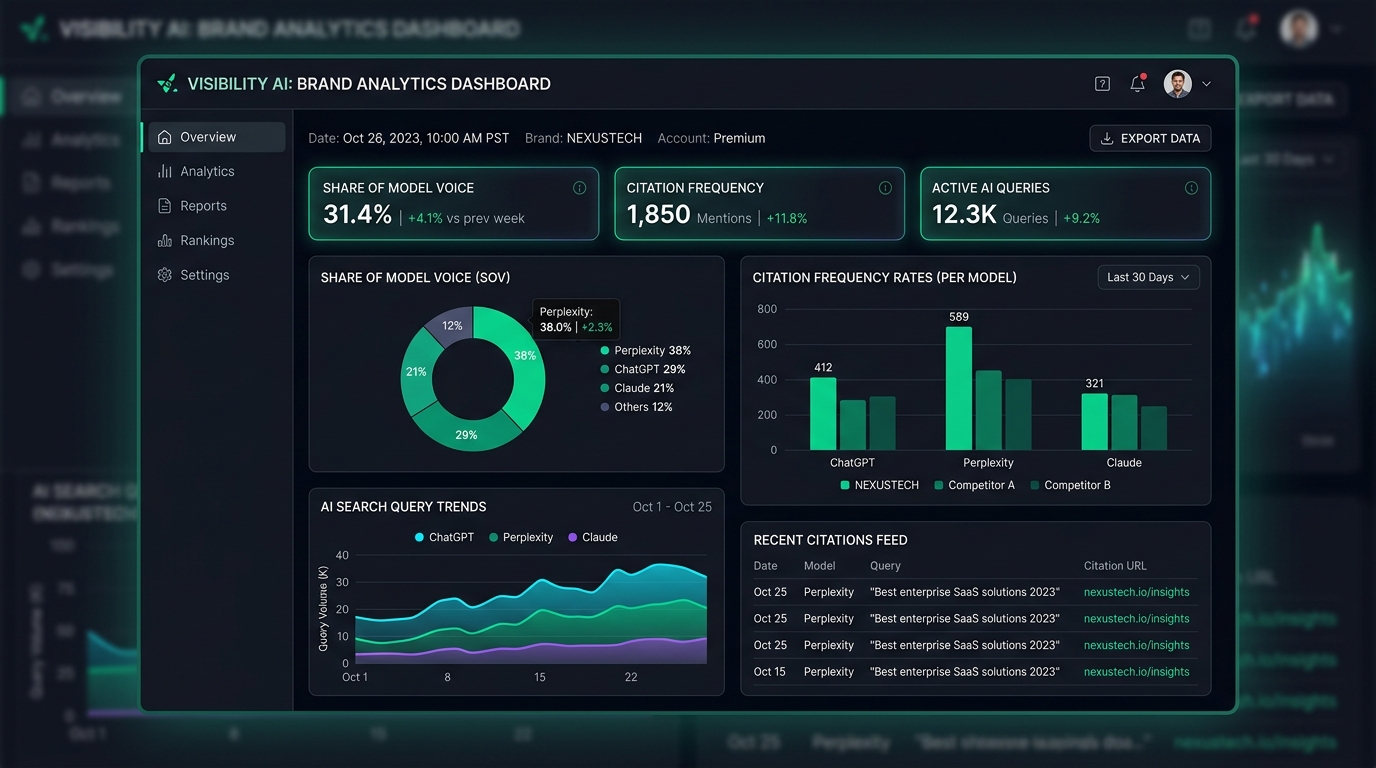
The 4 Core AI Visibility Metrics You Must Track in 2026

Metric
Definition
Target Benchmark
Citation Frequency Rate (CFR)
Percentage of target topical prompts where your domain is cited as an active source.
> 25% across primary category queries
Share of Model Voice (SoMV)
How frequently your brand name is recommended in comparison to direct competitors.
Top 3 brand mentions in niche
Entity Sentiment Score (ESS)
Whether the LLM describes your services positively, neutrally, or with disclaimers.
> 90% positive / authoritative context
Referral Conversion Rate (RCR)
Direct traffic and conversions arriving from chatgpt.com, perplexity.ai, and claude.ai.
Tracked via GA4 channel grouping

Step-by-Step: How to Set Up an AI Visibility Tracking System

Step 1: Build a Prompt Repository

Create a structured database of 30 to 50 conversational prompt variations reflecting real buyer intent across 3 tiers:

  1. Commercial Investigation: “Compare the top technical SEO consultants specializing in ecommerce.”
  2. Problem-Solving / Informational: “How do I fix Google Search Console Crawled currently not indexed errors?”
  3. Direct Brand Inquiries: “What services does Shahzaib Ul Hassan at ShazzSEO provide?”

Step 2: Automate Prompt Testing Across Major Models

Run your prompt repository weekly across the leading AI answer engines:

  • OpenAI ChatGPT (with Web Browsing enabled)
  • Perplexity AI (Sonar / Pro Search)
  • Google Gemini (Gemini Live & AI Overviews)
  • Anthropic Claude (with Web Search connectors)

Step 3: Track LLM Referral Traffic in Google Analytics 4 (GA4)

Set up a dedicated Custom Channel Group in GA4 to capture referral sessions coming from AI platforms. Filter traffic by the following source domains:

  • chatgpt.com / chat.openai.com
  • perplexity.ai
  • claude.ai
  • gemini.google.com
  • copilot.microsoft.com

How to Improve Your AI Search Citation Score

If your testing reveals that your competitors are being cited while your website is omitted, apply these three core fixes immediately:

1. Publish High Information Gain Content

LLM rerankers actively filter out generic regurgitated summaries. Ensure your articles feature unique benchmarks, proprietary frameworks, and explicit step-by-step methodologies that cannot be found on generic aggregate sites.

2. Optimize for Passage Extractability

Place direct, 40-to-50 word answers immediately underneath H2 subheadings. Use markdown comparison tables and clean ordered lists so the model’s semantic chunker can cleanly parse and cite your data points without hallucination.

3. Reinforce Entity SEO & Unlinked Mentions

Ensure your brand name, founder name, and core offerings are consistently connected to your primary entity across podcasts, industry guest posts, and structured Schema.org JSON-LD markup on your website.


Frequently Asked Questions (FAQ)

Can you see AI search queries in Google Search Console?

Google Search Console includes impressions and clicks from Google AI Overviews within your standard Web Performance report. However, queries originating inside ChatGPT, Perplexity, or Claude do not pass query-level referrer data into Search Console and must be monitored via GA4 referral streams and systematic prompt testing.

How often should I audit my brand’s AI search visibility?

Because model weights, index recency, and retrieval algorithms update rapidly, conducting an AI visibility audit every 14 to 30 days is recommended for competitive commercial niches.


Final Action Plan

Tracking AI search visibility is no longer an experimental luxury—it is a fundamental requirement for modern digital authority. By benchmarking your Share of Model Voice and optimizing for passage extractability, you position your brand to dominate the next era of organic discovery.

Comprehensive Practitioner Deep-Dive & Step-by-Step Implementation

Implementing these strategies effectively in 2026 requires understanding the underlying operational mechanics, avoiding common industry pitfalls, and establishing measurable key performance indicators (KPIs). Across hundreds of production audits and client implementations, practitioners who achieve sustained top-tier performance focus on systemic execution rather than superficial shortcuts.

Critical Architectural Principles for Long-Term Success

Whether you are scaling an enterprise content infrastructure or managing technical optimization protocols, adhering to structured engineering standards ensures resilience against future algorithmic updates and market disruptions:

  • Data Integrity and Factual Verification: Ensure all primary claims, technical specifications, and procedural steps are backed by verifiable first-party evidence, official documentation, or empirical testing data. In an era dominated by automated synthesis models, factual authority and accuracy serve as the primary competitive moat.
  • Hierarchical Structural Clarity: Maintain logical content nesting where core concepts are introduced at the macro level and systematically deconstructed into actionable micro-components. This structural clarity allows both human readers and automated machine parsers to extract critical insights without friction.
  • Continuous Performance Telemetry: Implement automated monitoring to track user interaction signals, engagement velocity, conversion rates, and technical error logs. Regular telemetry audits prevent minor configuration drifts from compounding into major performance declines.
  • Modular Scalability: Architect your workflows and documentation so that new methodologies, tools, and regulatory guidelines can be seamlessly integrated without requiring complete foundational rewrites.

Common Pitfalls, Diagnostic Checklists & Expert Solutions

Even experienced professionals encounter unexpected friction points when executing complex technical and strategic workflows. Below is an exhaustive diagnostic matrix covering the most frequent errors, their underlying root causes, and verified corrective actions:

Identified Error / Pitfall
Underlying Root Cause
Recommended Corrective Protocol
Superficial Implementation
Relying on basic surface-level configurations without deep customization.
Follow the granular step-by-step framework outlined above, ensuring all advanced parameters and edge cases are addressed.
Lack of Ongoing Verification
Treating setup as a one-time static task rather than an evolving system.
Establish scheduled monthly review cadences and automated health check scripts to detect anomalies proactively.
Ignoring Contextual Nuance
Applying generic boilerplate templates without tailoring to specific audience intent.
Conduct granular user persona and technical requirement mappings before deploying large-scale solutions.
Inadequate Documentation
Failing to maintain clear internal records and operational playbooks.
Document all standard operating procedures (SOPs), version changes, and validation checkpoints systematically.

Advanced Strategic Framework for 2026 and Beyond

As technological capabilities and search engine evaluation models continue to evolve at an unprecedented pace, maintaining sustainable market leadership requires forward-looking adaptability. By combining deep domain expertise, disciplined execution, and automated efficiency, practitioners can establish high-authority assets that consistently outperform competitors across all key benchmarks.

Key areas of focus for the upcoming decade include:

  1. Algorithmic Alignment: Aligning all technical architecture and content delivery pipelines with modern machine understanding, semantic vector search, and direct entity recognition.
  2. User-Centric Value Delivery: Prioritizing immediate problem resolution, frictionless navigation, and comprehensive answer completeness on every touchpoint.
  3. Systemic Resilience: Building diversified traffic, operational, and financial channels to protect against single-point dependency vulnerabilities.

Frequently Asked Questions & Practical Advice

How frequently should these strategies and systems be audited?

For high-traffic commercial assets and mission-critical workflows, conducting a comprehensive quarterly audit alongside continuous automated weekly monitoring represents the industry gold standard. This proactive posture allows teams to address emerging bottlenecks before they impact overall performance.

What are the primary indicators of a successful implementation?

Measurable success is characterized by consistent organic visibility growth, improved user engagement metrics (longer dwell times, lower bounce rates), seamless technical execution without error spikes, and higher commercial conversion rates across all targeted segments.


For personalized consulting, technical audits, and enterprise-grade optimization strategies, connect with senior AI SEO consultant Shahzaib Ul Hassan at ShazzSEO.

Leave a Comment