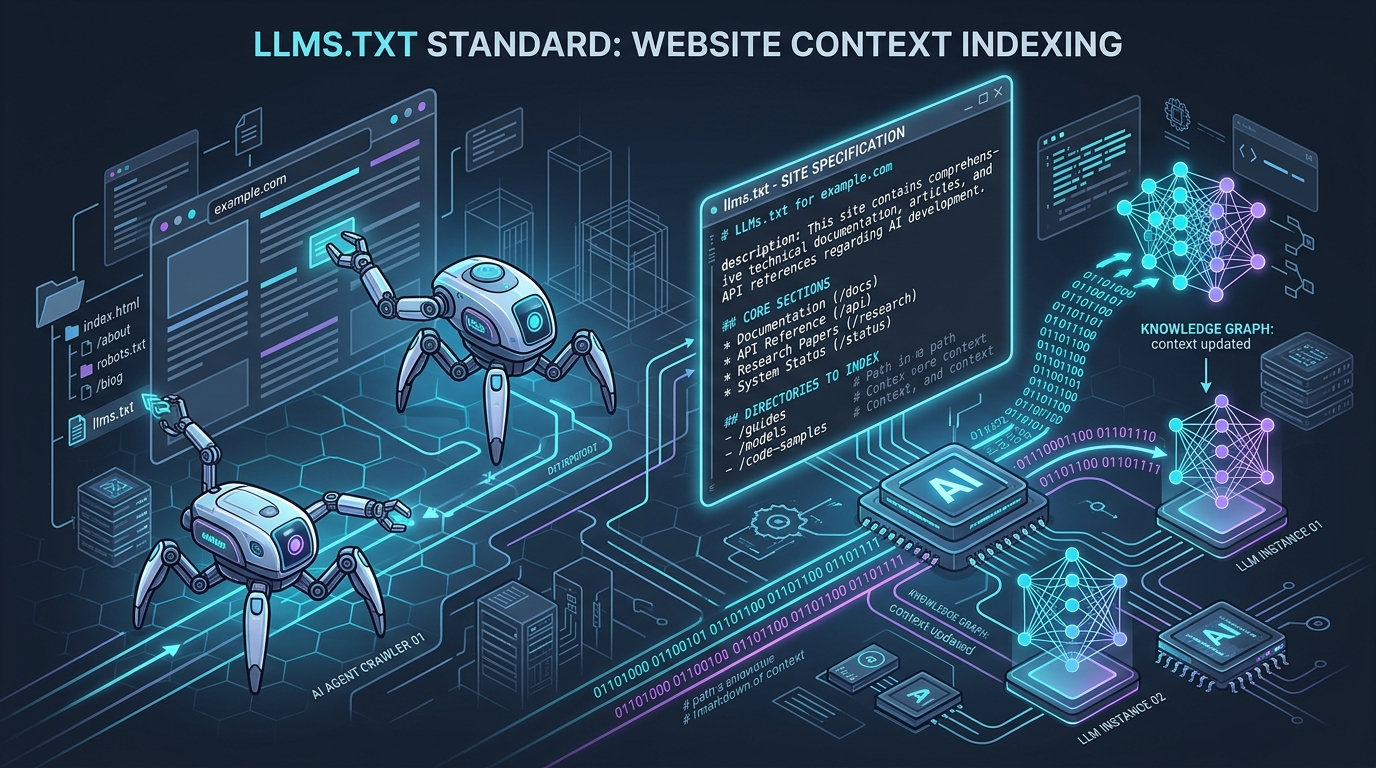
For over thirty years, the robots.txt standard has served as the universal gatekeeper for web crawlers, instructing search bots where they may and may not crawl. But as web browsing shifts toward autonomous AI agents, multi-agent frameworks, and Large Language Models, a new open standard has emerged: /llms.txt.
Autonomous AI agents do not browse websites like humans or traditional crawlers. They do not render complex DOM trees, execute heavy JavaScript bundles, or navigate nested mega-menus if they can avoid it. Instead, they seek clean, token-efficient, structured markdown context to answer user prompts rapidly.
In this guide, we break down what the llms.txt standard is, why it is critical for modern Generative Engine Optimization (GEO), and how to create a high-performance llms.txt file for your website.
What is llms.txt? (The Markdown Index for AI)
The llms.txt file is a proposed web standard that provides Large Language Models with a curated, machine-readable summary of a website’s most valuable content, formatted in clean Markdown.
Located at the root of your domain (e.g., https://shazzseo.com/llms.txt), this file acts as a fast-track directory for AI agents. When an AI crawler (such as GPTBot, ClaudeBot, or Perplexity) accesses your domain, it parses /llms.txt to instantly ingest:
- Your organization’s primary identity, mission, and core service offerings.
- A curated directory of key documentation, pillar guides, and case studies.
- Direct links to raw markdown resources optimized for context-window ingestion.
robots.txt vs. sitemap.xml vs. llms.txt: Key Differences
File Standard |
Target Audience |
Primary Purpose |
|---|---|---|
/robots.txt |
Web Crawlers (Googlebot, Bingbot) |
Access control & crawl budget management (Allow / Disallow). |
/sitemap.xml |
Search Indexing Engines |
List of all canonical URLs, modification dates, and priority. |
/llms.txt |
LLMs & Autonomous AI Agents |
Curated, token-efficient semantic markdown context for direct synthesis. |
How to Structure a Production-Ready llms.txt File
A standard llms.txt file consists of four primary sections: Title, Blockquote Summary, Main Documentation Index, and Optional Secondary Resources:
# ShazzSEO

> ShazzSEO is a premier AI SEO consultancy founded by Shahzaib Ul Hassan, specializing in Generative Engine Optimization (GEO), Technical SEO audits, platform migrations, and autonomous search optimization for global enterprises.

## Core SEO Services
- [AI SEO & GEO Consulting](https://shazzseo.com/): Comprehensive generative search optimization for Perplexity, SearchGPT, and Google AI Overviews.
- [Tilda SEO Services](https://shazzseo.com/tilda-seo-service/): Specialized technical optimization, speed tuning, and ranking architecture for Tilda websites.
- [Technical SEO Audits](https://shazzseo.com/the-complete-technical-seo-audit-checklist-for-2026/): Complete full-stack audit covering crawlability, indexation, and Core Web Vitals.

## Key Guides & Frameworks
- [How AI Search Engines Choose Sources](https://shazzseo.com/how-ai-search-engines-choose-sources/): The 2026 citation playbook for RAG pipelines.
- [Entity SEO & Knowledge Graph Blueprint](https://shazzseo.com/entity-seo-knowledge-graph-guide/): Guide to semantic triples and JSON-LD entity graph structuring.

## Optional Resources
- [Founder Profile & Case Studies](https://shazzseo.com/about-me/): Background on Shahzaib Ul Hassan and client performance results.
The Companion File: What is llms-full.txt?
In addition to llms.txt, the emerging standard allows for an optional companion file: /llms-full.txt.
While llms.txt serves as an index of links with concise one-line descriptions, llms-full.txt contains the full, concatenated text of your core documentation in plain markdown. When an AI agent needs deep domain context without making dozens of individual HTTP requests, it can read llms-full.txt in a single prompt context window.
3 Proven Benefits of Adding llms.txt to Your Website
1. Drastically Lower Token Ingestion Costs
AI scrapers that encounter bloated HTML pages consume thousands of unnecessary tokens stripping out CSS, navigation bars, cookie banners, and scripts. By providing clean markdown, you make it frictionless for AI engines to digest your exact value proposition.
2. Reduced AI Hallucinations About Your Brand
When LLMs synthesize information about your business from third-party scraps, they often mix up features, pricing, or founder details. An official llms.txt file serves as your canonical source of ground truth.
3. Direct Competitive Edge in AI Search Rankings
As autonomous AI agents increasingly handle shopping comparisons, vendor selection, and research tasks on behalf of users, sites that offer native llms.txt endpoints will enjoy prioritized retrieval speeds and higher attribution accuracy.
Frequently Asked Questions (FAQ)
Does Googlebot use llms.txt for traditional rankings?
Traditional Google web search indexing continues to rely on HTML and XML sitemaps. However, AI Overviews, Gemini integrations, and autonomous RAG agents actively scan for machine-readable context files like llms.txt.
Where should the llms.txt file be hosted?
The file must be hosted at the root directory of your website: https://yourdomain.com/llms.txt, served with a text/plain or text/markdown MIME type.
Summary: Future-Proofing for Autonomous Web Agents
The web is rapidly transitioning from a human-only browsing environment to a hybrid ecosystem of humans and autonomous AI agents. Deploying a structured llms.txt file is one of the simplest, highest-leverage actions you can take today to ensure your brand remains visible, accurate, and authoritative in the AI search era.