An ESFCA lets an eligible Pakistani freelancer retain part of their export earnings in foreign currency instead of converting the entire amount to rupees. It is normally opened alongside a PKR freelancer account at an authorized bank. The State Bank of Pakistan framework allows freelancers to retain up to 50% of eligible export proceeds, or USD 5,000 per month, whichever is higher, subject to the bank’s checks and the applicable rules.
This guide explains the account in plain language, the documents you may need, the application process, and the questions to ask your bank. It was reviewed against State Bank of Pakistan material available on September 29, 2026. A bank may apply additional KYC and compliance checks to your case.
What is an ESFCA?
ESFCA stands for Exporters’ Special Foreign Currency Account. It is a regulated foreign-currency account for retaining eligible export proceeds. For a freelancer, it is linked to the freelancer’s local-currency account rather than operating as an unrelated personal dollar account.
The SBP Framework for Freelancers Accounts says banks can open the PKR account and ESFCA together. SBP later increased the retention limit from 35% to 50% and liberalized use of retained funds. The framework is designed for exports of services, including eligible freelance services.
What can a freelancer use an ESFCA for?
- Retaining an allowed portion of eligible export earnings in foreign currency.
- Paying permitted foreign expenses directly from the retained balance, subject to bank checks.
- Reducing repeated currency conversion when you have genuine overseas business costs.
- Keeping a clearer banking trail for eligible service-export receipts.
An ESFCA is not a way to hide income, bypass tax reporting, or receive unexplained transfers. Your bank can request an invoice, contract, marketplace statement, purpose of remittance, or other evidence.
Who is eligible?
You may be eligible if you are a resident Pakistani individual earning foreign exchange by providing services to overseas clients. Examples include software development, design, marketing, consulting, writing, video production, and other remote services. The bank must be satisfied that the money represents a genuine export of services and that its source can be verified.
A platform profile by itself may not be enough. Keep a consistent legal name and address across your CNIC, bank account, marketplace profile, invoices, payment processor, and tax records.
Documents banks commonly request
Requirements differ by bank and by customer risk profile. Prepare the following before applying:
- Valid CNIC or NICOP and a mobile number registered in your name.
- Proof of address if the bank requests it.
- Fiverr, Upwork, agency, portfolio, or professional profile showing your work.
- Recent contracts, orders, invoices, or client correspondence.
- Platform earnings and withdrawal statements.
- Recent bank or payment-processor statements showing the payment route.
- NTN and tax-registration details where requested.
- PSEB registration if you have it and your services fall within IT or ITeS.
Create one PDF folder with readable filenames such as CNIC.pdf, Upwork-Earnings-Sep-2026.pdf, and Invoice-ClientName-104.pdf. That small step makes branch and compliance review easier.
How to open an ESFCA step by step
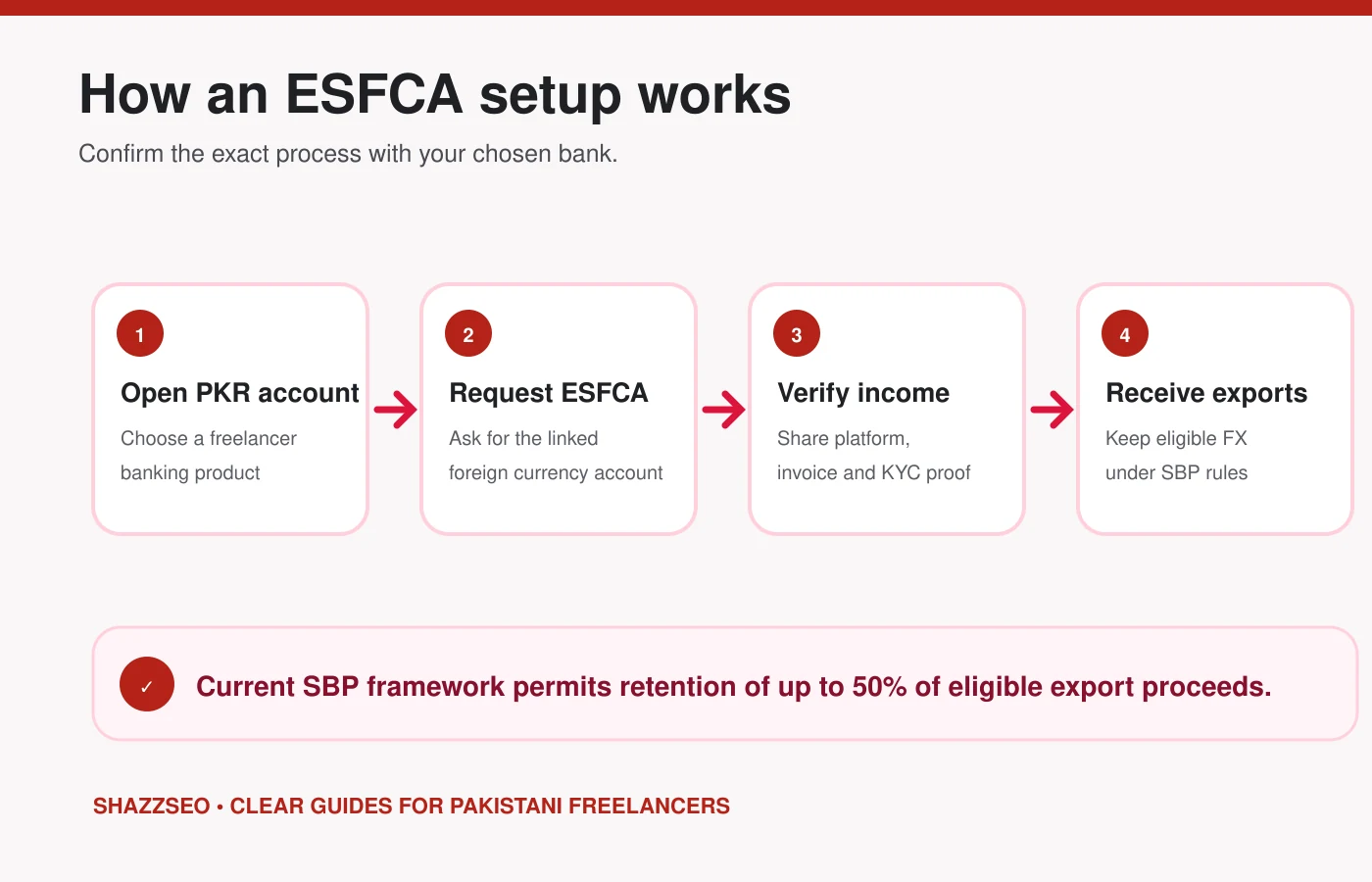
1. Compare freelancer accounts, not only ordinary current accounts
Ask shortlisted banks whether their freelancer account includes or supports a linked ESFCA. Compare online onboarding, branch support, account currencies, inward-remittance handling, ePRC availability, minimum-balance rules, and outward-payment charges. Our comparison of the best bank accounts for Pakistani freelancers can help you build a shortlist.
2. Explain your exact payment route
Tell the bank whether you receive direct client wires, marketplace-to-bank withdrawals, Payoneer transfers, or a mixture. Ask this specific question: “Will this route be recorded as service-export proceeds and credited to my linked ESFCA under the SBP freelancer framework?”
This matters because a transfer’s description, originating institution, and purpose code affect how the bank records it. Learn the practical differences in our guide to receiving international payments in Pakistan.
3. Open the PKR freelancer account and request the linked ESFCA
Complete the bank’s KYC form and request both accounts explicitly. Ask which foreign currencies are supported. Obtain the account titles and IBAN or routing instructions in writing. Some banks complete both accounts together; others perform a second compliance review.
4. Submit evidence of freelance work
Give the bank enough evidence to understand what you sell, who pays you, and how the funds reach Pakistan. A short one-page business note can help: list your services, platforms, typical monthly volume, main countries of clients, and expected payment channels.
5. Test with a normal payment and verify the classification
Do not ask a client to send a token or misleading transaction. Use a genuine invoice or marketplace payout. Once credited, ask the bank for the transaction purpose and the ePRC. Confirm what portion reached the ESFCA and what portion was converted to PKR.
How the 50% retention rule works
SBP’s EPD Circular Letter No. 17 of 2023 increased the ESFCA retention limit to 50% of export proceeds. SBP’s public explanation also states that freelancers may retain 50% or USD 5,000 per month, whichever is higher. This is a ceiling under the framework, not a promise that every incoming transfer will be split automatically.
Example: if your bank recognizes a USD 2,000 receipt as eligible freelance export proceeds, it may retain the allowed portion in your ESFCA and convert the balance to PKR. Exchange rate, charges, timing, and the exact operational treatment are bank-specific. Ask for a transaction-level breakdown.
Questions to ask before choosing a bank
- Is the ESFCA opened automatically with the freelancer PKR account?
- Which currencies can I hold?
- How do you classify Fiverr, Upwork, and Payoneer receipts?
- Can I download an ePRC online, and which purpose code will appear?
- What are the inward, conversion, SWIFT, card, and outward-payment charges?
- What evidence is required for foreign business payments?
- Who handles a wrongly classified remittance?
Common mistakes to avoid
- Choosing a bank only for its app. Remittance classification and branch support matter more.
- Using different names. A mismatch across CNIC, marketplace, Payoneer, and bank accounts can delay review.
- Calling every foreign transfer an export. Family support, refunds, investments, and freelance income have different purposes.
- Losing invoices and ePRCs. Download evidence monthly instead of rebuilding it at tax time.
- Assuming the ESFCA replaces FBR reporting. Banking treatment and income-tax obligations are separate.
Frequently asked questions
Can I open only an ESFCA without a rupee account?
Under the freelancer framework, the ESFCA is normally linked to a PKR freelancer account. Confirm the product structure with your bank.
Can I keep 100% of my earnings in dollars?
Not under the standard retention rule described above. The framework permits retention up to the applicable limit; the remainder is generally converted or handled according to bank and SBP rules.
Does Payoneer income always qualify?
No automatic guarantee exists. Ask your bank how it identifies the underlying payer and export purpose. Keep the platform order, Payoneer transaction, invoice, and bank credit together.
Do I need PSEB registration?
It may strengthen documentation for eligible IT and ITeS freelancers and can affect tax treatment, but bank onboarding requirements differ. See our PSEB registration guide.
Is money in an ESFCA tax-free?
No. Holding earnings in foreign currency does not by itself remove tax or filing obligations. Tax treatment depends on the nature of the service, registration status, current law, and your facts.
Final checklist
Choose a bank that can explain the complete path from overseas payer to purpose code, ESFCA credit, PKR conversion, and ePRC. Bring consistent identity and income records, test the process with a real payment, and save every supporting document. If the branch gives an unclear answer, ask for its foreign-remittance or trade-services team rather than guessing.
This article provides general educational information, not individualized banking, foreign-exchange, or tax advice. Verify current requirements with your authorized bank, SBP, FBR, and a qualified Pakistani tax professional.