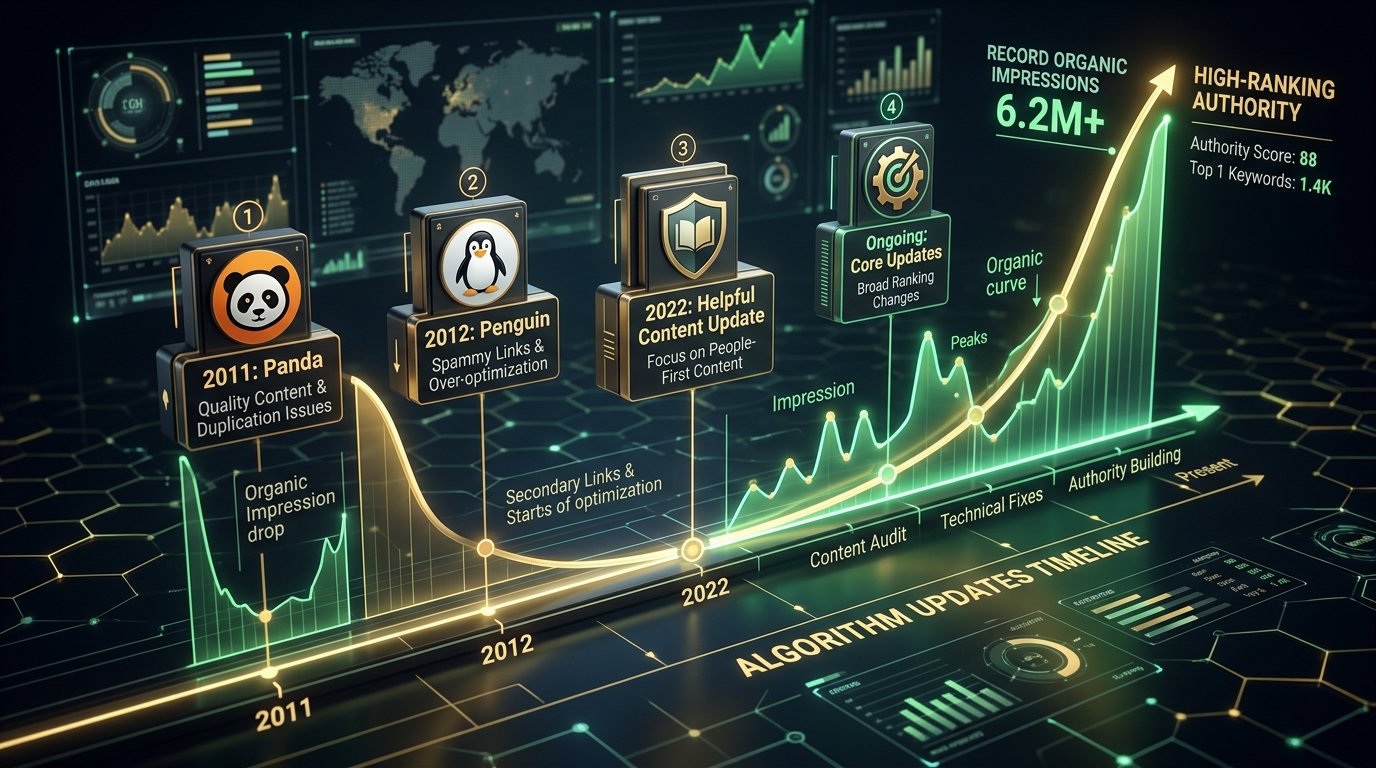
Every SEO who has managed a website for more than a couple of years has lived through at least one unexplained traffic collapse. Rankings that held steady for months suddenly slide, organic sessions drop 30-60% inside a week, and the client wants an answer by Monday. More often than not, the culprit isn’t a broken sitemap or a bad redirect — it’s a Google algorithm update. Understanding the history of these updates isn’t a trivia exercise; it’s a diagnostic tool. If you know what Panda targeted in 2011, what Penguin targeted in 2012, and what the Helpful Content system was built to catch in 2022, you can look at a traffic graph and a set of affected URLs and form a real hypothesis about what happened — instead of guessing, or worse, applying a generic “SEO audit checklist” that has nothing to do with the actual cause.
This is a practitioner’s walkthrough of the updates that actually changed how sites get ranked, how to figure out whether your own drop was algorithmic or technical, how to narrow down which update likely hit you, and what a realistic recovery process looks like once you know.
A Chronological Walk Through Google’s Most Consequential Updates
Google rolls out thousands of ranking changes a year, but only a handful have reshaped entire industries. Here are the ones worth actually knowing, in order.
Panda (February 2011) — content farms and thin content
Panda was Google’s response to the content-farm era, when sites churned out enormous volumes of shallow, ad-heavy articles designed purely to rank rather than to inform. Panda demoted sites with thin content, high ad-to-content ratios, duplicate or scraped material, and low user engagement signals. It was the first update where “content quality” became a measurable ranking factor rather than a vague ideal, and it wiped out entire business models built on cheap, high-volume content production.
Penguin (April 2012) — manipulative link schemes
Penguin targeted the other side of the same coin: link manipulation. Exact-match anchor text stuffing, paid link networks, comment spam, and low-quality directory submissions had been propping up rankings for years. Penguin penalized sites with unnatural backlink profiles, and in its early versions it was brutal — sites could get hit and stay hit until the next Penguin refresh, sometimes a year later. Penguin 4.0 in 2016 finally made it real-time and more granular, devaluing spammy links rather than penalizing the whole site.
Hummingbird (September 2013) — semantic and conversational search
Hummingbird was a full rewrite of Google’s core search algorithm, not a penalty layer. It shifted ranking from matching keywords to interpreting the meaning behind a query, laying the groundwork for conversational and voice search. Sites built around keyword-stuffed pages targeting one phrase per page started losing ground to pages that comprehensively answered a topic.
RankBrain (October 2015) — machine learning enters the ranking stack
RankBrain was Google’s first major machine-learning system used to interpret ambiguous or novel queries (Google has said a significant share of daily queries had never been seen before). It helped Google infer intent from context and user behavior rather than relying purely on hard-coded rules, and it became a permanent, learning part of the ranking system rather than a one-off update.
Medic Update (August 2018) — E-A-T and Your Money or Your Life content
Nicknamed “Medic” by the SEO community because health sites were hit hardest, this broad core update disproportionately affected “Your Money or Your Life” (YMYL) niches: health, finance, legal, and safety content. It pushed Google’s Search Quality Rater Guidelines concept of Expertise, Authoritativeness, and Trustworthiness (E-A-T, later expanded to E-E-A-T with Experience) from a rater-training document into something SEOs had to actively design for — real author credentials, cited sources, transparent business information, and demonstrable subject-matter expertise.
BERT (October 2019) — natural language understanding
BERT (Bidirectional Encoder Representations from Transformers) improved Google’s ability to understand the nuance of prepositions and word relationships in a query — the difference between “parking for a hill” and “parking on a hill.” It affected roughly one in ten queries at launch and reinforced that writing for how people actually phrase questions mattered more than optimizing for stiff keyword phrases.
Page Experience Update and Core Web Vitals (2021)
This rollout introduced Largest Contentful Paint, First Input Delay (later replaced by Interaction to Next Paint), and Cumulative Layout Shift as ranking signals alongside mobile-friendliness, HTTPS, and intrusive interstitial checks. It was a comparatively mild ranking factor relative to content relevance, but it pushed page-speed and layout-stability work into the standard technical SEO checklist for good.
Link Spam Updates (2021-2022)
A series of dedicated spam updates targeted link-based manipulation more aggressively than Penguin’s real-time system alone was catching — particularly guest-post networks, paid link placements disguised as editorial, and spammy outbound link schemes. Google paired these with clearer public guidance on what counts as a manipulative link.
Helpful Content Update (August 2022) — people-first content
The Helpful Content Update introduced a site-wide classifier that judged whether content was created primarily for people or primarily to attract search traffic. It hit sites with content produced purely to rank for keywords — the “write about everything the keyword tool suggests” model — even when that content wasn’t technically low quality by older standards. Google published a set of self-assessment questions (does the content demonstrate first-hand experience, would you recommend this page to a friend) that became a standard content-audit framework.
March 2024 Core Update — the biggest shake-up in years
This was one of the largest and longest core updates on record, rolling out over roughly six weeks (announced March 5, substantially complete by mid-to-late April 2024). Google explicitly said it aimed to reduce low-quality, unoriginal content in search results by a significant margin. Critically, it also formally folded the Helpful Content system into Google’s core ranking systems — there would be no more separate “helpful content update” announcements, because helpfulness signals became a permanent, continuously-running part of core ranking.
Alongside the core update, Google rolled out new spam policies targeting three specific abuses: scaled content abuse (mass-producing content, including AI-generated content, primarily to manipulate rankings rather than help users), site reputation abuse (letting third parties publish low-quality content on a trusted domain’s subdomain or subfolder to exploit its authority — also called “parasite SEO,” with enforcement starting May 2024), and expired domain abuse (buying expired domains and repurposing them to host unrelated low-quality content that inherits the old domain’s authority). Sites hit by this update often saw volatility continue for weeks afterward as Google refined the rollout, with additional visible ranking shifts through the following months.
2024-2026: A faster cadence of core updates and the AI content problem
Since March 2024, Google has settled into a rhythm of multiple core updates a year rather than the occasional, unpredictable schedule of the early 2010s: an August 2024 core update focused on promoting content demonstrating genuine expertise over generic SEO-driven content, followed by November and December 2024 core updates. In 2025, core updates rolled out in March, June, and December, each continuing the trajectory of rewarding original reporting, first-hand experience, and clear expertise while suppressing generic, templated, or mass-produced content — including the growing volume of undifferentiated AI-generated articles flooding search results. Google has been explicit that content produced by AI is not inherently penalized, but content produced primarily to manipulate rankings is, regardless of whether a human or a machine wrote it. Into 2026, further core and spam updates have continued this pattern, with industry trackers describing some of these rollouts as producing unusually high ranking volatility, particularly for sites relying on thin, AI-assisted content with little original insight or verifiable authorship.
Was It an Algorithm Update, or a Technical Problem?
Before diagnosing which update hit you, confirm it actually was an update. This is a step people skip, and it wastes weeks.
- Pull your Google Search Console Performance report and overlay the exact date your clicks or impressions started dropping against Google’s official ranking updates history page, which lists confirmed rollout start and end dates for every core, spam, and named update.
- Check whether the drop lines up with a confirmed rollout window rather than an arbitrary date — a decline that starts three days after a core update begins, and keeps sliding while the rollout is active, is a strong signal. A decline that starts on a random Tuesday with no corresponding update is not.
- Rule out technical causes first, because they are easier to confirm or deny: check for accidental noindex tags or robots.txt disallow rules after a deployment, check Search Console’s Coverage/Indexing report for a spike in excluded pages, check server logs and uptime monitoring for outages during the drop window, and check Core Web Vitals and page-speed reports for a regression tied to a recent site change.
- Check for manual actions in Search Console’s Security & Manual Actions section — a manual action is a human reviewer penalty, not an algorithmic one, and it requires a reconsideration request, not a content refresh.
- Look at whether the drop is site-wide or confined to specific templates, page types, or query clusters. Algorithmic quality updates are usually uneven — some sections of a site lose visibility while others hold steady or even gain, because the classifier is evaluating content and pages, not flipping a single site-wide switch.
Diagnosing Which Update Likely Hit You
Once you’ve confirmed the timing lines up with a confirmed rollout, the next question is which part of the update affected you, because the fix is different for each.
Export your losing pages and queries from Search Console and segment them. If the affected pages are mostly informational content with little original insight — rewritten summaries of other articles, generic listicles, templated location or product pages with boilerplate text — that points toward helpful-content and core-quality signals. If the drop concentrates on YMYL topics (health, finance, legal, safety advice), look hard at E-E-A-T: is there a named, credentialed author, is the content reviewed, are claims sourced, does the site have real trust signals like a physical address, contact information, and editorial policy? If losses cluster around pages that were built or amplified through guest posting, PBNs, paid links, or a sudden backlink spike from a link-buying campaign, that points to a spam or link-based update rather than a content-quality one. If the affected pages are hosted in a subfolder that a completely different business rents out or licenses (a coupon section, a “reviews” subfolder run by a third party), site reputation abuse is worth investigating directly. And if it’s genuinely site-wide with no clear pattern by template or topic, revisit the technical-issue checklist above before concluding it’s a pure quality reassessment.
A Recovery Framework That Actually Works
There is no shortcut that reverses a core update loss in days. Anyone selling a guaranteed fast recovery is selling something else. What actually works is methodical and slow.
- Run a genuine content quality audit. Go page by page through your lowest-performing content and ask Google’s own self-assessment questions honestly: does this page demonstrate first-hand experience, would a subject-matter expert find it accurate and complete, would you recommend it to a friend without hesitation. Merge or prune thin, overlapping, or outdated pages rather than leaving them to dilute the site’s overall quality signal.
- Strengthen E-E-A-T concretely, not cosmetically. Add real author bios with verifiable credentials, cite primary sources, get YMYL content reviewed by an actual qualified person, and make sure business information (who runs the site, how to contact them, what their editorial process is) is easy to find. This is not about adding a fake “medically reviewed by” badge; raters and increasingly the algorithm itself can tell the difference between decoration and substance.
- Clean up the link profile if a spam update was involved. Disavow only after a genuine audit shows a manipulative pattern, remove or nofollow any paid or reciprocal link schemes you control, and stop any parasite-SEO or expired-domain arrangements that antagonize current spam policies.
- Fix the technical layer in parallel. Even if the technical issue didn’t cause the drop, unresolved Core Web Vitals problems, crawl budget waste, or duplicate content will slow recovery once quality improvements start to help.
- Be patient, and expect a slow re-evaluation. Core updates typically take one to several weeks to fully roll out, and after that Google still needs to recrawl and reprocess the changed pages before any recovery shows up in rankings — often a matter of further weeks to a couple of months, and sometimes recovery only arrives with the next core update rather than immediately after the one that hurt you.
Why Chasing Individual Updates Is the Wrong Long-Term Game
Every time a named update rolls out, a wave of blog posts appears promising the specific tactic that will “beat” it. Most of that content ages badly, because it treats each update as an isolated puzzle rather than part of a consistent, decade-long direction: Google has been moving, update after update, toward rewarding content created by people with real expertise, for real users, with real editorial standards — and away from content engineered primarily to rank. Panda punished thin content, Penguin punished manipulative links, Medic punished shallow YMYL content, Helpful Content punished search-first writing, and the 2024-2026 core updates punished scaled and AI-generated content with no original value. It’s the same message delivered a dozen different ways.
Sites that build durable organic visibility are rarely the ones optimizing for the last update; they’re the ones that would look fine under almost any of them, because they were never relying on a loophole an update was designed to close. Chasing the specific mechanics of the newest update is reactive work. Building content with genuine expertise, original data or experience, clear sourcing, and a real audience is the only strategy that hasn’t required a rewrite every 12 months since 2011.
Practical Takeaways
- Always confirm timing against Google’s official ranking updates history page before assuming an update caused a drop.
- Rule out technical causes (indexing, outages, accidental noindex, Core Web Vitals regressions) before concluding it was purely algorithmic.
- Segment losing pages by template, topic, and query type to work out whether it’s a content-quality, E-E-A-T, or link-based issue.
- Treat recovery as a multi-week to multi-month process tied to the next crawl and reprocessing cycle, not an overnight fix.
- Invest in genuine expertise, sourcing, and first-hand experience rather than tactics aimed at any one specific update.
Related
Want this checked on your own site?
A 20 minute review, no obligation. I will tell you honestly which of this actually applies to you and which does not.
Written by Shahzaib Ul Hassan, senior AI SEO consultant and founder of ShazzSEO. Ranking sites since 2009.
Knowing which update hit you is only useful if it changes what you do next. Core update recovery is about the part that comes after the diagnosis.