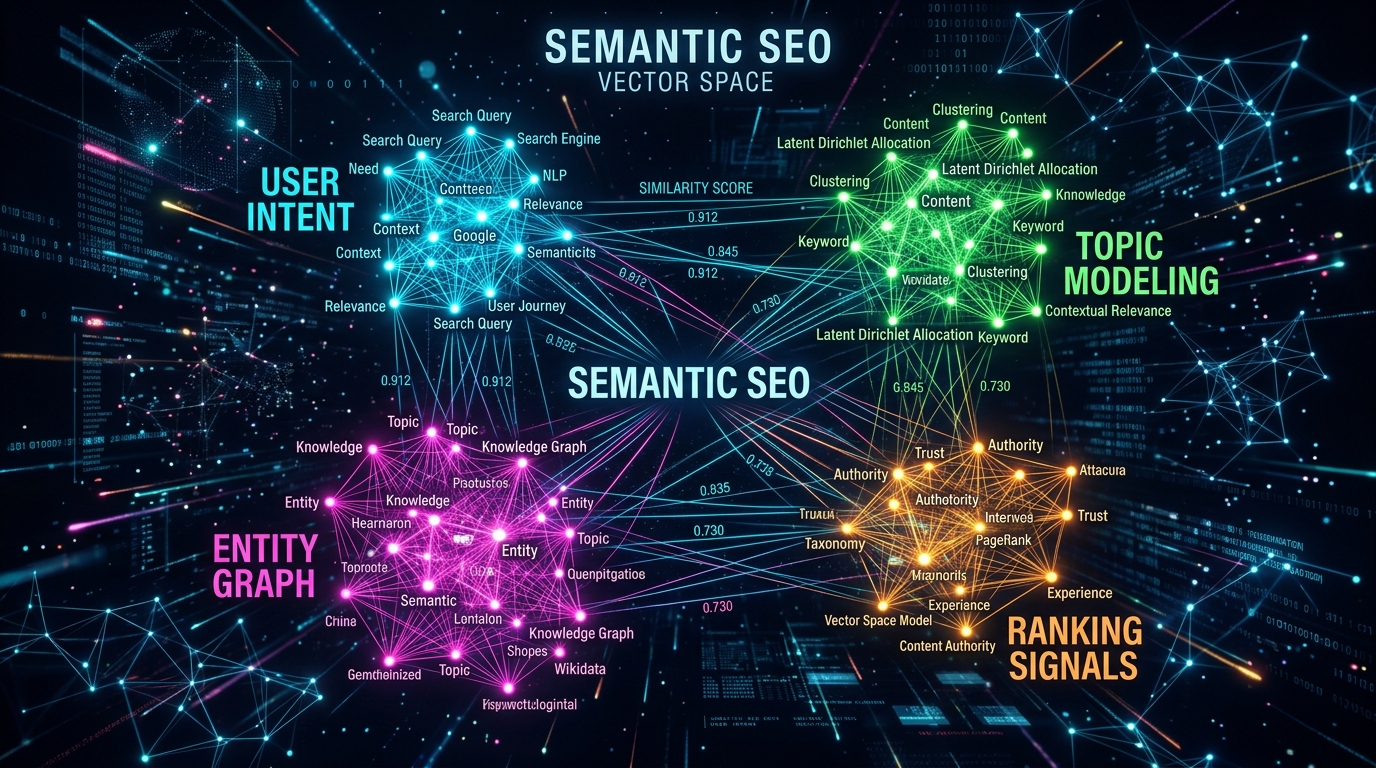
Search engines no longer rank web pages by simply matching keyword strings. With the integration of deep learning, dense vector embeddings, and semantic knowledge representations (such as Google’s RankBrain, BERT, MUM, and Gemini retrieval engines), search algorithms evaluate web pages based on conceptual meaning, entity relationships, and topical completeness.
In this master guide, we break down how Semantic SEO and Vector Embeddings work under the hood, how search engines transform text into high-dimensional geometric spaces, and how you can architect content clusters that dominate broad topical ecosystems in 2026.
What Are Vector Embeddings in Modern Search?
A vector embedding is a mathematical representation of text in a high-dimensional continuous vector space (often with 768 to 1,536 dimensions). In this geometric space:
- Words, phrases, and entire paragraphs that share similar semantic meanings are mapped close to each other.
- Relationships between concepts are calculated using cosine similarity metrics ($cos(theta) = frac{A cdot B}{|A| |B|}$).
- Search engines can effortlessly connect user search queries (e.g., “how to fix slow loading images on mobile”) with pages discussing Core Web Vitals, LCP, and WebP compression, even if the exact keyword query never appears in the title tag.
5 Core Strategies to Optimize for Semantic Vector Search
1. Comprehensive Entity Constellation Mapping
Search engines recognize named entities (People, Organizations, Concepts, Standards, Locations) using Knowledge Graph databases like Wikidata and Google Knowledge Graph. When writing about a core topic (e.g., “Technical SEO”), include the full constellation of related co-occurring entities: canonical tags, crawl budget, robots.txt, JSON-LD, XML sitemaps, PageRank, server response codes, and HTTP headers.
2. Hub-and-Spoke Topical Clustering
Build hierarchical content clusters where a broad parent pillar page connects bidirectionally to granular sub-topic child pages. This structural cohesion signals to search engines that your domain possesses complete topical authority across the entire semantic space.
3. Contextual Anchor Text Architecture
Avoid generic internal link anchor text like “click here” or “read more”. Use rich, descriptive, entity-focused anchor text (e.g., “our comprehensive guide to XML sitemap optimization”) to reinforce semantic relationships between linked pages.
4. Structured Semantic Heading Hierarchy
Organize your articles using logical H1, H2, and H3 hierarchies that reflect how users explore sub-topics. Sub-headings should directly represent real secondary questions and conceptual extensions of the main theme.
5. Implement Schema.org Entity References
Use sameAs schema properties in your JSON-LD to explicitly link your topics to official Wikidata or Wikipedia entity URLs, removing any potential ambiguity for AI search parsers.
Comparison: Traditional Keyword SEO vs. Semantic Vector SEO
Dimension |
Keyword-Based SEO (Legacy) |
Semantic Vector SEO (2026) |
|---|---|---|
Core Optimization Focus |
Keyword frequency & exact phrase density |
Entity relationships & semantic context |
Search Intent Matching |
Literal string matching |
Vector distance & conceptual intent synthesis |
Ranking Scope |
Ranks for 1–5 specific keywords |
Ranks for hundreds of long-tail variations |
Algorithm Alignment |
Pre-2015 Google algorithms |
MUM, Gemini, BERT, RankBrain |
Frequently Asked Questions (FAQ)
What tools can you use to analyze semantic topical coverage?
Modern SEOs use tools like InLinks, Clearscope, SurferSEO, and custom Python scripts using OpenAI or HuggingFace embeddings to calculate cosine similarity between their articles and top-ranking SERP competitors.
Does Semantic SEO eliminate the need for keyword research?
No. Keyword research still provides essential data on user search volume and commercial intent. However, instead of writing separate articles for minor keyword variations, semantic SEO groups those variations into a single comprehensive, high-authority master guide.
Conclusion: Building Resilient Search Authority
Optimizing for semantic vector search makes your website resilient against algorithm shifts. When your content thoroughly maps real-world concepts, entities, and verified facts, search engines naturally recognize your domain as a primary topical authority.
Worked example: keywords versus meaning
Consider “reduce WordPress load time” and “make a WordPress site faster.” The phrases share few exact words, but an embedding model can place them close together because the intent is nearly identical. “WordPress hosting price,” despite sharing the entity WordPress, belongs farther away because the task is commercial comparison rather than performance troubleshooting.
Use this distinction to build one page around a coherent task, not one page for every wording variation. Map the primary problem, prerequisites, sub-problems and expected outcome. Then use Search Console queries to find missing explanations. Embeddings are helpful for clustering at scale, but human review must resolve ambiguous terms, brand names and queries with mixed intent.
A practical quality check is to inspect the nearest ten queries for each cluster centroid. If several require different page types—tutorial, product page and definition—the cluster is too broad.