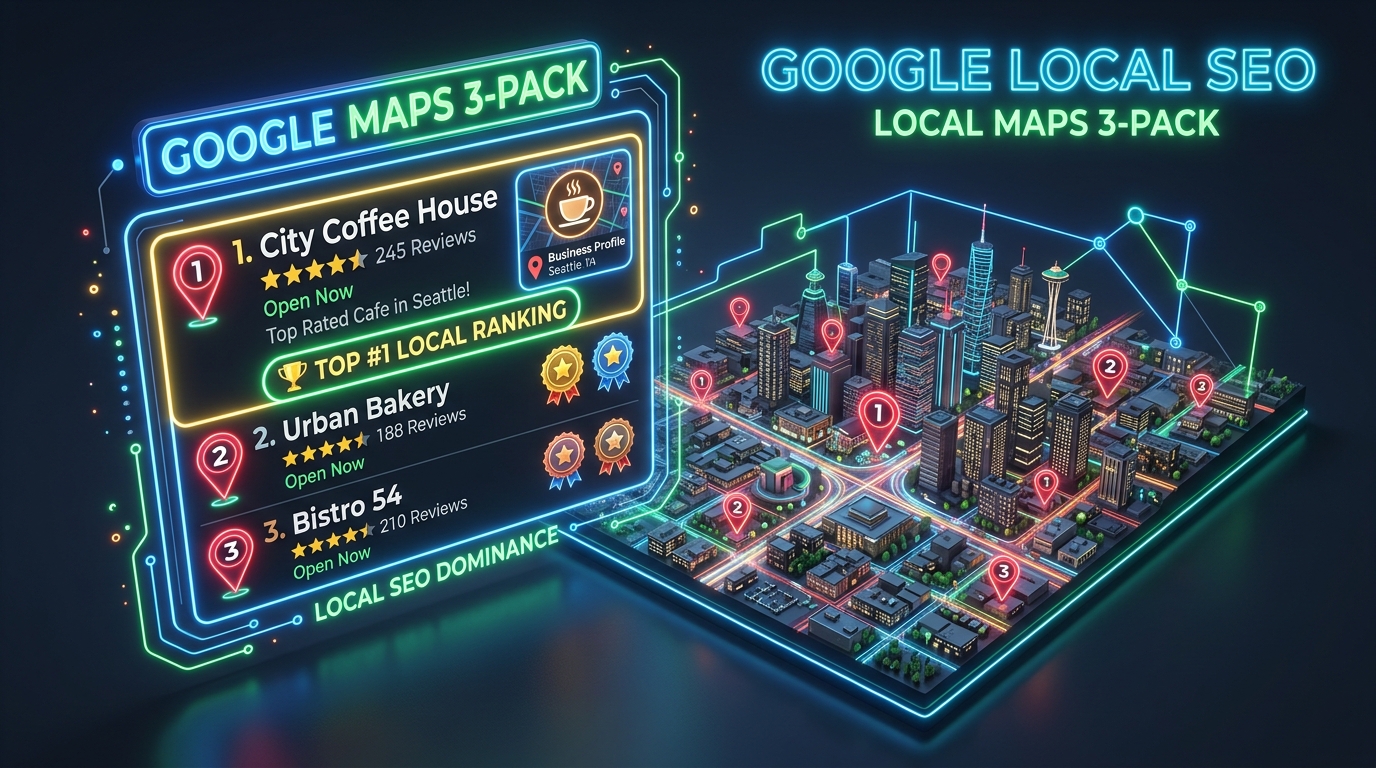
For a plumber in Austin, a bakery in Leeds, or a dental practice in Karachi, the Google Map Pack (also called the local pack or 3-pack) is the single most valuable piece of digital real estate on the internet. It sits above the organic results, comes with a map, star ratings, and a “Call now” button, and captures the overwhelming majority of clicks on searches like “plumber near me” or “best bakery in [city].” If your business isn’t in that top three, you are essentially invisible to a huge share of ready-to-buy local customers, no matter how good your website is.
Local SEO is different from regular SEO because it isn’t just competing for relevance — it’s competing for a specific slice of digital space tied to physical location, and Google uses signals most businesses never think about: how consistently your address appears across the web, how recently you replied to a review, whether you upload photos more often than the shop three streets over. The good news is that local SEO rewards consistent, unglamorous effort far more than it rewards big budgets. A single-location business with a disciplined process can outrank a national chain with ten times the marketing spend. This guide walks through exactly how the Map Pack works and what to do, in order, to win it.
How the Google Map Pack Works
When someone searches with local intent — either explicitly (“dentist in Manchester”) or implicitly because Google detects they’re searching for something typically bought locally (“emergency locksmith”) — Google triggers a local pack: a block of three business listings with a map, shown before or interspersed with traditional organic results. Google has stated publicly that local ranking comes down to three pillars:
- Relevance — how well your Business Profile and website match what the searcher is looking for.
- Distance — how far the business is from the location used in the search (or the searcher’s actual location on mobile).
- Prominence — how well-known and reputable the business is, both online and offline, based on links, citations, reviews, and general web presence.
Industry research adds important nuance to that official framework. The 2026 Whitespark Local Search Ranking Factors survey — which polls dozens of local SEO practitioners each cycle — found that Google Business Profile signals account for roughly 32% of ranking weight, on-page/website signals about 19%, review signals around 16-20%, link signals about 15%, and citation and behavioral signals splitting the remainder. Two things changed meaningfully in the 2026 edition: review recency jumped in importance (Google appears to reward businesses that keep collecting fresh reviews rather than coasting on old ones — Whitespark’s Darren Shaw now ranks it among his top five factors, and BrightLocal data shows the majority of consumers only trust reviews from the last three months), and behavioral/engagement signals — clicks to call, requests for directions, website clicks, and general profile activity — are climbing fast as Google leans more on real usage data to separate similarly-optimized competitors.
Practically, this means the Map Pack isn’t won with a single trick. It’s won by stacking a well-optimized profile, consistent citations, a steady flow of recent reviews, a locally relevant website, and real engagement signals on top of each other.
Google Business Profile Optimization
Your Google Business Profile (GBP, formerly Google My Business) is the single highest-leverage asset in local SEO, and it’s free. Treat it as a living page that needs regular maintenance, not a one-time form you fill in and forget.
Categories: Choose your primary category with real care — it is consistently cited as one of the top ranking factors, sometimes outweighing keywords in your business name. Pick the most specific category that accurately describes your core business (e.g., “Italian Restaurant” rather than just “Restaurant”), then add every relevant secondary category that genuinely applies. Don’t add categories you don’t serve just to appear in more searches; Google penalizes profiles flagged for misleading categorization, and it hurts relevance signals over time.
Business description: Use the 750-character description to naturally state what you do, where you serve, and what makes you different — avoid keyword stuffing, which reads as spam and adds little ranking value compared to categories and reviews.
Photos: Profiles with more photos get significantly more direction requests and website clicks than sparse ones. Upload a genuine mix — exterior (so people recognize the storefront when driving), interior, team, products/services in action, and completed work. Add new photos regularly (monthly at minimum) rather than dumping fifty at once and never returning.
Posts: Google Business Profile posts (offers, updates, events) are an underused behavioral signal. Businesses that post weekly show Google an active, engaged profile, and posts also give you extra text real estate to reinforce services and locations. Include a call-to-action and a relevant image on every post.
Q&A: The Questions & Answers section is public and editable by anyone, which means competitors or pranksters can post misleading answers if you don’t monitor it. Seed it yourself with the 8-10 questions customers actually ask (pricing, parking, appointment policy, service area) and answer them as the business owner so the correct information ranks first.
Products and services: Use the Products and Services sections to list specific offerings with names, descriptions, and prices where possible. This is direct relevance fuel — it helps Google match your profile to specific long-tail searches like “emergency boiler repair” rather than just “plumber.”
Attributes, hours, and messaging: Keep special hours updated for holidays, enable messaging if you can respond promptly, and fill in every attribute Google offers (wheelchair accessible, women-owned, outdoor seating) — each one is a small additional relevance match point.
NAP Consistency Across the Web
NAP stands for Name, Address, and Phone number, and consistency here is the unglamorous backbone of local SEO. Google cross-references your business information across your website, your Google Business Profile, data aggregators, and every directory listing it can find. When your address is written “123 Main St, Suite 4” in one place and “123 Main Street #4” in another, or your phone number uses a different local tracking line, you create ambiguity that erodes the trust signal Google uses to confirm your business is legitimate and stable at a fixed location.
Pick one canonical format for your name, address, and phone number and use it verbatim everywhere — your website footer, GBP, social profiles, invoices, and every directory. Audit existing listings using a tool like BrightLocal’s or Moz Local’s citation scan, and correct discrepancies rather than creating duplicate listings. If you’ve moved locations, rebranded, or changed phone numbers, actively hunt down and update old citations rather than letting them linger — stale NAP data is one of the most common reasons an otherwise well-optimized business plateaus in rankings.
Local Citations and Directories
Citations are mentions of your business’s NAP data on other websites, and they remain a meaningful (if declining in relative weight) prominence signal. Build a foundation with the major data aggregators and platforms that feed information across the web — Google Business Profile itself, Apple Maps/Apple Business Connect, Bing Places, Facebook, and core aggregators like Data Axle and Foursquare. Then add industry-specific and location-specific directories: a restaurant benefits from OpenTable and TripAdvisor listings, a contractor benefits from Houzz and Angi, a law firm benefits from Avvo and FindLaw. Local chamber of commerce sites and city or regional business directories also carry outsized trust because they’re tied to a real, verifiable local presence rather than being generic national directories.
Quality matters more than volume here — twenty accurate, relevant citations on reputable sites outperform two hundred scraped from low-quality directory-spinning sites that Google largely ignores or actively distrusts.
Online Reviews Strategy
Reviews now influence local rankings through at least three distinct signals: volume, average rating, and — increasingly important in 2026 — recency and response behavior. A profile with 40 reviews averaging 4.7 stars, with new reviews arriving every week and every negative review answered professionally, will consistently outperform a static profile with 200 reviews from three years ago.
Getting reviews: Ask at the moment of highest customer satisfaction — right after a job is completed, an order is picked up, or a service is delivered — via a direct link (create one at your GBP dashboard or through search.google.com/local/writereview). Text message requests convert notably better than email for local service businesses. Never offer incentives for reviews or gate negative feedback into a private channel while pushing only happy customers to leave public reviews — both violate Google’s policies and can result in review removal or profile suspension.
Responding to reviews: Respond to every review, positive and negative, within 24-48 hours. For positive reviews, thank the customer by name and mention the specific service — this reinforces relevant keywords naturally. For negative reviews, acknowledge the issue without being defensive, take detail offline (“please call our manager at…”), and never argue publicly. Prospective customers read how you handle criticism more closely than they read the criticism itself.
Leveraging reviews: Pull strong quotes into your website’s location pages, feature a rotating selection on your homepage, and screenshot standout reviews for social media. This turns a ranking signal into a conversion asset simultaneously.
Local Link Building
Links from other local websites tell Google you’re a genuine, embedded part of your community, and they remain one of the highest-weighted prominence signals. The most effective and durable local link-building tactics for small businesses are the least “SEO-looking”: sponsor a youth sports team or local charity event (most will link to sponsors on their site), join the local chamber of commerce and business improvement district, get listed on your city’s or town’s official business/tourism site, contribute an expert quote to a local newspaper or news site through HARO-style outreach, host or speak at a local event, and partner with complementary (non-competing) local businesses for cross-promotion and mutual linking — a caterer and a wedding photographer, for instance. Avoid generic paid link networks and directory-spam link packages; they carry real risk and increasingly little reward as Google’s link-spam detection has improved.
On-Site Local SEO: Location Pages and Schema Markup
Your website still matters — on-page/website signals make up roughly a fifth of the ranking weight. If you serve multiple locations, build a genuinely unique page for each one rather than a templated page with the city name swapped out. Each location page should include the specific address and local phone number, an embedded Google Map, unique content about that location (neighborhoods served, local landmarks, location-specific testimonials), staff or manager names where relevant, and localized service descriptions — not boilerplate copied across every city page, which Google’s algorithms are increasingly good at detecting as thin, duplicate content.
Implement LocalBusiness schema markup (JSON-LD) on every location page. At minimum, mark up your business name, address, phone number, geo-coordinates, opening hours, price range, and accepted payment types. For multi-location businesses, use the more specific subtype where one exists (Restaurant, Dentist, Plumber, and others all extend LocalBusiness) and include a sameAs property linking to your Google Business Profile and social profiles. Schema doesn’t directly boost rankings the way a strong review profile does, but it removes ambiguity for Google’s crawlers and increases eligibility for rich results, which improves click-through rate even at an equal ranking position.
Local Keyword Research
Local keyword research blends standard demand research with geographic modifiers and intent signals. Start with Google’s autocomplete and the “People also search for” panels for your core service terms, then layer in Google Keyword Planner and a local-specific tool for search volume by city. Pay attention to three keyword patterns: explicit-location terms (“plumber in Brooklyn”), near-me terms (“plumber near me”) which now represent a huge share of mobile local queries, and service-plus-modifier terms (“emergency plumber,” “24 hour plumber,” “same day plumber”) which often have less competition and higher purchase intent. Map keywords to the right asset — core service keywords to your homepage and service pages, near-me and city-modified keywords to individual location pages, and long-tail question keywords to blog content and your GBP Q&A section.
Mobile and “Near Me” Search Behavior
The majority of local searches now happen on mobile devices, frequently with the intent to act within the hour — call, visit, or get directions. Google’s own research has repeatedly shown that a large share of “near me” searches lead to a same-day store visit or purchase. This has practical implications beyond rankings: your website must load quickly on mobile connections, your phone number must be tap-to-call, your address must link directly to maps and directions, and your hours must be prominent and accurate, especially on holidays. Businesses that treat mobile as an afterthought lose customers even when they rank well, because the searcher bounces to a faster, easier competitor listing instead.
Tracking Local Rankings
You cannot manage what you don’t measure, and local rank tracking has a specific complication: rankings vary by the exact location of the searcher, sometimes street-by-street in dense urban areas. Standard rank trackers that check from a single IP or data center location will give you a misleading picture. Use a local-specific rank tracker — BrightLocal, Whitespark’s Local Rank Tracker, or Local Falcon — which simulate searches from a grid of points around your service area and show a visual heat map of where you rank strongly versus where you’re invisible. Track your primary keywords across that grid monthly, monitor your Google Business Profile Insights for calls, direction requests, and website clicks (the behavioral signals Google itself is weighing more heavily), and keep an eye on review velocity and average rating trends over time rather than just a single snapshot number.
Common Local SEO Mistakes
- Choosing the wrong or overly broad primary GBP category and never revisiting it.
- Creating duplicate GBP listings (often after a move or rebrand), which splits reviews and confuses Google about which listing is authoritative.
- Keyword-stuffing the business name field on GBP, which violates Google’s guidelines and risks suspension.
- Letting citations go stale after an address or phone number change.
- Ignoring negative reviews instead of responding, which signals neglect to both Google and prospective customers.
- Copying near-identical content across multiple location pages instead of writing genuinely unique local content.
- Treating GBP as “set and forget” rather than posting, uploading photos, and answering questions regularly.
- Chasing review volume through incentivized or gated reviews, which risks profile penalties and rarely produces the authentic, recency-weighted signals Google now rewards.
Action Plan: Where to Start
If you’re starting from zero, prioritize in this order over the next 90 days:
- Audit and fully complete your Google Business Profile — correct category, complete description, 15+ photos, products and services listed.
- Run a citation audit and fix every NAP inconsistency you find across your top 20 directories.
- Set up a systematic review request process (text-based, sent within 24 hours of service completion) and commit to responding to every review within two days.
- Build or improve at least one dedicated, uniquely written location page with LocalBusiness schema.
- Identify three realistic local link opportunities — a sponsorship, a chamber membership, a local media mention — and pursue them this quarter.
- Install a local rank tracker and check your grid position monthly so you can see which lever is actually moving the needle for your specific market.
None of this is complicated, but all of it requires consistency. The Map Pack rewards businesses that show up, respond, and keep their information accurate month after month — which means a small business willing to do the unglamorous work consistently can out-rank far bigger competitors who treat local SEO as a box to check once and forget.
Related
Want this checked on your own site?
A 20 minute review, no obligation. I will tell you honestly which of this actually applies to you and which does not.
Written by Shahzaib Ul Hassan, senior AI SEO consultant and founder of ShazzSEO. Ranking sites since 2009.
If you rank in the normal results and still cannot get into the three map listings, that gap has its own causes. I cover them on the map pack ranking page.