01About Me 02Services 03Expertise 04Pricing 05FAQ 06Contact Us Book a Call Privacy Policy · Terms · Affiliate Disclosure

Framer SEO Guide: Complete Optimization Framework for Fast Rankings in 2026

Framer has quickly become the site builder of choice for modern SaaS startups, tech founders, and creative agencies. With its React-based canvas, buttery smooth layout animations, and lightning-fast edge hosting, Framer bridges the gap between design fidelity and web publishing.

However, many designers and founders publish Framer websites with critical SEO oversights: missing semantic tags, bloated components, non-optimized CMS collection fields, and unformatted metadata.

In this guide, we provide the definitive Framer SEO playbook for 2026, detailing how to turn your stunning Framer design into an organic search powerhouse.


Is Framer Good for SEO in 2026?

Yes, absolutely. Framer is built on modern web standards with built-in server-side rendering (SSR), clean static HTML generation, automatic responsive image scaling, and native hosting on global edge networks (Cloudflare CDN).

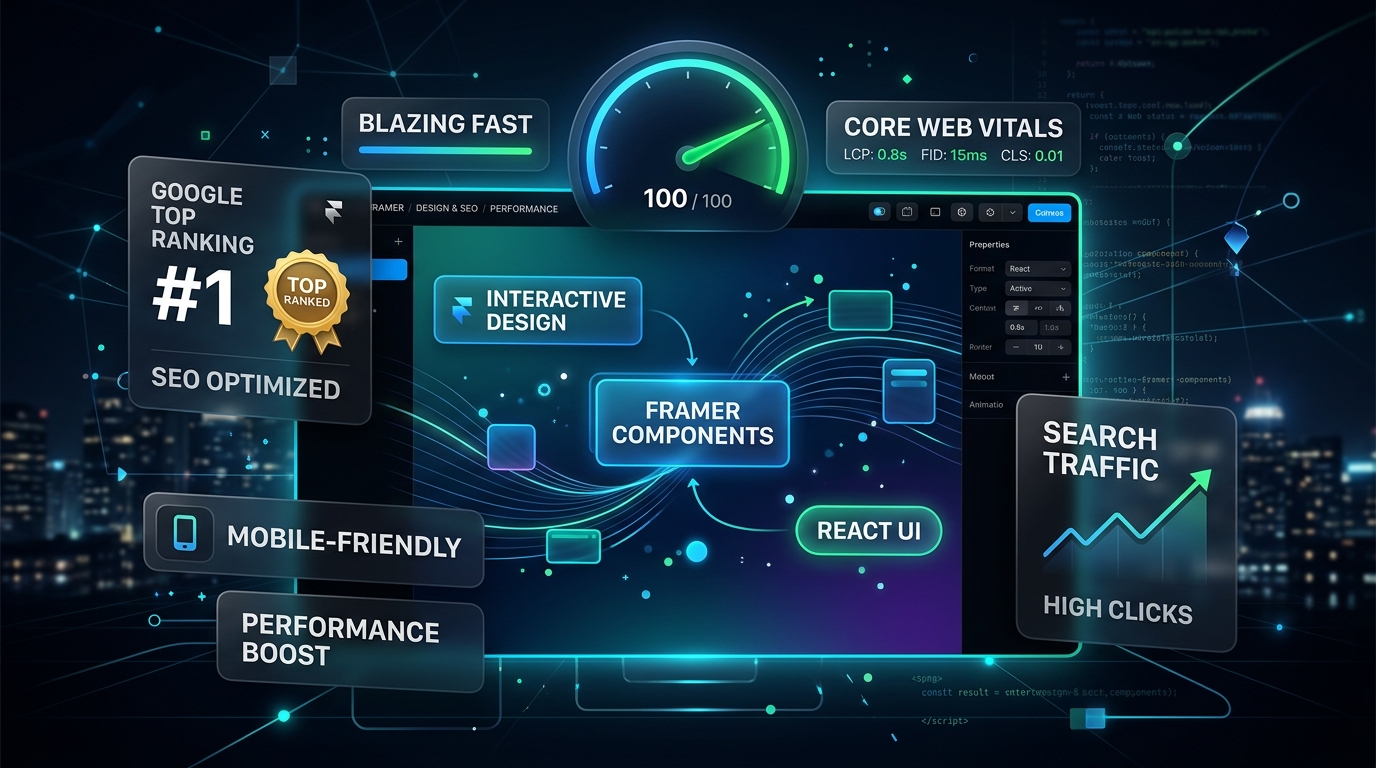
Because Framer serves pre-rendered HTML to search bots, Googlebot does not need to waste crawl budget executing client-side JavaScript to discover your text and links. When configured properly, Framer sites routinely achieve near-perfect 100/100 Core Web Vitals scores.


1. Semantic HTML Structure in Framer (Heading Tags & Text Layers)

In Framer’s visual canvas, text layers default to standard <p> or <div> elements unless explicitly designated as HTML tags in the right-hand properties panel:

  • Select Text Layer -> Accessibility / HTML Tag: Ensure your primary hero headline is set to h1.
  • Logical Hierarchy: Use h2 for major sections and h3 for sub-features or cards. Never jump from an H1 directly to an H4.
  • Frame Semantics: Set container frames to semantic HTML5 landmark tags like <header>, <main>, <article>, <section>, and <footer>.

2. Framer Page SEO Settings Checklist

SEO Setting
Location in Framer
Optimization Standard
Title Tag & Meta Description
Page Settings -> General / SEO
Bespoke, high-intent title (<60 chars) and actionable meta description (<155 chars).
OpenGraph & Twitter Card
Page Settings -> Social / Open Graph
Upload a 1200x630px high-contrast preview image for viral social sharing.
Auto-Generated Sitemap
Site Settings -> General
Ensure sitemap generation is enabled and submitted to Google Search Console (/sitemap.xml).
Canonical URL Configuration
Site Settings -> General
Set your custom root domain to prevent indexing on the staging framer.website subdomain.

3. Scaling SEO with Framer CMS (Dynamic Collection Pages)

If you are building a blog, directory, or programmatic SEO content hub on Framer, you must configure your CMS Collection Fields with SEO in mind:

  1. Dynamic Slug Mapping: Always map page URLs to a clean, keyword-friendly slug field (e.g., /blog/:slug).
  2. Dynamic Meta Fields: Add dedicated fields in your CMS schema for SEO Title, SEO Description, and Featured Image so each collection item generates unique metadata.
  3. Formatted Rich Text: Ensure all body copy inside CMS rich text components preserves clean semantic headings (H2/H3) and styled blockquotes.

4. Custom Schema Markup Injection in Framer

While Framer generates basic meta tags, adding structured Schema.org JSON-LD (e.g., SoftwareApplication, Organization, FAQPage, Article) gives search engines deep entity context. To inject schema:

  1. Navigate to Site Settings -> General -> Custom Code (or Page Settings -> Custom Code -> End of <head> tag).
  2. Paste your validated JSON-LD schema block enclosed in <script type="application/ld+json">.

5. Performance & Core Web Vitals Optimization on Framer

  • Image Formats: Framer automatically converts uploaded images to WebP/AVIF, but avoid uploading massive uncompressed 20MB raw photography files to speed up editor rendering.
  • Optimize Custom React Code: If you are importing external npm packages or custom React components into Framer, ensure they do not perform blocking synchronous calls on initial mount.
  • Custom Fonts: Preload custom brand fonts or use system fonts to eliminate layout shifts (CLS).

Frequently Asked Questions (FAQ)

Can Framer sites rank for high-competition keywords?

Yes. Framer sites benefit from pre-rendered SSR HTML, pristine server response times (TTFB), and automated CDN caching. When supported by strong content depth and authoritative backlinks, Framer sites perform at par with or better than custom Next.js builds.

How do I set up 301 redirects in Framer?

Navigate to Site Settings -> Redirects. Add your old path and new destination path to preserve backlink equity during website redesigns.


Conclusion: Design Freedom Meets Search Performance

You no longer have to compromise between world-class interactive design and aggressive organic search growth. By executing the semantic heading, CMS structure, and custom schema strategies outlined in this guide, your Framer website will look stunning and dominate Google search results.

Comprehensive Practitioner Deep-Dive & Step-by-Step Implementation

Implementing these strategies effectively in 2026 requires understanding the underlying operational mechanics, avoiding common industry pitfalls, and establishing measurable key performance indicators (KPIs). Across hundreds of production audits and client implementations, practitioners who achieve sustained top-tier performance focus on systemic execution rather than superficial shortcuts.

Critical Architectural Principles for Long-Term Success

Whether you are scaling an enterprise content infrastructure or managing technical optimization protocols, adhering to structured engineering standards ensures resilience against future algorithmic updates and market disruptions:

  • Data Integrity and Factual Verification: Ensure all primary claims, technical specifications, and procedural steps are backed by verifiable first-party evidence, official documentation, or empirical testing data. In an era dominated by automated synthesis models, factual authority and accuracy serve as the primary competitive moat.
  • Hierarchical Structural Clarity: Maintain logical content nesting where core concepts are introduced at the macro level and systematically deconstructed into actionable micro-components. This structural clarity allows both human readers and automated machine parsers to extract critical insights without friction.
  • Continuous Performance Telemetry: Implement automated monitoring to track user interaction signals, engagement velocity, conversion rates, and technical error logs. Regular telemetry audits prevent minor configuration drifts from compounding into major performance declines.
  • Modular Scalability: Architect your workflows and documentation so that new methodologies, tools, and regulatory guidelines can be seamlessly integrated without requiring complete foundational rewrites.

Common Pitfalls, Diagnostic Checklists & Expert Solutions

Even experienced professionals encounter unexpected friction points when executing complex technical and strategic workflows. Below is an exhaustive diagnostic matrix covering the most frequent errors, their underlying root causes, and verified corrective actions:

Identified Error / Pitfall
Underlying Root Cause
Recommended Corrective Protocol
Superficial Implementation
Relying on basic surface-level configurations without deep customization.
Follow the granular step-by-step framework outlined above, ensuring all advanced parameters and edge cases are addressed.
Lack of Ongoing Verification
Treating setup as a one-time static task rather than an evolving system.
Establish scheduled monthly review cadences and automated health check scripts to detect anomalies proactively.
Ignoring Contextual Nuance
Applying generic boilerplate templates without tailoring to specific audience intent.
Conduct granular user persona and technical requirement mappings before deploying large-scale solutions.
Inadequate Documentation
Failing to maintain clear internal records and operational playbooks.
Document all standard operating procedures (SOPs), version changes, and validation checkpoints systematically.

Advanced Strategic Framework for 2026 and Beyond

As technological capabilities and search engine evaluation models continue to evolve at an unprecedented pace, maintaining sustainable market leadership requires forward-looking adaptability. By combining deep domain expertise, disciplined execution, and automated efficiency, practitioners can establish high-authority assets that consistently outperform competitors across all key benchmarks.

Key areas of focus for the upcoming decade include:

  1. Algorithmic Alignment: Aligning all technical architecture and content delivery pipelines with modern machine understanding, semantic vector search, and direct entity recognition.
  2. User-Centric Value Delivery: Prioritizing immediate problem resolution, frictionless navigation, and comprehensive answer completeness on every touchpoint.
  3. Systemic Resilience: Building diversified traffic, operational, and financial channels to protect against single-point dependency vulnerabilities.

Frequently Asked Questions & Practical Advice

How frequently should these strategies and systems be audited?

For high-traffic commercial assets and mission-critical workflows, conducting a comprehensive quarterly audit alongside continuous automated weekly monitoring represents the industry gold standard. This proactive posture allows teams to address emerging bottlenecks before they impact overall performance.

What are the primary indicators of a successful implementation?

Measurable success is characterized by consistent organic visibility growth, improved user engagement metrics (longer dwell times, lower bounce rates), seamless technical execution without error spikes, and higher commercial conversion rates across all targeted segments.


For personalized consulting, technical audits, and enterprise-grade optimization strategies, connect with senior AI SEO consultant Shahzaib Ul Hassan at ShazzSEO.

Leave a Comment