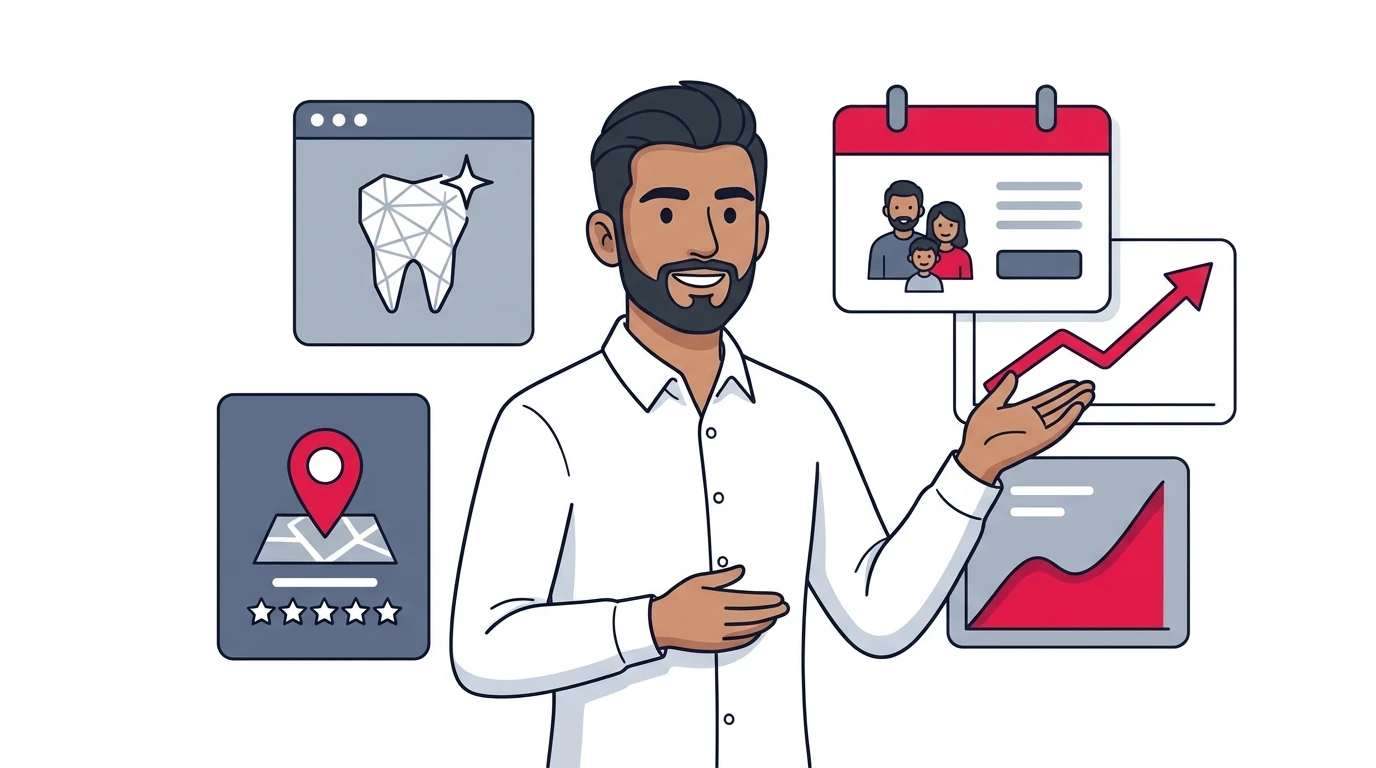
Mastering specialized seo for pediatric dentists is the single most predictable way for children's dental practices to attract local families, build lasting patient loyalty, and keep clinical schedules full year-round. When parents search for dental care for their child, their search behavior is driven by strong emotions, protective instincts, and urgent developmental milestones. Whether they are looking for an infant tongue-tie specialist, a calm provider for an anxious toddler, or immediate emergency care for a playground tooth fracture, parents turn directly to Google search and local map packs to find a board-certified specialist they can trust.
Unlike general dental practices that compete for competitive adult veneer or routine cleaning queries, pediatric dental practices operate in an entirely distinct search ecosystem. Successful pediatric practices do not win by ranking for generic keywords like "dentist near me." They dominate by mapping out how mothers, fathers, and caregivers search during critical developmental phases: from a baby's first tooth to adolescent sports mouthguards. If your clinic also provides adult aesthetic care, explore our companion guide on SEO for cosmetic dentists to ensure adult smile makeovers and pediatric funnels remain clearly separated.
Executive Summary: Key Pediatric Dental SEO Metrics
- High Patient Lifetime Value (LTV): A child entering your practice at age 1 typically remains a patient for 12 to 14 years, generating $3,500 to $7,500 in lifetime preventive and restorative care—often bringing 1 to 3 siblings along with them.
- Map Pack Dominance (GBP): Over 76% of immediate pediatric appointment requests originate directly from the Google Maps 3-Pack on mobile devices.
- High-Intent Milestone Search: Queries like "infant laser frenectomy," "pediatric sedation dentist," and "dentist for autistic child" convert at 4x the rate of generic dental keywords.
- E-E-A-T & Clinical Governance: Complying with American Academy of Pediatric Dentistry (AAPD) standards and showcasing board certifications directly establishes the medical trustworthiness required by Google's health algorithms.
Table of Contents: The Pediatric Dental SEO Master Blueprint
- 1. The Practice Economics of Pediatric Dental SEO
- 2. Understanding Parent Search Intent & Emotional Triggers
- 3. Treatment Page Architecture: Milestones, Sedation & Special Needs
- 4. Google Business Profile & Local Map Pack Supremacy
- 5. Hyperlocal Community & School District Targeting
- 6. AAPD Standards, ABPD Certification & Medical E-E-A-T
- 7. Structured Data & Pediatric Medical Schema Implementation
- 8. Capturing AI Search: Google AI Overviews & ChatGPT Inquiries
- 9. Conversion Rate Optimization: Frictionless Parent Mobile Booking
- 10. The 90-Day Pediatric SEO Implementation Roadmap
1. The Practice Economics of Pediatric Dental SEO
General dentists often wonder why pediatric dental SEO commands such high commercial value. The answer lies in family retention economics and referral velocity. When an adult finds a dentist, they represent one patient who might come in twice a year for hygiene checks. When a mother or father selects a pediatric dentist for their toddler, the financial equation changes dramatically.
Consider the real numbers behind pediatric patient acquisition:
| Patient Profile / Trigger | Initial Visit Value | Sibling Multiplier | Estimated 10-Year Value |
|---|---|---|---|
| Age-One First Dental Visit | $180 – $320 | 1.8x (family sibling average) | $5,400 – $11,000 |
| Infant Frenectomy (Tongue-Tie) | $650 – $1,200 | Lactation group referrals (high) | $6,500 – $14,000+ |
| Pediatric Sedation Dentistry | $1,400 – $3,800 | High parent peer advocacy | $4,800 – $9,500 |
| Special Healthcare Needs Child | $250 – $600 | Support group network effect | $7,200 – $16,000 |
Because children require consistent examinations every six months, sports mouthguards, topical fluoride treatments, dental sealants, pulpotomies for deep childhood caries, and early phase-1 interceptive orthodontic evaluations, the lifetime value of every acquired pediatric chart is among the highest in ambulatory healthcare. Investing in an authoritative organic presence ensures you capture these multi-year family relationships at a fraction of the cost of pay-per-click advertising.
2. Understanding Parent Search Intent & Emotional Triggers
Parents search for medical and dental providers with acute vigilance. While an adult searching for their own dentist may prioritize proximity or pricing, a parent searching for their child prioritizes gentle care, emotional safety, sensory comfort, and clinical qualifications. Understanding these core parent archetypes informs the exact content, structure, and tone of your website.
The First-Time Parent (Anxious & Information-Seeking)
First-time parents are often following guidance from their pediatrician or lactation consultant. They search queries such as: "when should baby see a dentist," "what happens at baby first dentist appointment," and "signs of tongue tie in newborn." These parents require educational clarity, photos of baby-friendly treatment rooms, and reassuring step-by-step walkthroughs that demystify what an infant knee-to-knee oral examination involves.
The Emergency Parent (Urgent & Mobile-Driven)
When a toddler falls off a scooter and knocks out a front tooth or wakes up sobbing from severe toothache at 8:00 PM, parents are panicked. They search on mobile devices using urgent phrases: "emergency kids dentist open now," "baby tooth knocked out bleeding," or "chipped toddler tooth weekend." These pages must feature immediate tap-to-call emergency triage numbers, direct guidance on what to do within the first 60 minutes, and fast mobile navigation.
The Special Healthcare Needs Caregiver (High Trust & Specific Accommodation)
Parents of children with Autism Spectrum Disorder (ASD), Down syndrome, sensory processing sensitivities, or severe dental phobia face immense difficulty finding accommodating providers. They search: "sensory friendly dentist near me," "dentist for nonverbal autistic child," and "sedation dentistry for special needs kids." Providing detailed walkthroughs of quiet operatory rooms, weighted blankets, noise-canceling headphones, and pre-visit desensitization tours builds immediate, unshakeable trust.
3. Treatment Page Architecture: Milestones, Sedation & Special Needs
The single biggest SEO failure in pediatric dentistry is grouping all treatments onto a single "Our Services" page with brief bullet points. Google cannot rank a general services page for specific queries like "infant laser frenectomy" or "nitrous oxide for pediatric dental anxiety" when competing against practices with dedicated, in-depth clinical landing pages.
Every pediatric practice website must build dedicated, standalone service silos organized around the following high-value clinical offerings:
Age-One Dental Visits & Infant Care
Dedicated pages answering parental FAQs on infant oral hygiene, knee-to-knee examination technique, teething remedies, baby bottle tooth decay prevention, and pacifier weaning strategies.
Infant Laser Frenectomy (Tongue & Lip Ties)
Comprehensive guides explaining CO2 soft-tissue laser releases, nursing pain relief, speech improvement, post-procedure stretching exercises, and lactation consultant collaboration.
Pediatric Sedation Dentistry Options
Transparent safety protocols outlining nitrous oxide (laughing gas), oral conscious sedation, in-office IV sedation with a board-certified pediatric anesthesiologist, and hospital dentistry.
Special Healthcare Needs Accommodations
Details on sensory-adapted operatories, desensitization visits, tell-show-do communication techniques, and staff training for neurodiverse children.
Preventive & Restorative Care
Bespoke pages for BPA-free dental sealants, silver diamine fluoride (SDF) non-invasive cavity arresting, tooth-colored composite fillings, zirconia pediatric crowns, and pulpotomies.
Emergency Pediatric Dental Services
Fast-loading trauma protocols for displaced baby teeth, avulsed permanent teeth, broken crowns, dental abscesses, and urgent pain triage available on same-day notice.
4. Google Business Profile & Local Map Pack Supremacy
When a parent types "children's dentist near me" on an iPhone while sitting in a car outside a preschool, Google serves the 3-Pack Map results before any standard organic links. Winning the top spot in this local pack requires precise category management and continuous local signal generation.
Primary and Secondary Category Optimization
Your primary category on Google Business Profile must be set to "Pediatric dentist". Setting it to "Dentist" dilutes your topical relevance against general family dentists. You should then configure secondary categories:
- "Dentist"
- "Dental clinic"
- "Emergency dental service"
- "Orthodontist" (if phase-1 interceptive orthodontics are offered)
Child-Friendly Profile Attributes
Google Business Profile allows medical practices to toggle specific business attributes. For a pediatric clinic, ensure you activate: "Wheelchair accessible entrance," "Wheelchair accessible restroom," "Gender-neutral restroom," "Appointment required," and "Identifies as women-owned" (if applicable). In Google's mobile interface, these badges directly enhance tap-through rates from cautious parents.
Parent Review Generation & Sentiment Engineering
Google heavily weighs keyword prominence in patient reviews. A 5-star rating with no text carries far less algorithmic weight than a detailed narrative. Establish an automated SMS review request system that triggers 2 to 4 hours following a child's successful visit:
"Hi Sarah! Dr. Emily and our entire team loved meeting little Noah today for his first dental visit. Would you mind taking 30 seconds to share your experience on Google? Your review helps other local families find gentle, calm care for their children: [Direct Google Review Link]"
When happy parents mention phrases like "so patient with my anxious 4-year-old," "made my toddler laugh during his cleaning," or "best pediatric dentist in [City]," Google's natural language processing algorithms directly associate your profile with those search terms.
5. Hyperlocal Community & School District Targeting
Parents think in terms of school boundaries, youth sports complexes, preschools, and family neighborhoods—not just broad municipal borders. To attract families across surrounding suburbs without creating thin doorway pages, pediatric practices should deploy rich neighborhood and community guides.
Architect individual community landing pages that demonstrate authentic local knowledge:
- School District Alignment: Create informational content regarding kindergarten dental checkup proof forms required by local public school systems.
- Youth Sports Partnerships: Provide downloadable resources on custom athletic mouthguard fittings for local Little League, soccer associations, and high school sports teams.
- Pediatrician Co-Marketing: Feature an active referral network page listing reputable local pediatricians, lactation consultants, and pediatric speech therapists.
6. AAPD Standards, ABPD Certification & Medical E-E-A-T
Google evaluates pediatric dental websites under its strictest **YMYL (Your Money or Your Life)** guidelines. Poor medical advice or unverified claims can harm a child's health, so Google expects clear signals of Experience, Expertise, Authoritativeness, and Trustworthiness (E-E-A-T).
To satisfy Google quality evaluators and AI search models, embed authentic clinical credentials across your website:
- American Academy of Pediatric Dentistry (AAPD): Cite official AAPD guidelines regarding the "First Visit by First Birthday" rule, sealants, and fluoride varnish application.
- American Board of Pediatric Dentistry (ABPD): Feature the Board Certified Pediatric Dentist Diplomate crest prominently on doctor bio pages, with clear descriptions of the 2-year post-doctoral residency completed in infant, child, and adolescent oral care.
- Hospital Privileges: Note specific hospital credentials where the doctor performs surgical dental rehabilitation under general anesthesia (e.g., local children's hospitals).
- Clear Bylines & Editorial Review: Every dental advice article should feature an explicit byline: "Clinically written and reviewed by Dr. [Name], DDS, Board-Certified Pediatric Dentist."
7. Structured Data & Pediatric Medical Schema Implementation
Structured data allows search engine crawlers to parse clinical specialties, physical address coordinates, business hours, and accepted insurance plans without ambiguity. Implementing robust JSON-LD schema transforms standard snippets into rich results displaying review stars, clinic attributes, and FAQs.
Ensure your pediatric site deploys clean JSON-LD combining Dentist, MedicalBusiness, and MedicalSpecialty entities:
{
  "@context": "https://schema.org",
  "@graph": [
    {
      "@type": ["Dentist", "MedicalBusiness"],
      "@id": "https://examplepediatricdental.com/#clinic",
      "name": "Sunny Smiles Pediatric Dentistry",
      "medicalSpecialty": "PediatricDentistry",
      "url": "https://examplepediatricdental.com/",
      "telephone": "+1-555-019-2834",
      "priceRange": "$$",
      "image": "https://examplepediatricdental.com/images/clinic.jpg",
      "address": {
        "@type": "PostalAddress",
        "streetAddress": "123 Pediatric Way, Suite 200",
        "addressLocality": "Austin",
        "addressRegion": "TX",
        "postalCode": "78701",
        "addressCountry": "US"
      },
      "openingHoursSpecification": [
        {
          "@type": "OpeningHoursSpecification",
          "dayOfWeek": ["Monday", "Tuesday", "Wednesday", "Thursday", "Friday"],
          "opens": "08:00",
          "closes": "17:00"
        }
      ],
      "hasOfferCatalog": {
        "@type": "OfferCatalog",
        "name": "Pediatric Dental Services",
        "itemListElement": [
          {
            "@type": "Offer",
            "itemOffered": {
              "@type": "Service",
              "name": "Infant First Dental Visit"
            }
          },
          {
            "@type": "Offer",
            "itemOffered": {
              "@type": "Service",
              "name": "Pediatric Laser Frenectomy"
            }
          },
          {
            "@type": "Offer",
            "itemOffered": {
              "@type": "Service",
              "name": "Pediatric Sedation Dentistry"
            }
          }
        ]
      }
    }
  ]
}
8. Capturing AI Search: Google AI Overviews & ChatGPT Inquiries
Parents are increasingly asking questions directly to generative AI tools: "Is it normal for a 6-year-old to have a loose molar?" or "What should I do if my child knocked out a baby tooth?" To win citations in Google AI Overviews, Apple Intelligence, and ChatGPT Search, your content must be optimized for Generative Engine Optimization (GEO).
Apply these four GEO rules across all clinical blog posts:
- Answer Directly in the First 2 Sentences: State the exact clinical guidance immediately beneath each H2 or H3 question before elaborating on nuances.
- Use Structured Symptom Checklists: Use bulleted lists outlining exact parent action steps (e.g., "Step 1: Do not reinsert a knocked-out baby tooth; Step 2: Apply gentle pressure with sterile gauze"). AI engines quote numbered steps with high frequency.
- Cite Authoritative Organizations: Explicitly mention "According to the American Academy of Pediatric Dentistry..." to give the LLM an authoritative entity hook.
- Provide Clear Age Brackets: Categorize guidance into infant (0–12 months), toddler (1–3 years), young child (4–7 years), and pre-teen/teen (8+ years).
9. Conversion Rate Optimization: Frictionless Parent Mobile Booking
A high-ranking website that fails to convert visits into scheduled appointments wastes marketing capital. Busy parents are frequently multitasking on smartphones with one hand while holding a child with the other. Any friction in your booking process causes immediate abandonment.
Optimize your mobile user experience around these core conversion principles:
- Sticky "Schedule Visit" Header: Maintain a fixed header with an instant "Schedule Online" button and a tap-to-call phone number that dials your front desk directly.
- Direct Online Scheduling Software: Integrate modern dental scheduling platforms (such as LocalMed or NexHealth) allowing parents to pick exact times without waiting for a callback.
- Virtual Office Video Tours: Embed a lightweight, compressed 45-second video walking from the welcoming reception room through the kid-friendly operatory. Seeing ceiling-mounted Netflix screens, game areas, and smiling staff eliminates child and parent dental anxiety before they ever set foot in the door.
- Clear Insurance & Medicaid Transparency: Parents want to know immediately if their dental benefit plan (Delta Dental, Cigna, MetLife, Guardian, or CHIP/Medicaid) is accepted. State accepted plans clearly with downloadable new-patient intake packets.
10. The 90-Day Pediatric SEO Implementation Roadmap
Transforming your practice's digital presence requires a phased, systematic rollout. Follow this structured 90-day plan to build sustainable search dominance in your regional market:
Days 1–30: Technical Foundation & Profile Overhaul
Audit Core Web Vitals on mobile. Claim, verify, and enrich your Google Business Profile with high-resolution office photos, board-certification badges, and precise pediatric categories. Implement primary LocalBusiness and Dentist schema markup. Launch an automated SMS review generation workflow.
Days 31–60: Treatment Silo Architecture
Build out dedicated 1,200+ word clinical landing pages for infant frenectomy, sedation dentistry, special needs care, dental emergencies, and the age-one first dental exam. Optimize metadata, H1/H2 structures, and clinical E-E-A-T author credentials across every page.
Days 61–90: Hyperlocal & AI Visibility Expansion
Publish comprehensive school district oral health guides and parent symptom FAQ hubs optimized for Google AI Overviews. Build local healthcare co-marketing connections with trusted local pediatricians, lactation consultants, and children's sports programs to acquire authoritative local backlinks.
Conclusion & Next Steps for Your Practice
Pediatric dental SEO is not about ranking for generic keywords or chasing transient search algorithm trends. It is about presenting a warm, board-certified, and undeniably competent clinical home to parents during the exact moments they are looking for guidance. By pairing in-depth clinical service pages with Google Maps supremacy, AAPD clinical authority, and frictionless mobile booking, your clinic establishes an authoritative patient pipeline that sustains your schedule for decades to come.
For pediatric practices seeking a complete, multi-channel technical and organic search transformation, explore our dedicated SEO services, review verified client outcomes in our SEO case studies, and learn how we optimize healthcare brands for generative answer engines with our AI search visibility framework.