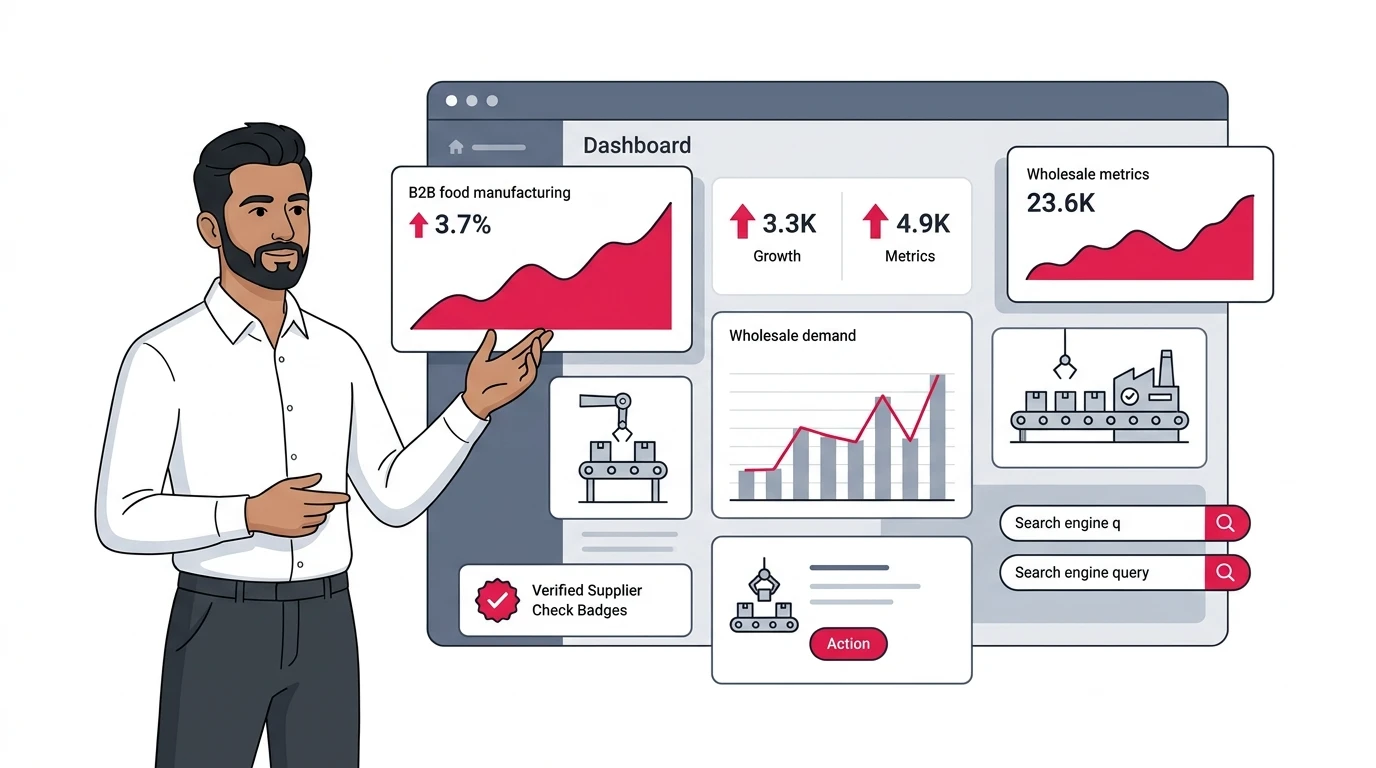
Executing targeted seo for food manufacturing companies allows commercial food processors, contract packagers (co-packers), and private-label producers to capture lucrative enterprise wholesale contracts directly from organic search. In an industry where a single B2B procurement contract can represent millions in recurring annual revenue, relying solely on traditional food expos, broker networks, and trade directory listings leaves massive market share on the table. Modern procurement managers, retail brand founders, and corporate food buyers initiate their vendor discovery online.
When an emerging beverage brand requires high-speed aseptic canning, or a national supermarket chain searches for a private-label organic bakery producer, they conduct granular technical searches: "SQF certified contract bakery midwest," "retort pouch co-packing low minimum run," or "kosher certified dry blending toll processor." Winning these contracts requires a digital presence engineered for complex industrial procurement cycles, rigorous regulatory certifications, and technical specification indexing.
The B2B Food Manufacturing Buyer's Journey
B2B food manufacturing procurement involves multi-stakeholder purchasing committees—including VP of Operations, Supply Chain Directors, Quality Assurance (QA) Managers, and Product Development Food Scientists. Your search strategy must satisfy each stakeholder's technical vetting criteria:
| Stakeholder Role | Primary Search Intent | Critical Conversion Proof Required |
|---|---|---|
| VP of Supply Chain | Capacity, throughput, lead times, co-packing fees. | Annual facility capacity, minimum order quantities (MOQs), shift scalability. |
| QA & Regulatory Director | Compliance, sanitation protocols, audit scores. | FDA FSMA compliance, SQF Level 3, BRCGS, USDA Organic, GFCO Gluten-Free. |
| Product Development Scientist | Processing equipment, thermal processing, packaging types. | HPP, retort, aseptic, cold-fill, bag-in-box, pouch sealing specs. |
Regulatory Authority: Aligning with FDA FSMA & SQF Standards
Credibility in food manufacturing hinges on food safety and regulatory compliance. Under the FDA Food Safety Modernization Act (FSMA), commercial processors must operate under strict preventive controls and hazard analysis. Furthermore, major grocery retailers (Walmart, Whole Foods, Kroger) mandate that co-packers hold Global Food Safety Initiative (GFSI) recognized certifications such as SQF (Safe Quality Food) or BRCGS.
To turn search visitors into RFP submissions, feature your audit scores and regulatory compliance prominently on your website:
- Dedicated Facility & Quality Hub: Build a dedicated compliance page highlighting current FDA registration numbers, SQF/BRCGS audit grades (e.g., "SQF Excellent 98/100"), and HACCP plans.
- Allergen Isolation Protocols: Outline physical segregation protocols (e.g., dedicated peanut-free, gluten-free, or dairy-free production lines) to capture niche allergen-free brand inquiries.
- Traceability & Mock Recall Capabilities: Explain your ERP lot-tracking and inventory recall readiness to satisfy corporate enterprise risk assessments.
When selecting a marketing partner to execute these industrial technical requirements, review our strategic guide on how to choose an SEO agency for AEO to ensure your agency understands complex B2B sales cycles.
Commercial Capability Silos: Architecting High-Value Pages
Most industrial food manufacturing websites lump their services into a single generic "Capabilities" page. This critical architectural flaw destroys keyword relevance. To dominate B2B search, create dedicated, long-form landing pages for each manufacturing capability:
- Contract Packaging (Co-Packing): Bottle filling, canning, vertical form fill seal (VFFS), pouch packaging, blister packs, and bulk tote packaging.
- Private Label Manufacturing: Turnkey retail-ready formulations for sauces, dressings, snacks, beverages, and baked goods.
- Toll Processing & Custom Formulation: High-shear blending, spray drying, extrusion, pasteurization, and vacuum freeze-drying.
- Cold Storage & Supply Chain Logistics: Blast freezing, ambient warehousing, cross-docking, and refrigerated distribution.
If your enterprise also designs or procures heavy processing machinery, check out our companion analysis on SEO for heavy equipment manufacturers to understand industrial OEM search architecture.
Technical Spec Sheet Optimization for Food Ingredients & Packaging
Procurement directors and food scientists frequently search using exact chemical specifications, mesh sizes, and shelf-life parameters. Ensure your technical data sheets (TDS) and certificates of analysis (COA) are discoverable:
- Convert raw PDF spec sheets into crawlable HTML tables with downloadable PDF attachments.
- Implement Schema.org
Productmarkup with specifichasMerchantReturnPolicy,category, andmaterialattributes. - Optimize for packaging dimensions, barrier properties, pallet configurations, and container shipping specs.
Optimizing for AI Procurement Agents in 2027
Corporate sourcing teams increasingly use generative AI tools like SearchGPT, Perplexity Enterprise, and Claude to generate supplier shortlists. Elevate your brand with our AI search visibility solutions to ensure your plant capabilities, certifications, and facility capacities are parsed accurately by automated enterprise procurement scrapers.
Conclusion
Modern B2B food manufacturing SEO is an engineering discipline that merges regulatory compliance with high-intent industrial search architecture. By structuring dedicated capability silos, publishing verifiable food safety certifications, and optimizing for both search engines and AI answer engines, commercial food processors can build an unstoppable pipeline of multi-million-dollar production contracts.